
Modern metabolomics relies heavily on precision—both in identifying molecules and accurately quantifying them within complex biological samples. One of the most advanced approaches enabling this level of accuracy is Isotopic Ratio Outlier Analysis (IROA). At the heart of this methodology lies a powerful concept known as isotopic envelopes, which significantly improves both identification and quantitation in mass spectrometry-based studies.
In this blog, we’ll explore how IROA works, the science behind isotopic labeling, and how isotopic envelopes contribute to enhanced precision in metabolomics.
Understanding IROA: A Smarter Approach to Metabolomics
IROA is designed to create distinct molecular signatures within a biological sample by incorporating stable carbon isotopes (12C and 13C) into molecules at controlled ratios. Typically, one population of molecules is labeled with approximately 5% 13C, while another is labeled with around 95% 13C.
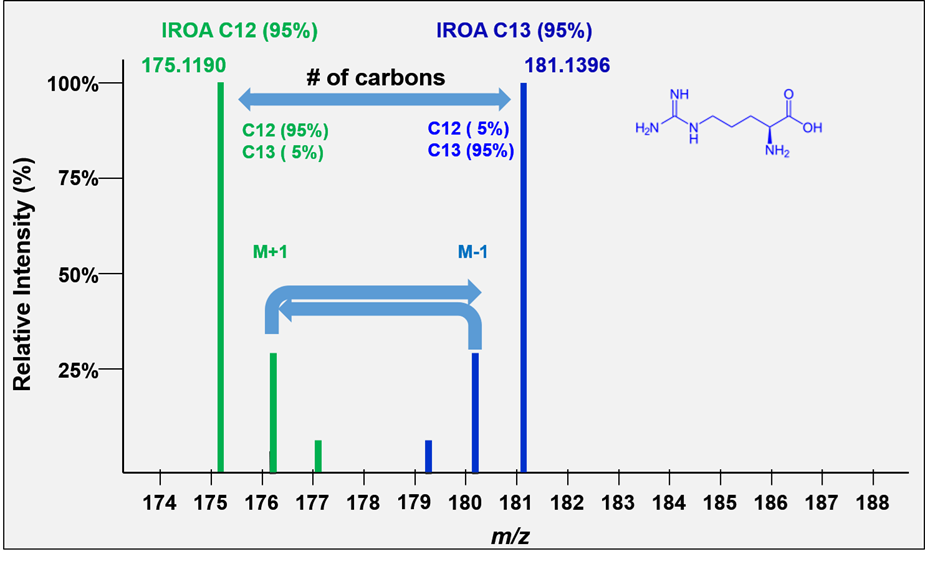
This dual-labeling strategy produces a mirror-image pattern in mass spectrometry. Molecules with 5% 13C show an enhanced M+1 peak, while those with 95% 13C display an enhanced M-1 peak. These mirrored patterns are not only visually distinctive but also analytically powerful.
Compared with traditional labeling methods (which often exceed 98% enrichment), IROA enhances minor peaks that would otherwise be difficult to detect. For example, in a six-carbon molecule such as arginine, the M+1 or M-1 peaks can reach up to 32% of the monoisotopic peak height, compared with only 6% under natural abundance conditions. This increased visibility plays a crucial role in accurate data interpretation.
Isotopomers and Isotopologs: Building the Foundation
To understand isotopic envelopes, it’s important to distinguish between isotopomers and isotopologs:
- Isotopomers are molecules with the same number of isotopes arranged differently. They share the same mass and appear as a single peak in a mass spectrum.
- Isotopologs differ in the number of isotopes they contain. Each isotopolog has a unique mass and appears as a separate peak.
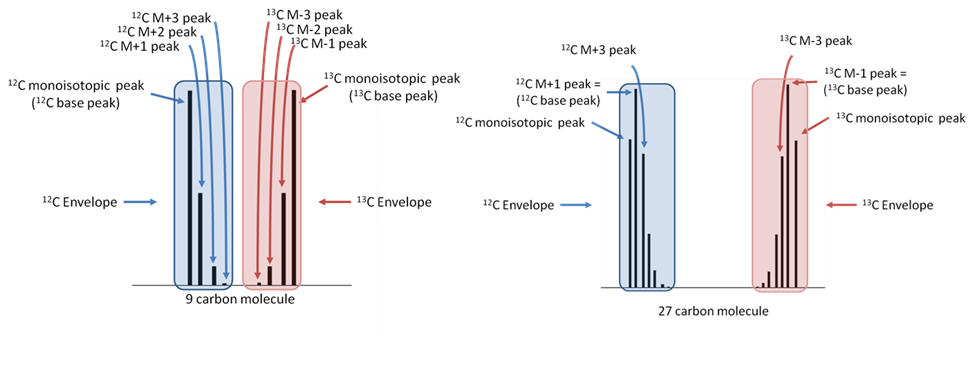
Every molecule forms an isotopolog “ladder” in a mass spectrum, beginning with the 12C monoisotopic peak and extending to the 13C monoisotopic peak. The number of steps in this ladder depends on the number of carbon atoms within the molecule.
This ladder is unique to each molecular formula, making it a reliable tool for identification. However, interpreting these patterns can become complex, which is where isotopic envelopes simplify the process.
What Are Isotopic Envelopes?
In simple terms, isotopic envelopes are grouped patterns of peaks formed by isotopologs in a mass spectrum. Rather than analyzing individual peaks separately, scientists evaluate the entire cluster of peaks as a single analytical unit.
Each molecule generates a characteristic isotopic envelope based on its carbon composition and isotopic distribution. In IROA experiments, two envelopes are always present:
- A natural or lightly labeled sample (approximately 5% 13C)
- A heavily labeled internal standard (approximately 95% 13C)
These two envelopes overlap on the same isotopolog ladder while displaying different peak distributions, creating a distinctive and easily recognizable pattern.
Enhancing Identification Through Unique Patterns
One of the greatest advantages of isotopic envelopes is their ability to act as molecular fingerprints. Since every molecular formula produces a unique isotopolog ladder and envelope shape, researchers can confidently identify compounds even within highly complex biological mixtures.
Additionally, the mass difference between adjacent peaks—approximately 1.00335 atomic mass units—corresponds to the difference between 12C and 13C. This consistent spacing enables analytical tools such as ClusterFinder, developed by IROA Technologies, to automatically detect and classify isotopic patterns.
This level of precision reduces ambiguity and minimizes false identifications, making it especially valuable in metabolomics research.
Improving Quantitation Accuracy
Accurate quantitation is just as important as compound identification. Traditional analytical methods often rely on the intensity of a single peak, which can be affected by signal suppression or background noise.
IROA takes a different approach by summing all peaks within each isotopic envelope rather than relying on a single measurement. This provides a far more reliable estimate of total metabolite abundance.
An important principle is that the ratio between the 12C and 13C envelopes remains constant, even when signal suppression occurs. This built-in reference allows correction for analytical variability, ensuring highly accurate quantitation across different samples.
Advanced normalization algorithms further compensate for experimental variation, delivering highly reproducible results.
The Role of Mass Defect in Precision
Another factor contributing to the accuracy of IROA-based analysis is the concept of mass defect, which refers to the small difference between a molecule’s nominal mass and its exact mass.
By analyzing both the 12C and 13C monoisotopic peaks, researchers can calculate the residual mass contributed by other elements within the molecule. Averaging these values reduces analytical error and improves molecular formula determination.
With high-resolution mass spectrometry, this approach often leads to a single possible molecular formula for compounds below approximately 500 amu, significantly increasing confidence in metabolite identification.
For additional information on mass spectrometry and isotopic analysis, visit:
Mass Spectrometry and Isotope Analysis
Why This Matters in Real-World Applications
The ability to accurately identify and quantify metabolites has broad implications across life sciences. From disease research and pharmaceutical development to environmental analysis and nutrition studies, analytical precision is essential.
By leveraging isotopic envelopes, IROA provides:
- Greater sensitivity for detecting low-abundance metabolites
- Improved quantitative accuracy
- Reduced analytical errors
- Enhanced reproducibility across experiments
These advantages make IROA a valuable solution for laboratories seeking highly reliable metabolomics data.
Conclusion
IROA represents a significant advancement in metabolomics by providing a robust framework for both compound identification and accurate quantitation. At the core of this methodology, isotopic envelopes simplify complex spectral data while enabling highly reliable molecular interpretation.
By combining controlled isotopic labeling, distinctive peak patterns, and advanced computational analysis, IROA Technologies continues to push the boundaries of analytical precision. As metabolomics continues to evolve, approaches like IROA will play an increasingly important role in delivering accurate, reproducible, and actionable scientific insights.
Frequently Asked Questions (FAQs)
What are isotopic envelopes in metabolomics?
Isotopic envelopes are clusters of mass spectral peaks formed by molecules with different isotopic compositions. They improve both compound identification and quantitative accuracy in metabolomics studies.
How does IROA improve quantitation accuracy?
IROA improves quantitation by summing all peaks within an isotopic envelope rather than relying on a single peak, reducing errors caused by signal suppression and analytical variability.
Why are 5% and 95% 13C labels used in IROA?
These labeling ratios create distinctive mirror-image isotopic patterns that make metabolites easier to identify, distinguish, and quantify accurately.
What is the difference between isotopomers and isotopologs?
Isotopomers contain the same number of isotopes arranged differently, while isotopologs differ in the total number of isotopes they contain and therefore have different molecular masses.
How do isotopic envelopes improve compound identification?
Each molecular formula produces a unique isotopic envelope, allowing researchers to recognize compounds with greater confidence, even in highly complex biological samples.