Isotopic Envelopes

Browse all articles filed under the "Isotopic Envelopes" tag.

IROA-Peaks

Showing 1–3 of 3 articles

IROA-Peaks

How Isotopic Envelopes Enhance Precision Based in Metabolomics

Modern metabolomics relies heavily on precision—both in identifying molecules and accurately quantifying them within complex biological samples. One of the most advanced approaches enabling this level of accuracy is Isotopic Ratio Outlier Analysis (IROA).

At the heart of this methodology lies a powerful concept known as isotopic envelopes, which significantly improves both identification and quantitation in mass spectrometry-based studies.

In this blog, we'll explore how IROA works, the science behind isotopic labeling, and how isotopic envelopes contribute to enhanced precision in metabolomics.

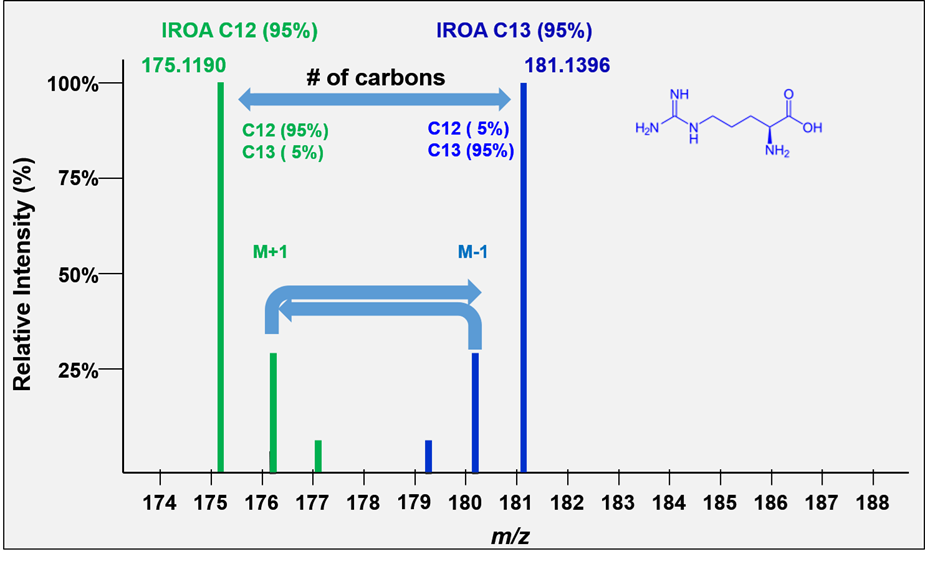
Understanding IROA: A Smarter Approach to Metabolomics IROA is designed to create distinct molecular signatures within a biological sample by incorporating stable carbon isotopes (12C and 13C) into molecules at controlled ratios.

Typically, one population of molecules is labeled with approximately 5% 13C, while another is labeled with...

What Is an Isotopic Envelope

How the Isotopic Envelope Helps Identify Molecules Accurately Act

In the world of modern science, identifying molecules with precision is essential for breakthroughs in healthcare, environmental studies, and biotechnology.

One of the most powerful tools scientists rely on for this purpose is mass spectrometry. While this technique may sound complex, one of its most fascinating aspects—the isotopic envelope—plays a crucial role in making molecular identification highly accurate.

In this blog, we’ll break down this concept in simple terms and explore how it helps scientists achieve reliable results in analytical chemistry.

  What Is an Isotopic Envelope? Every chemical element exists in different forms known as isotopes. These isotopes have the same number of protons but different numbers of neutrons, which means they have slightly different masses.

When a molecule is analyzed using mass spectrometry, it doesn’t appear as a...

How to Identify Isotopic Peaks in Mass Spectrometry

Mass spectrometry is one of the most powerful analytical techniques used in chemistry, pharmaceuticals, environmental research, and life sciences. It helps scientists determine the molecular composition of compounds with remarkable accuracy.

When analyzing mass spectra, one of the important patterns researchers look for is isotopic distribution. Learning how to recognize these patterns can greatly improve the interpretation of experimental data.

In this guide, we'll explain how to identify Isotopic Peaks in mass spectrometry, why they occur, and how scientists use them to better understand molecular structures.

Understanding Isotopes and Their Role in Mass Spectrometry To understand isotopic patterns in mass spectra, it's important to first know what isotopes are.

Isotopes are atoms of the same element that have the same number of protons but different numbers of neutrons. Because of...