Untargeted metabolomics
Untargeted metabolomics measures as many metabolites as possible to find differences between samples and generate new hypotheses.
IROA Technologies makes metabolomics quantitative with carbon-13 internal standards, authentic metabolite libraries and ClusterFinder software.
Correct ion suppression, normalize every sample and identify metabolites with confidence, across batches, instruments and laboratories.
Metabolomics is the large-scale study of metabolites, the small molecules of metabolism, measured in cells, tissues and biofluids.
Metabolites sit downstream of genes and proteins, so the metabolome is the closest molecular readout of what is happening in a biological system right now. Most studies use liquid chromatography mass spectrometry (LC-MS) or NMR to measure hundreds to thousands of metabolites, usually below about 1,500 Da, in every sample.
Sources: NIH primer on LC-MS metabolomics · EMBL-EBI
Untargeted metabolomics measures as many metabolites as possible to find differences between samples and generate new hypotheses.
Targeted metabolomics measures a defined panel of known metabolites to confirm findings and report concentrations.
IROA standards and software correct ion suppression and normalize data in both, so untargeted results become quantitative and comparable.
Metabolomics data is often distorted by ion suppression, batch effects and inconsistent quantitation, and IROA corrects each one.
Affects relative quantitation
Corrects ion suppression and normalizes with internal standards
Lead to inconsistent results
Stable isotope-labeled for accurate quantitation
Create misleading data
Powerful data analysis and visualization
Limits biological interpretation
Confident metabolite ID with MS-based confirmation
LC-MS metabolomics signals shift with ion suppression, sample matrix and batch effects, so the same amount of a metabolite can look different.
IROA pairs every shared metabolite with a carbon-13 labeled twin that suffers the same suppression, so the ratio between them stays true. Flip the switch to see the effect on one metabolite measured in eight samples.
Illustrative example, not measured data.
The IROA workflow turns every metabolite into a measurable pair in three steps, from sample preparation to corrected, identified results.
A carbon-13 labeled yeast extract goes into every sample, giving each shared metabolite a labeled twin with a recognizable isotope pattern.
Natural and labeled forms co-elute and experience the same ion suppression, while the long-term reference standard tracks drift across runs.
ClusterFinder finds every pair, identifies compounds, corrects suppression and normalizes data so results stay comparable across batches.
IROA metabolomics products cover the full workflow, led by the TruQuant workflow kit and the IROA Internal Standard Kit for LC-MS.
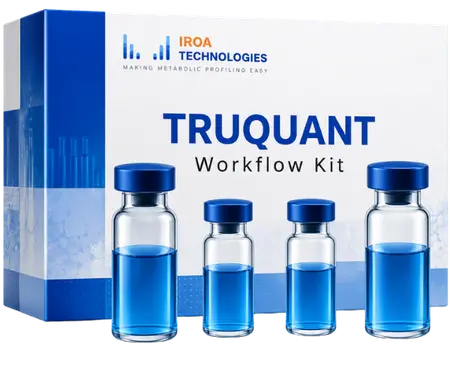
Semi-targeted QC workflow that corrects ion suppression, normalizes every sample and identifies metabolites across batches.
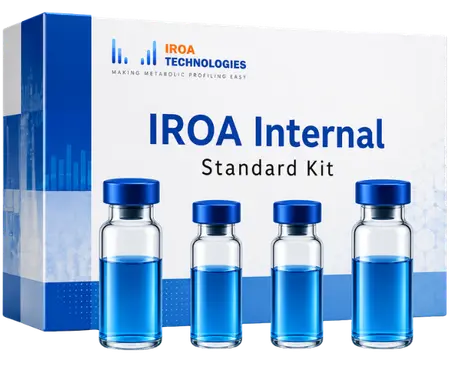
Fully labeled 95% U-13C yeast extract that gives each shared metabolite a co-eluting twin for suppression correction.
Certified metabolite standards for accurate identification.
SoftwareIdentification and quantitative analysis of IROA data.
SoftwareBuild retention time and spectral libraries from IROA standards.
NormalizationSample normalization built on the corrected signals.
ResearchPlain-language summaries of the key IROA metabolomics studies.
DownloadsClusterFinder, MLS Discovery and supporting tools.
IROA metabolite libraries are authentic standards in ready-to-use 96-well plates for confident metabolite identification in LC-MS metabolomics.
Primary metabolites across seven plates
View all librariesCompound counts from the IROA library product sheets.
Peer-reviewed metabolomics studies show IROA correction works across samples, batches and laboratories, with full papers linked for every claim.
Corrects suppression compound by compound in non-targeted metabolomics.
2026 · Analytical ChemistrySuppression correction plus Dual MSTUS normalization across batches.
2026 · Analytical ChemistryAll eight labs separated the sample mixtures in a round robin study.
Metabolomics publications, application notes and study summaries show how labs use IROA standards and software to produce reproducible data.
Answers to common metabolomics questions, from targeted versus untargeted work to ion suppression, internal standards and IROA technology.
Ask a scientistMetabolomics is the large-scale study of metabolites, the small molecules of metabolism, measured in cells, tissues and biofluids. Because metabolites sit downstream of genes and proteins, the metabolome gives the closest molecular readout of what is happening in a biological system. Most studies use liquid chromatography mass spectrometry (LC-MS) or NMR to measure hundreds to thousands of metabolites in each sample.
Untargeted metabolomics measures as many metabolites as possible for discovery, while targeted metabolomics measures a defined panel. Untargeted work finds differences between samples and generates hypotheses; targeted work confirms findings and quantifies known compounds. IROA standards and software support both approaches.
LC-MS signals shift with ion suppression, sample matrix, instrument drift and batch effects, so equal amounts can give unequal signals. Without correction, these effects can be mistaken for biology. Internal standards that behave like each metabolite are the most direct way to correct them.
Ion suppression is the loss of signal that happens when other compounds in a sample compete for ionization in the mass spectrometer source. It varies from compound to compound and from sample to sample, so it distorts comparisons. IROA corrects it compound by compound using a co-eluting carbon-13 labeled internal standard.
A stable isotope labeled standard has the same chemistry as its natural metabolite, so both elute together and experience the same suppression. Measuring the ratio between them corrects for losses that a single unlabeled measurement cannot. The IROA Internal Standard provides labeled counterparts for hundreds of metabolites at once.
IROA adds a carbon-13 labeled yeast extract to every sample, so each shared metabolite shows a natural and a labeled peak. The pair has a recognizable isotope pattern, and ClusterFinder software finds these pairs, identifies the compounds, corrects ion suppression and normalizes the data, so results stay comparable across samples, batches and instruments.
Metabolite libraries of standards are collections of authentic compounds used to record retention times and spectra on your own LC-MS method. Matching a sample feature to an authentic standard is what allows a confident identification. IROA libraries come pre-weighed in 96-well plates with plate maps and MLSDiscovery software.
Most labs start with the TruQuant workflow kit: the IROA internal standard, a long-term reference standard and ClusterFinder software. Our scientists can help you plan the workflow for your instrument and samples, so get in touch with your study details.
Search and retrieve Certificates of Analysis (CoA) and Safety Data Sheets (SDS) for your products quickly and easily.
Enter your lot number to instantly download your Certificate of Analysis.
Enter your lot number to instantly download your Safety Data Sheet.
Talk to an IROA scientist about your samples, instrument and workflow, or find a certificate of analysis or safety data sheet.