
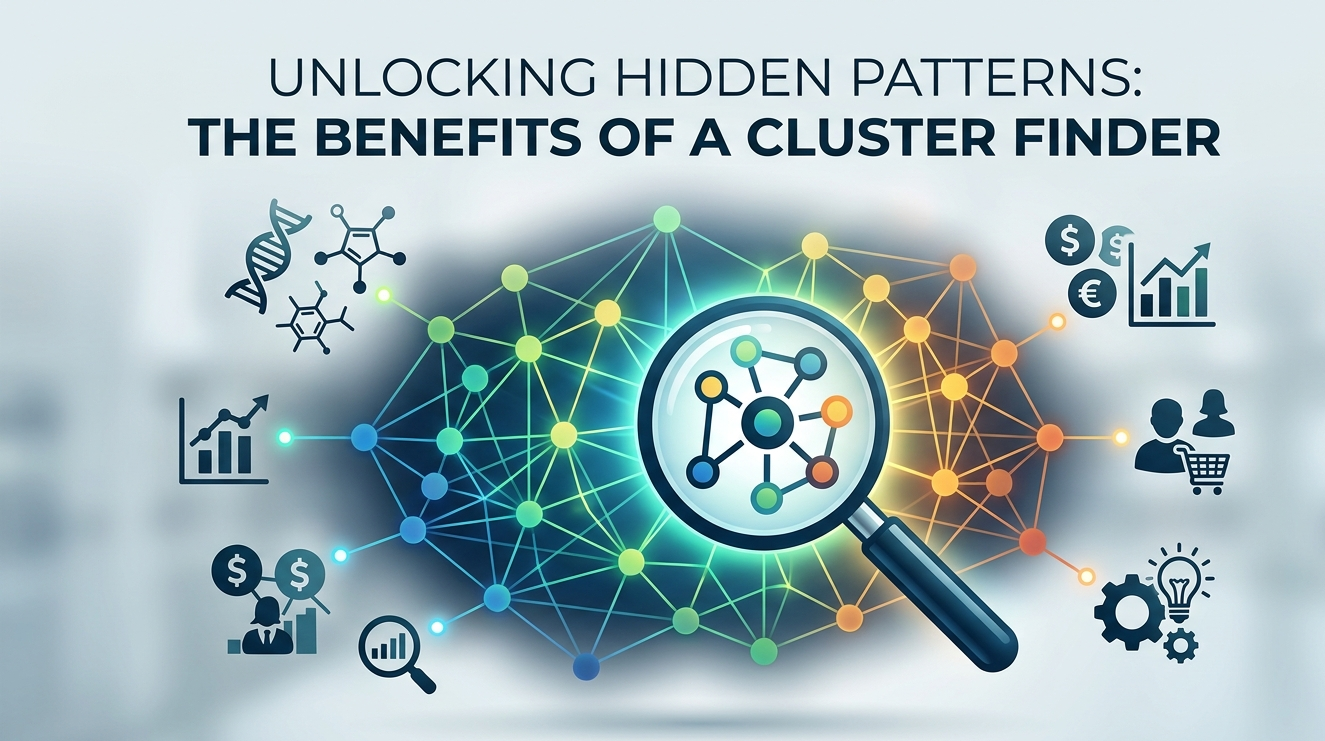
In today’s data-driven world, organizations and research labs are generating massive volumes of complex data every day. Whether it’s metabolomics, genomics, finance, or customer analytics, the challenge lies not just in collecting data but in making sense of it. This is where advanced analytical tools come into play—especially a Cluster Finder, which has become a cornerstone for uncovering meaningful patterns hidden within large datasets.
A well-designed clustering approach allows researchers and analysts to group similar data points together, making it easier to interpret trends, detect anomalies, and draw actionable insights. In this blog, we’ll explore the top benefits of using a Cluster Finder for advanced data analysis and why it’s becoming essential across industries.
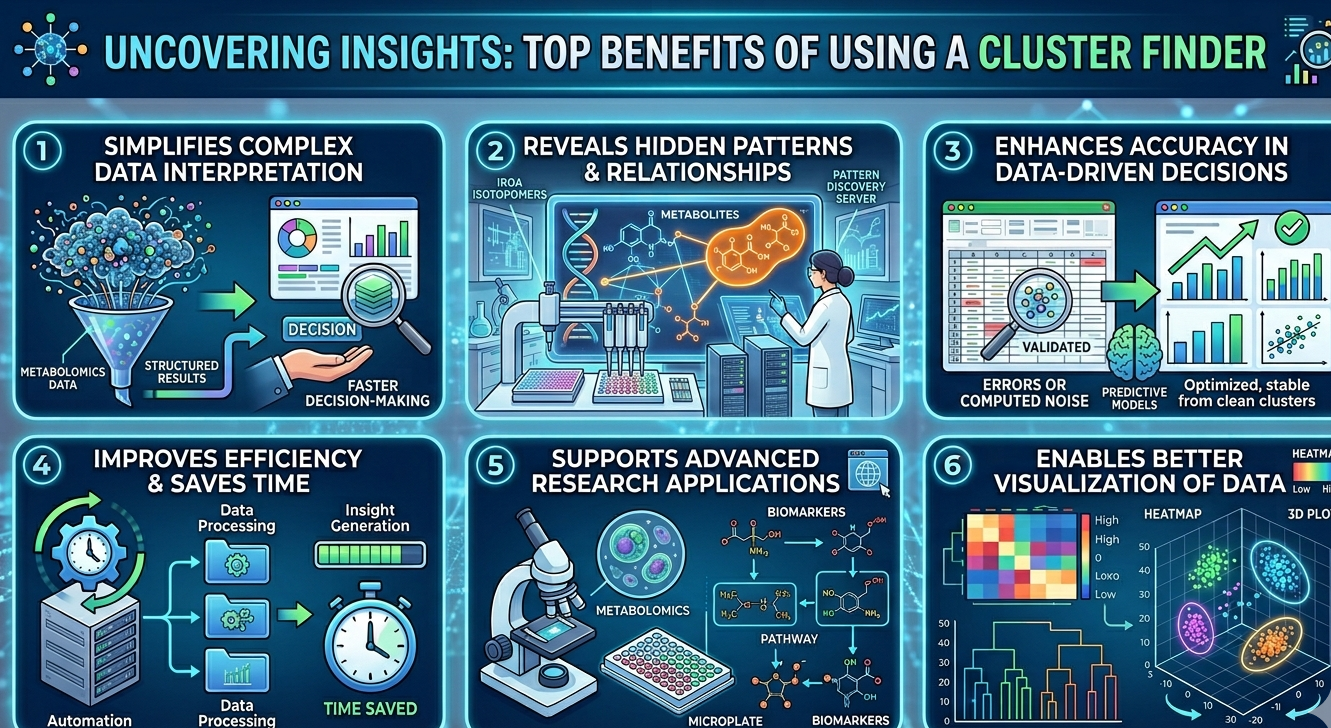
1. Simplifies Complex Data Interpretation
One of the biggest challenges in data analysis is dealing with high-dimensional and unstructured datasets. A Cluster Finder helps break down this complexity by organizing data into logical groups or clusters based on similarities.
Instead of analyzing thousands or millions of individual data points, users can focus on clusters that represent shared characteristics. This significantly simplifies interpretation and enables faster decision-making, especially in fields like metabolomics, where datasets can be highly intricate.
2. Reveals Hidden Patterns and Relationships
Raw data often contains patterns that are not immediately visible through traditional analysis methods. By using clustering techniques, analysts can uncover relationships between variables that may otherwise go unnoticed.
For example, in biomedical research, clustering can help identify groups of metabolites that behave similarly under certain conditions. This can lead to breakthroughs in understanding disease mechanisms or treatment responses. Tools developed by companies like iroa technologies are particularly valuable in such scenarios, as they are designed to handle complex biological data with precision.
3. Enhances Accuracy in Data-Driven Decisions
Accurate decision-making depends on identifying reliable patterns within data. Clustering reduces noise and highlights meaningful groupings, allowing analysts to base their conclusions on structured insights rather than scattered information.
When data is grouped effectively, it becomes easier to detect outliers, validate hypotheses, and improve predictive models. This is especially beneficial in industries like healthcare and finance, where even small errors can have significant consequences.
4. Improves Efficiency and Saves Time
Manual data analysis can be time-consuming and prone to human error. A Cluster Finder automates much of this process, allowing researchers to quickly segment data and focus on interpretation rather than organization.
By reducing the time spent on preprocessing and exploratory analysis, teams can allocate more resources to innovation and problem-solving. This increased efficiency is a major advantage for organizations dealing with large-scale data operations.
5. Supports Advanced Research Applications
Clustering plays a critical role in advanced scientific research, particularly in fields like metabolomics and systems biology. It enables researchers to classify biological samples, identify biomarkers, and understand complex biochemical pathways.
For instance, clustering techniques are widely used in metabolomics workflows to group compounds with similar behaviors. This helps in identifying metabolic signatures associated with diseases or environmental changes. If you want to explore more about clustering techniques in data science, you can visit this informative resource:
https://www.ibm.com/topics/clustering
6. Enables Better Visualization of Data
Visualization is a key aspect of data analysis, as it helps communicate findings effectively. Clustering makes it easier to create visual representations such as heatmaps, dendrograms, and scatter plots.
These visual tools allow stakeholders to quickly grasp trends and relationships without needing deep technical expertise. By presenting data in a structured and visually appealing way, a Cluster Finder enhances collaboration between technical and non-technical teams.
7. Scales with Growing Data Needs
As organizations continue to generate more data, scalability becomes a critical factor. Modern clustering tools are designed to handle large datasets efficiently, making them suitable for both small research projects and enterprise-level applications.
Whether you’re analyzing customer behavior or complex biological systems, a robust clustering solution can adapt to your needs without compromising performance. This scalability ensures long-term usability and return on investment.
8. Facilitates Innovation Across Industries
From healthcare to marketing, clustering is driving innovation across multiple sectors. In healthcare, it helps identify patient groups for personalized treatment. In marketing, it enables customer segmentation for targeted campaigns.
By leveraging clustering techniques, organizations can gain deeper insights into their data and develop strategies that are both effective and innovative. Companies like iroa technologies are at the forefront of enabling such advancements through specialized analytical solutions.
Conclusion
In an era where data is one of the most valuable assets, the ability to analyze it effectively can make all the difference. A Cluster Finder not only simplifies complex datasets but also uncovers hidden patterns, improves accuracy, and enhances efficiency.
Whether you’re a researcher, data scientist, or business analyst, integrating clustering tools into your workflow can significantly elevate your analytical capabilities. As data continues to grow in volume and complexity, the role of clustering will only become more critical in driving meaningful insights and innovation.
FAQs
Q1. What is a Cluster Finder?
A Cluster Finder is a tool or algorithm used to group similar data points into clusters based on shared characteristics, making it easier to analyze and interpret large datasets.
Q2. How is clustering used in metabolomics?
In metabolomics, clustering helps group metabolites with similar patterns, aiding in the identification of biomarkers and understanding biological processes.
Q3. Can clustering improve data accuracy?
Yes, clustering reduces noise and highlights meaningful patterns, which improves the accuracy of analysis and decision-making.
Q4. Is a Cluster Finder suitable for large datasets?
Absolutely. Modern clustering tools are designed to handle large and complex datasets efficiently, making them ideal for advanced data analysis.
Q5. Which industries benefit most from clustering?
Industries like healthcare, finance, marketing, and scientific research benefit greatly from clustering due to their reliance on data-driven insights.