Metabolomics—the comprehensive study of small molecules (metabolites) in biological systems—has become a cornerstone of modern life sciences. From disease biomarker discovery to precision nutrition and environmental monitoring, metabolomics offers insights that bridge genotype and phenotype. However, the field’s potential depends heavily on reliable identification and interpretation of complex spectral data. This is where a well-constructed metabolite library becomes indispensable. In this article, we examine how a Metabolite Library accelerates metabolomics research, the steps to build one effectively, and how companies like iroa technologies are helping labs transform raw data into actionable knowledge.
Why identification is the bottleneck in metabolomics
Mass spectrometry (MS) and nuclear magnetic resonance (NMR) generate vast amounts of data, but raw spectra mean little without accurate annotation. Researchers often face:
- Ambiguous identifications due to overlapping spectra or isomeric compounds.
- Long turnaround times for manual curation and validation.
- Inconsistencies across platforms and labs, making data comparison difficult.
These challenges slow discovery and limit reproducibility. A curated metabolite library addresses these issues by providing reference spectra, standardized metadata, and search tools that enable fast, confident identifications.
What is a metabolite library and what it contains
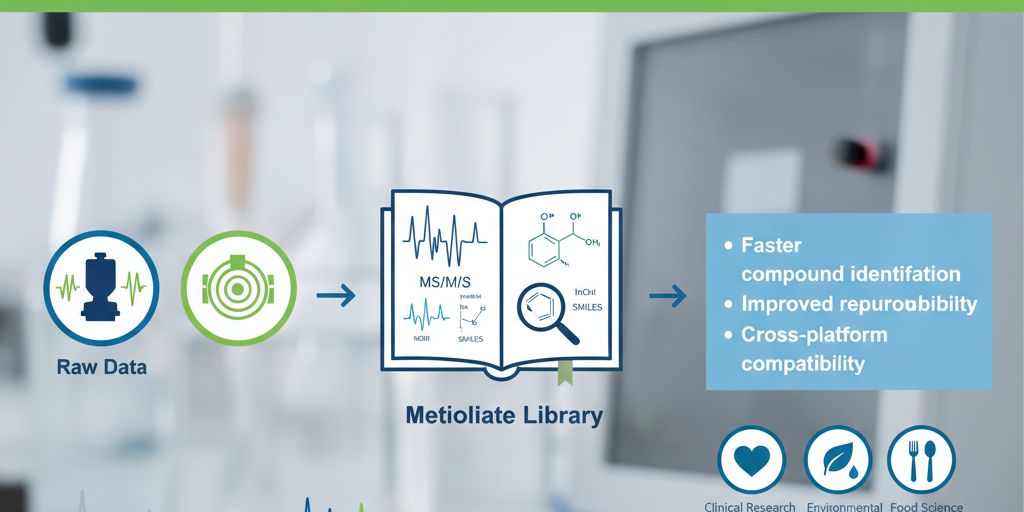
A metabolite library is a structured, searchable collection of reference records for metabolites. Typical entries include:
- Reference spectra (MS/MS, GC-MS, NMR)
- Retention time or retention index information
- Chemical identifiers (InChI, SMILES, CAS)
- Structural annotations and synonyms
- Experimental conditions (instrument settings, ionization mode, matrix)
- Quality metrics and curation notes
By combining spectral data with robust metadata, these libraries make it possible to match unknown signals against validated references quickly and reproducibly.
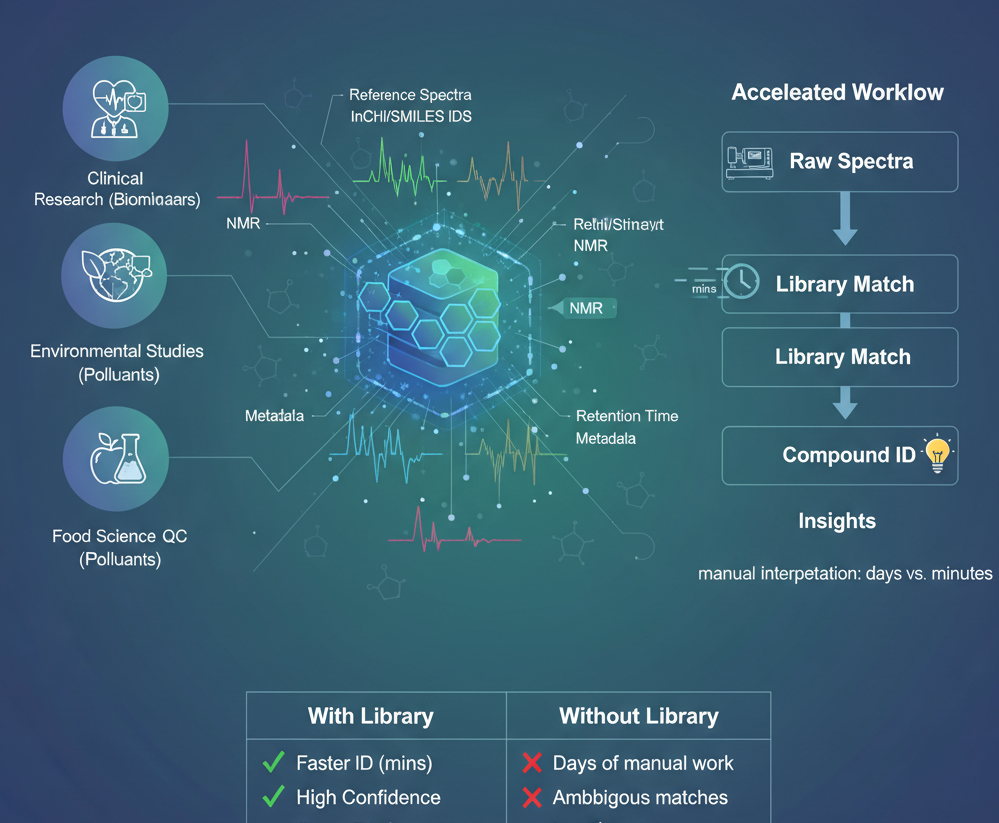
How a Metabolite Library speeds up workflows
- Faster compound identification
Researchers can automatically match experimental spectra to library entries, reducing manual interpretation time from days to minutes. This speed is crucial for large cohort studies and high-throughput screening. - Improved confidence and reproducibility
Libraries with validated spectra and provenance information provide traceable identification. That reduces false positives and supports reproducible science—critical for publications and regulatory submissions. - Cross-platform compatibility
Well-annotated libraries include retention indices and instrument-specific notes, allowing researchers to adapt references to different MS platforms and chromatographic methods. - Scalable curation and automation
Modern libraries integrate with processing pipelines and software (including AI-enhanced tools), enabling semi-automated curation and continual expansion without sacrificing quality. - Facilitating multi-omics integration
Accurate metabolite IDs are essential for linking metabolomics with genomics, proteomics, and transcriptomics. Libraries provide the anchor points needed for meaningful biological interpretation.
Building a high-quality metabolite library: best practices
- Start with authentic standards
Whenever possible, include spectra generated from pure standards to ensure reliability. Record experimental conditions meticulously so future users can reproduce or adapt matches. - Capture rich metadata
Add retention times, instrument settings, sample matrix, and curation notes. Metadata improves matching accuracy and helps users determine whether a library entry is applicable to their setup. - Standardize identifiers and formats
Use internationally recognized chemical identifiers (InChI, SMILES) and adopt standard data formats (mzML, mzXML) to improve interoperability. - Implement quality control and versioning
Track provenance, curator changes, and quality scores. Versioning ensures researchers know which library iteration was used for a given analysis. - Promote community contributions with curation safeguards
Community-driven libraries grow faster but must include expert review and validation steps to maintain quality.
How technology partners help: the iroa technologies example
Companies like iroa technologies specialize in turning laboratory data into actionable insights. By developing integrated platforms that support library creation, automated spectral matching, and metadata management, they help labs reduce time-to-result and increase identification accuracy. iroa technologies’ solutions often emphasize scalability and interoperability—key features for research groups expanding from pilot studies to large-scale projects. Their tools can be particularly valuable for labs seeking to implement standardized workflows and ensure regulatory-grade traceability.
Real-world impact: case studies in brief
- Clinical research: Faster metabolite identification accelerates biomarker discovery for disease diagnostics and therapeutic monitoring.
- Environmental studies: Rapid screening of pollutants in complex matrices helps agencies respond quickly to contamination events.
- Food science: Metabolite libraries support quality control and origin verification by enabling fast comparison against known profiles.
These examples show how a library reduces manual bottlenecks and enables more ambitious study designs.
External resource
For a broader view of community standards and spectral data formats, see the Metabolomics Standards Initiative:
FAQs
Q: How many spectra should a good metabolite library contain?
A: There’s no fixed number—quality matters more than quantity. A useful library should include authentic standard spectra for the metabolites relevant to your research area, plus enough metadata to ensure reliable matching across instruments.
Q: Can I use public libraries or should I build my own?
A: Public libraries are a great starting point, but building a lab-specific library with in-house standards and retention information improves accuracy and reproducibility for your workflows.
Q: How often should a metabolite library be updated?
A: Regular updates are recommended—at least annually, or whenever you add new methods, instruments, or validated standards. Track versions so analyses remain traceable.
Q: What role does software play in library use?
A: Software enables automated spectral matching, scoring, and integration into data pipelines. Choose tools that support standard formats and allow easy import/export of library entries.
Q: Is a metabolite library useful for non-MS platforms?
A: Yes. Libraries can include NMR or other spectroscopic references. The key is consistent metadata and reference-quality spectra for the platforms you use.