
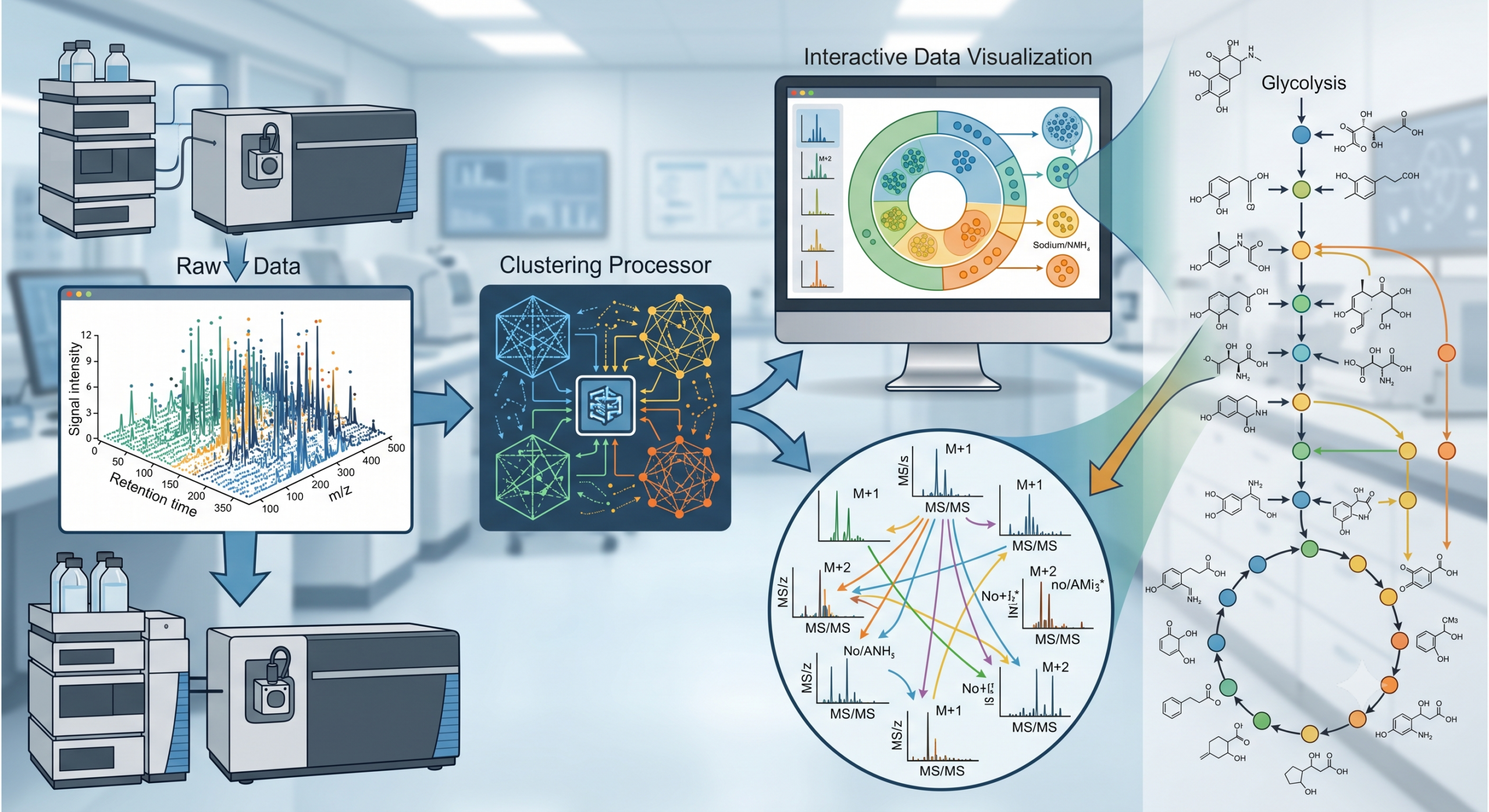
Metabolomics research generates vast amounts of complex data, offering scientists valuable insights into biological processes, disease mechanisms, and metabolic pathways. However, transforming raw analytical data into meaningful biological information remains one of the greatest challenges in the field. As metabolomics studies continue to expand in scale and complexity, researchers increasingly rely on advanced computational tools to streamline data analysis and improve confidence in their findings.
One such solution is Cluster Finder, a powerful approach designed to simplify metabolomics data processing, enhance metabolite identification, and improve overall workflow efficiency. By helping researchers organize and interpret complex datasets more effectively, Cluster Finder technology is becoming an essential component of modern metabolomics research.
Understanding the Challenge of Metabolomics Data Analysis
Modern metabolomics platforms such as liquid chromatography-mass spectrometry (LC-MS), gas chromatography-mass spectrometry (GC-MS), and nuclear magnetic resonance (NMR) spectroscopy can detect thousands of metabolites within a single sample.
While this capability offers tremendous scientific value, it also creates significant analytical challenges, including:
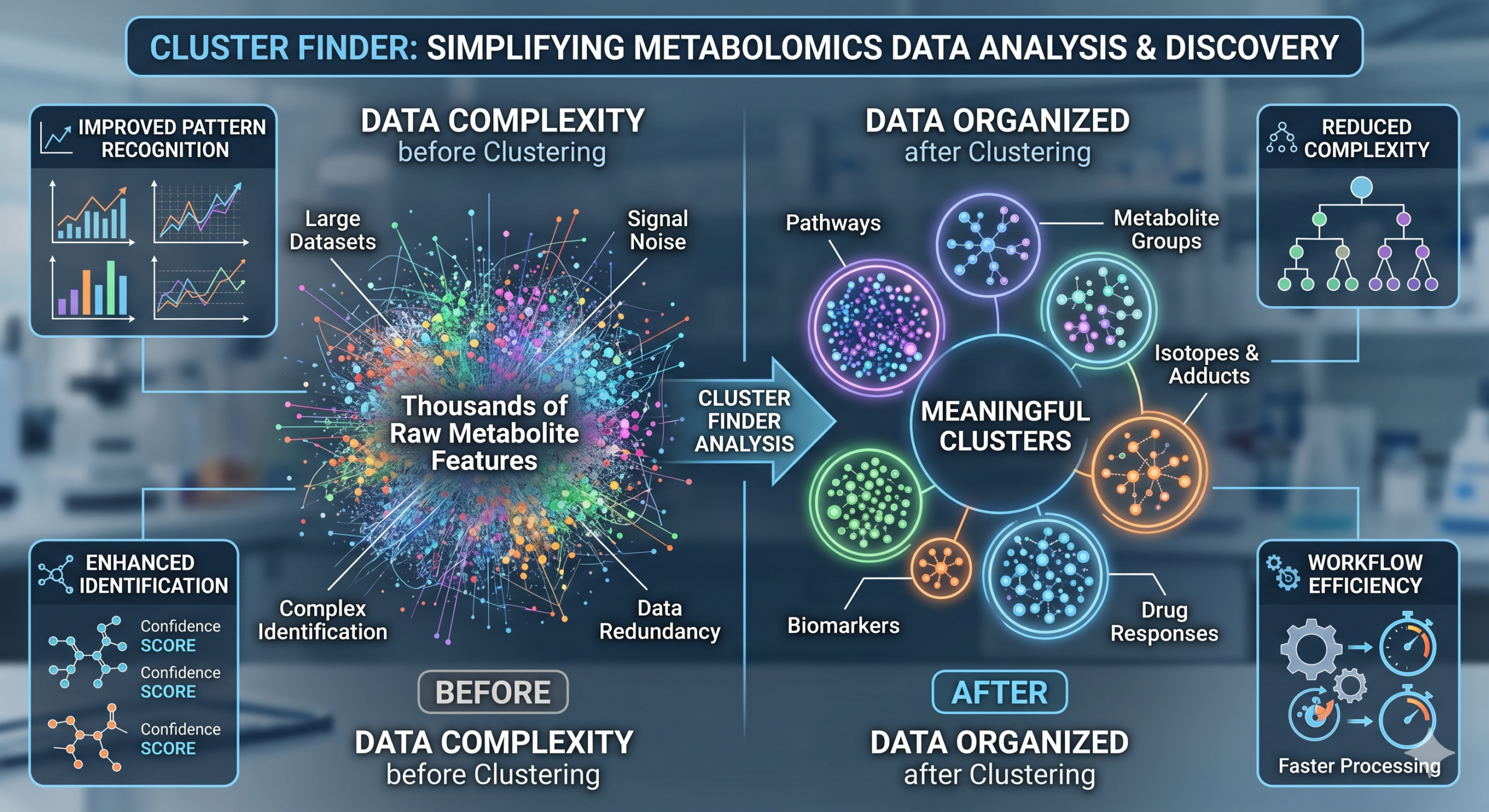
- Large datasets with thousands of detected features
- Signal noise and background interference
- Complex metabolite identification processes
- Data redundancy
- Time-consuming manual analysis
Researchers often spend substantial time filtering, organizing, and interpreting data before they can begin drawing biological conclusions. Efficient analytical tools are therefore critical for improving productivity and ensuring accurate results.
What Is Cluster Finder?
Cluster Finder is a specialized data analysis approach that helps researchers group related metabolic signals into meaningful clusters based on shared characteristics and patterns.
Rather than examining every detected feature individually, clustering techniques organize similar data points together, allowing researchers to identify relationships that may otherwise remain hidden within large datasets.
In metabolomics, clustering can help:
- Identify metabolite groups
- Detect biological patterns
- Reduce data complexity
- Improve feature annotation
- Accelerate data interpretation
By simplifying the analytical process, clustering methods enable researchers to focus on biologically relevant information rather than becoming overwhelmed by raw data volume.
Why Clustering Matters in Metabolomics
Metabolites often participate in interconnected biological pathways. Changes in one metabolite frequently influence related compounds, creating coordinated metabolic responses.
Clustering methods help researchers uncover these relationships by grouping features that display similar behaviors across samples.
Key benefits include:
Improved Pattern Recognition
Clustering enables researchers to identify trends, similarities, and differences within datasets that may not be immediately obvious through traditional analysis methods.
This is particularly valuable when studying:
- Disease biomarkers
- Drug responses
- Environmental exposures
- Nutritional interventions
- Cellular metabolism
Recognizing these patterns can lead to deeper biological insights and more robust scientific conclusions.
Reduced Data Complexity
Metabolomics datasets often contain thousands of signals, many of which may be related to the same biological process.
Grouping related features into clusters simplifies interpretation and reduces the burden of manual data review. This allows scientists to focus on the most meaningful information within their experiments.
Enhanced Metabolite Identification
One of the most difficult aspects of metabolomics is accurately identifying unknown metabolites.
Clustering approaches can improve confidence in identification by grouping related isotopes, adducts, fragments, and metabolite derivatives together. This helps researchers distinguish genuine biological signals from analytical artifacts.
Improving Workflow Efficiency
Research teams continually seek ways to reduce analysis time while maintaining data quality. Cluster-based approaches contribute significantly to workflow optimization.
Faster Data Processing
Automated clustering methods can rapidly organize large datasets that would otherwise require extensive manual review.
This enables researchers to:
- Process data more efficiently
- Reduce analysis bottlenecks
- Increase laboratory productivity
- Accelerate project timelines
Better Quality Control
Clustering techniques can help identify outliers, inconsistent samples, and analytical anomalies.
Early detection of potential issues allows researchers to address data quality concerns before they affect downstream analyses, improving the overall reliability of study results.
Improved Reproducibility
Reproducibility remains a major priority across scientific research. Standardized computational workflows that incorporate clustering methodologies help reduce subjective interpretation and improve consistency between studies.
As a result, findings become easier to validate and compare across laboratories.
The Role of Advanced Software Solutions
The effectiveness of clustering depends heavily on the quality of the computational tools used during analysis.
Modern metabolomics software platforms integrate clustering algorithms with advanced visualization, statistical analysis, and metabolite annotation capabilities.
Organizations such as IROA Technologies have developed innovative software solutions that help researchers manage increasingly complex metabolomics datasets. By combining high-quality analytical workflows with sophisticated computational tools, researchers can improve data accuracy, simplify interpretation, and generate more meaningful biological insights.
These technologies support a wide range of applications, including biomarker discovery, systems biology, clinical research, pharmaceutical development, and precision medicine.
Applications Across Research Fields
Cluster-based metabolomics analysis is being used in numerous scientific disciplines.
Clinical Research
Researchers use clustering techniques to identify metabolic signatures associated with disease progression, treatment response, and patient outcomes.
Drug Development
Pharmaceutical scientists apply clustering methods to evaluate metabolic effects of new compounds and monitor therapeutic efficacy.
Precision Medicine
By analyzing individual metabolic profiles, researchers can identify patient-specific patterns that support personalized treatment strategies.
Agricultural and Environmental Research
Clustering helps scientists investigate plant metabolism, environmental stress responses, and ecosystem health through large-scale metabolomics studies.
The Future of Metabolomics Data Analysis
As metabolomics technologies continue to evolve, datasets will become even larger and more complex. Artificial intelligence, machine learning, and advanced clustering algorithms are expected to play an increasingly important role in extracting valuable information from these data-rich environments.
Future developments may include:
- Automated metabolite identification
- Real-time data interpretation
- Enhanced predictive modeling
- Improved biomarker discovery
- Greater integration with multi-omics research
These innovations will further strengthen the role of clustering tools in metabolomics and expand their impact across scientific and healthcare applications.
Conclusion
Efficient data analysis is essential for unlocking the full potential of metabolomics research. By organizing complex datasets into meaningful patterns, Cluster Finder technologies help researchers improve accuracy, streamline workflows, and gain deeper biological insights.
From metabolite identification and quality control to biomarker discovery and precision medicine, clustering approaches offer significant advantages throughout the analytical process. As the field continues to grow, organizations like IROA Technologies are helping researchers leverage advanced computational tools to overcome data complexity and accelerate scientific discovery.
For additional information on metabolomics research and data analysis resources, visit the official website of the Metabolomics Society.
Frequently Asked Questions (FAQs)
1. What is Cluster Finder in metabolomics?
Cluster Finder is a data analysis approach that groups related metabolic signals into clusters, helping researchers simplify complex datasets and identify meaningful biological patterns.
2. How does clustering improve metabolomics research?
Clustering reduces data complexity, improves metabolite identification, enhances pattern recognition, and supports more efficient data interpretation.
3. Why is metabolite identification challenging?
Metabolomics datasets often contain thousands of signals, including metabolites, fragments, isotopes, and analytical artifacts, making accurate identification a complex process.
4. How does Cluster Finder improve workflow efficiency?
By automating data organization and reducing manual review, Cluster Finder accelerates analysis, improves productivity, and supports faster research outcomes.
5. How does IROA Technologies support metabolomics data analysis?
IROA Technologies provides advanced metabolomics software and analytical solutions that improve data quality, metabolite identification, workflow efficiency, and research reproducibility.