

Natural compounds derived from plants have played a significant role in medicine, nutrition, and biotechnology for centuries. As research into botanical compounds continues to expand, ensuring the accuracy, purity, and consistency of these substances has become increasingly important. This is where Phytochemical Standards serve as essential tools for scientific and pharmaceutical research.
From drug development and quality control to metabolomics and analytical chemistry, standardized plant compounds provide researchers with reliable references that support reproducible and high-quality results. Understanding their role can help laboratories and pharmaceutical organizations improve the reliability of their studies and product development processes.
What Are Phytochemical Standards?
Phytochemical standards are highly purified compounds extracted from plants or synthesized to serve as reference materials in analytical and pharmaceutical applications. These compounds are used to identify, quantify, and validate the presence of bioactive substances in natural products.
Researchers rely on these standards to ensure consistency during analytical procedures such as:
- High-performance liquid chromatography (HPLC)
- Gas chromatography (GC)
- Liquid chromatography-mass spectrometry (LC-MS)
- Nuclear magnetic resonance (NMR)
- Metabolomics studies
By comparing unknown samples with reference compounds, scientists can achieve accurate and reproducible measurements.
Why Are Standardized Plant Compounds Important?
Natural products often contain complex mixtures of chemicals, and their composition can vary depending on factors such as:
- Geographic origin
- Climate conditions
- Harvesting methods
- Storage conditions
- Extraction procedures
Without reference standards, obtaining consistent analytical results becomes challenging. Standardized compounds help:
Ensure Product Quality
Pharmaceutical and nutraceutical companies use reference compounds to verify the identity and concentration of active ingredients. This helps maintain batch-to-batch consistency and regulatory compliance.
Support Drug Discovery
Many modern medicines originate from plant-derived compounds. Researchers require precise reference materials to investigate biological activities and discover new therapeutic agents.
Improve Analytical Accuracy
Reference standards provide a benchmark for validating analytical methods, reducing variability, and increasing confidence in scientific findings.
Enable Regulatory Compliance
Organizations such as the U.S. Food and Drug Administration (FDA) and international pharmacopoeias emphasize quality assurance and validated testing methods for botanical products.
Applications in Pharmaceutical Research
Plant-based compounds have become increasingly valuable in pharmaceutical development. Reference materials support multiple stages of research and production.
Drug Development
Scientists use purified compounds to identify active molecules and evaluate their therapeutic potential. Standardized reference materials enable researchers to perform precise dose-response studies and toxicity assessments.
Quality Control Testing
Manufacturers analyze raw materials and finished products to verify the concentration and purity of active compounds. Reliable standards ensure that products meet safety and efficacy requirements.
Stability Studies
Researchers evaluate how compounds change under different environmental conditions. These studies help determine shelf life and optimal storage conditions for pharmaceutical products.
Pharmacokinetic Investigations
Reference compounds are essential for studying absorption, distribution, metabolism, and excretion processes, providing critical insights into drug behavior.
Importance in Metabolomics and Systems Biology
Metabolomics focuses on identifying and measuring small molecules within biological systems. Because plants contain thousands of metabolites, accurate characterization requires dependable reference compounds.
At IROA Technologies, advanced metabolomics solutions support researchers seeking deeper insights into biochemical pathways and cellular functions. Reliable standards enhance:
- Compound identification
- Quantitative analysis
- Biomarker discovery
- Data reproducibility
- Comparative studies
Combining metabolomics technologies with high-quality standards improves confidence in experimental outcomes and accelerates scientific discovery.
Characteristics of High-Quality Reference Materials
Selecting appropriate Phytochemical Standards is critical for obtaining reliable analytical results. Ideal standards should possess:
High Purity
Purity levels above 95% are generally preferred for analytical applications, minimizing interference during measurements.
Structural Verification
Characterization through NMR, LC-MS, and other techniques ensures the identity of the compound.
Stability
Standards should maintain their integrity during transportation and storage to preserve analytical accuracy.
Traceability
Proper documentation and certificates of analysis provide transparency and confidence in research results.
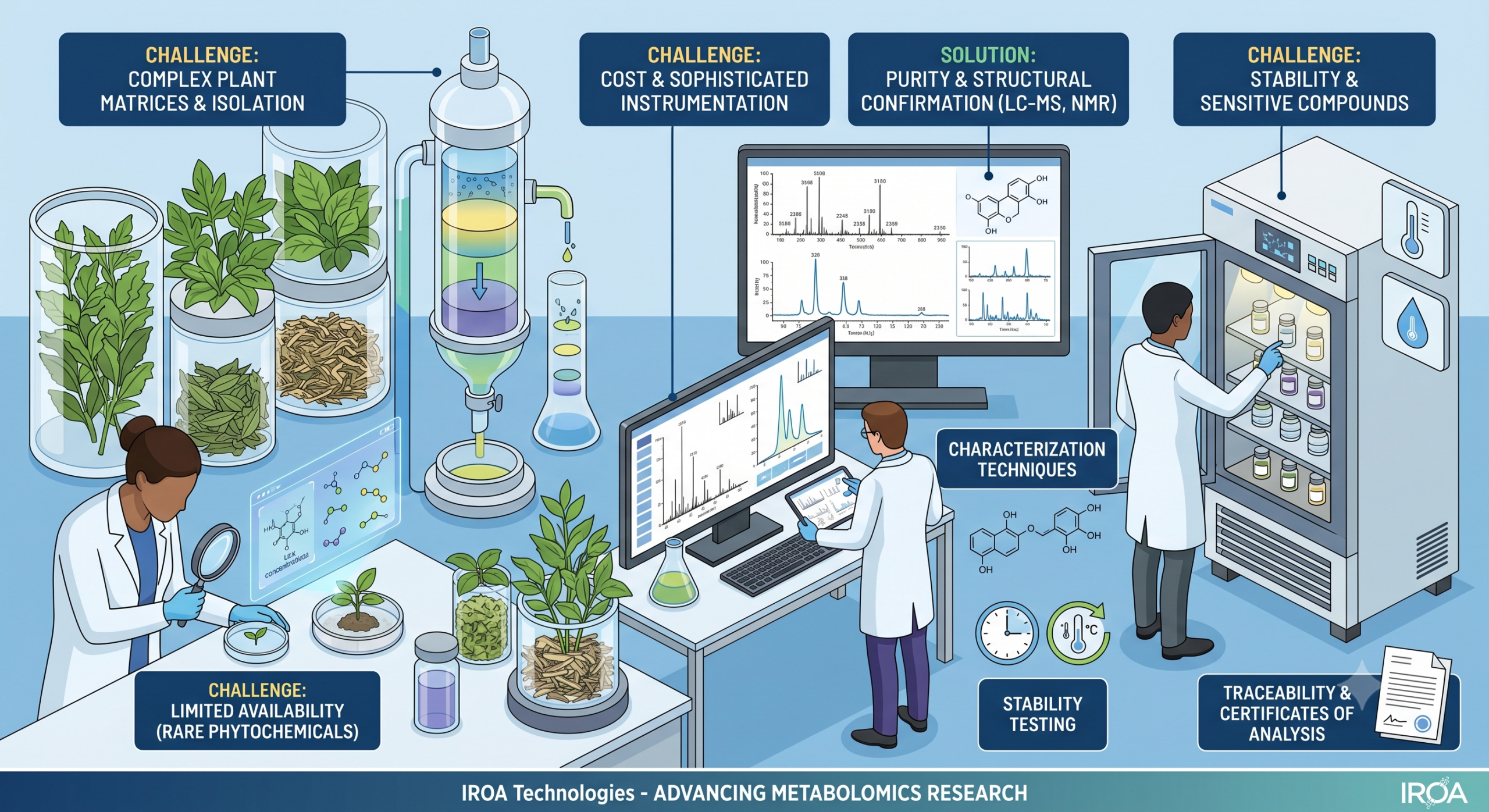
Challenges in Developing Plant-Based Standards
Despite their importance, producing reference compounds presents several challenges.
Complex Plant Matrices
Many plants contain hundreds of similar compounds, making isolation and purification difficult.
Limited Availability
Rare phytochemicals may occur in low concentrations, restricting large-scale production.
Stability Issues
Some compounds are highly sensitive to temperature, moisture, or light exposure, requiring specialized storage conditions.
Cost Considerations
Purification and structural confirmation require sophisticated instrumentation and expertise, contributing to higher costs.
Future Trends
Advances in analytical technologies and metabolomics are creating new opportunities for botanical research. Emerging trends include:
- High-resolution mass spectrometry
- AI-assisted compound identification
- Comprehensive metabolite libraries
- Standardized metabolomics workflows
- Precision medicine applications
As pharmaceutical and life science industries increasingly rely on natural products, demand for validated reference compounds will continue to grow.
Conclusion
Reliable reference compounds are essential for ensuring the accuracy, consistency, and reproducibility of plant-based research. From pharmaceutical development to metabolomics and quality control, Phytochemical Standards provide the foundation necessary for trustworthy scientific analysis.
Organizations such as IROA Technologies continue to advance metabolomics research by providing innovative analytical solutions that support biomarker discovery and systems biology studies. As natural product research expands, robust standards will remain central to scientific and pharmaceutical innovation.
External Resource
For additional information on botanical medicines and quality standards, visit the National Center for Complementary and Integrative Health (NCCIH):
National Center for Complementary and Integrative Health (NCCIH)
Frequently Asked Questions
What are phytochemical standards used for?
They are used as reference materials for identifying and quantifying plant-derived compounds in pharmaceutical, nutraceutical, and research applications.
Why are reference standards important in analytical chemistry?
They provide accuracy, reproducibility, and quality assurance for analytical methods and scientific studies.
How do phytochemical standards support metabolomics research?
They improve compound identification, quantitative analysis, and biomarker discovery, resulting in more reliable metabolomic data.
Which analytical techniques commonly use phytochemical standards?
HPLC, LC-MS, GC, and NMR are among the most common analytical methods that rely on reference standards.
How does IROA Technologies contribute to metabolomics research?
IROA Technologies provides advanced metabolomics tools and solutions that help researchers perform precise and reproducible analyses for biomarker discovery and systems biology applications.