

Cannabis research has experienced significant growth over the past decade as scientists, healthcare professionals, and policymakers seek to better understand the plant’s therapeutic potential. However, one of the major challenges in cannabis research has been the lack of consistency across products and study materials. Variations in cannabinoid content, cultivation methods, and processing techniques can make it difficult to compare research findings or replicate study results.
This challenge has led to the growing adoption of Standardized Cannabis, a critical development that is helping improve research quality, clinical reliability, and scientific understanding. By ensuring consistency in composition and quality, standardized cannabis products are becoming essential tools for both laboratory investigations and clinical studies.
Understanding Cannabis Standardization
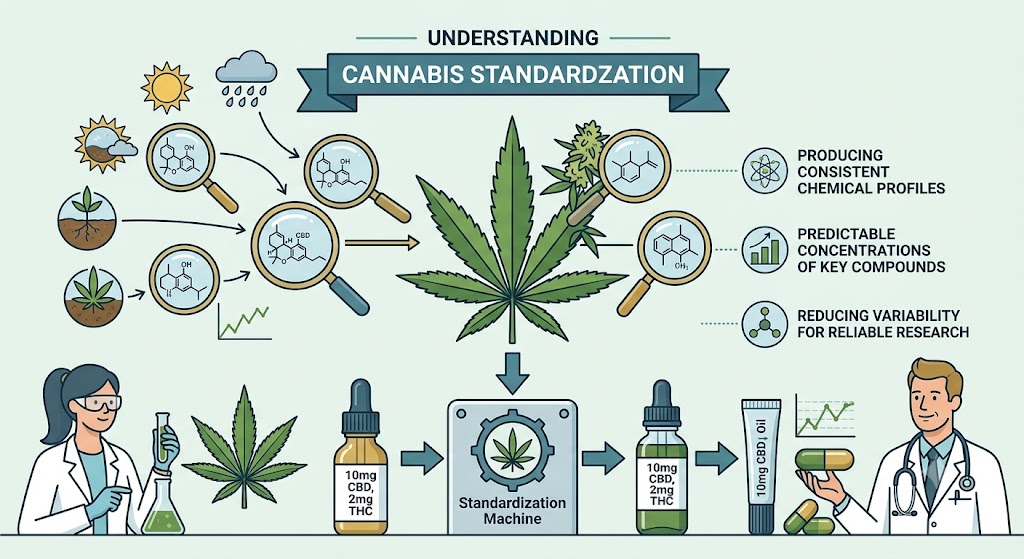
Cannabis contains hundreds of bioactive compounds, including cannabinoids, terpenes, flavonoids, and other phytochemicals. The concentration of these compounds can vary significantly depending on genetics, growing conditions, harvesting practices, and extraction methods.
Standardization refers to the process of producing cannabis products with consistent chemical profiles and predictable concentrations of key compounds. Researchers and clinicians can then work with materials that maintain the same composition across multiple batches.
This consistency is crucial because it allows scientists to determine whether observed effects are truly linked to specific cannabis compounds rather than variations in product quality.
Why Standardization Matters in Research
Scientific research relies heavily on reproducibility. If researchers cannot replicate study results using the same materials and methods, confidence in the findings decreases.
In cannabis research, inconsistent products have historically created obstacles for scientists attempting to validate previous studies. Differences in cannabinoid concentrations can influence outcomes, making it difficult to establish reliable conclusions.
Standardized products address this issue by providing researchers with uniform materials. This allows for:
- More accurate comparisons between studies
- Improved reproducibility of findings
- Better identification of therapeutic mechanisms
- Enhanced data quality and reliability
- Greater confidence in clinical recommendations
As cannabis research expands into areas such as pain management, neurological disorders, mental health, and inflammation, standardization becomes increasingly important for generating meaningful scientific evidence.
Supporting Clinical Studies and Patient Safety
Clinical trials require precise dosing and controlled study conditions. Inconsistent cannabis products can introduce variables that affect patient responses and study outcomes.
The use of Standardized Cannabis helps researchers ensure that participants receive consistent doses throughout a trial. This improves the accuracy of safety assessments and therapeutic evaluations.
Standardized products can also help researchers:
- Monitor treatment effectiveness more accurately
- Evaluate dose-response relationships
- Reduce variability among study participants
- Improve patient safety monitoring
- Support regulatory compliance
As regulatory agencies continue to evaluate cannabis-based therapies, standardized formulations provide the level of consistency required for rigorous clinical research.
The Role of Advanced Analytical Technologies
Achieving cannabis standardization requires sophisticated analytical methods capable of accurately measuring cannabinoids and other chemical constituents.
Modern laboratories use advanced technologies such as:
Mass Spectrometry
Mass spectrometry enables researchers to identify and quantify a wide range of cannabis metabolites with exceptional sensitivity and accuracy.
Chromatographic Techniques
Methods such as high-performance liquid chromatography (HPLC) and gas chromatography (GC) help separate and analyze complex cannabis compounds.
Metabolomics
Metabolomics has emerged as a powerful approach for understanding the complete chemical profile of cannabis products. By examining thousands of metabolites simultaneously, researchers can gain deeper insights into product consistency and biological activity.
Companies such as IROA Technologies contribute to this advancement by providing innovative metabolomics solutions that support comprehensive chemical analysis and data interpretation across a variety of biological and plant-based research applications.
Advancing Medical Cannabis Development
The medical cannabis industry is increasingly focused on developing evidence-based therapies supported by scientific data. Standardization plays a key role in this process.
Researchers developing cannabis-derived medications must demonstrate consistent product quality, safety, and effectiveness. Standardized formulations help establish the foundation necessary for regulatory approval and clinical acceptance.
Benefits include:
- Improved product quality control
- Enhanced manufacturing consistency
- Stronger scientific validation
- Greater healthcare provider confidence
- Better patient outcomes
As pharmaceutical companies and research institutions continue exploring cannabinoid-based treatments, standardized products are expected to become an industry standard.
Regulatory and Industry Implications
Regulatory agencies around the world are placing greater emphasis on quality assurance and product consistency within the cannabis sector. Standardization supports compliance with regulatory requirements while promoting consumer and patient safety.
Organizations involved in cannabis cultivation, extraction, manufacturing, and research increasingly recognize that standardized products can:
- Improve market credibility
- Support international research collaboration
- Facilitate regulatory approval processes
- Strengthen consumer trust
- Promote scientific advancement
As regulations evolve, standardization will likely become a key benchmark for quality across the cannabis industry.
The Future of Cannabis Research
The future of cannabis science depends on generating reliable, reproducible, and clinically meaningful data. Standardization provides the framework necessary to achieve these goals.
Emerging technologies in metabolomics, analytical chemistry, and systems biology are expected to further improve researchers’ ability to characterize cannabis products and understand their biological effects.
With continued innovation, collaboration, and scientific rigor, Standardized Cannabis will play an increasingly important role in advancing medical discoveries, improving patient care, and expanding our understanding of this complex plant.
Conclusion
Cannabis research is entering a new era driven by scientific precision and evidence-based investigation. Standardization addresses one of the most significant challenges facing the field by ensuring product consistency and improving research reliability.
From clinical trials to pharmaceutical development, standardized cannabis products are helping researchers generate more accurate data, enhance patient safety, and support regulatory progress. Combined with advanced analytical platforms and metabolomics technologies from organizations like IROA Technologies, standardization is paving the way for a deeper understanding of cannabis and its potential applications in medicine and healthcare.
External Resource
To learn more about cannabis research and public health perspectives, visit the National Center for Complementary and Integrative Health (NCCIH):
Cannabis and Cannabinoids Health Information
Frequently Asked Questions (FAQs)
1. What is standardized cannabis?
Standardized cannabis refers to cannabis products that are manufactured with consistent concentrations of cannabinoids and other key compounds, ensuring uniform quality across batches.
2. Why is standardization important in cannabis research?
Standardization improves reproducibility, data reliability, and scientific accuracy by reducing variations that can influence research outcomes.
3. How does standardized cannabis support clinical trials?
It ensures consistent dosing, improves patient safety monitoring, and helps researchers accurately evaluate therapeutic effects.
4. What technologies are used to standardize cannabis products?
Common technologies include mass spectrometry, chromatography, and metabolomics-based analytical methods.
5. How does metabolomics contribute to cannabis research?
Metabolomics enables comprehensive profiling of cannabis compounds, helping researchers better understand product composition, quality, and biological activity.