
In today’s data-driven scientific world, researchers face a common challenge: biological datasets are growing larger, more complex, and more interconnected than ever before. Whether you are working in metabolomics, systems biology, pharmaceutical development, food analysis, or environmental studies, the ability to interpret complex datasets quickly and accurately is crucial.
This is where Clustering Search Engines transform the landscape. They bring speed, structure, and intelligence to scientific data interpretation, helping teams uncover meaningful patterns in minutes instead of days. At IROA Technologies, the mission is to provide researchers with analytical solutions that deliver clarity, precision, and confidence—starting with powerful data exploration tools designed for modern scientific demands.
This blog explores how Clustering Search Engines work, why they matter, and how IROA Technologies supports faster, smarter insights across the scientific community.
Understanding Clustering Search Engines in Modern Science
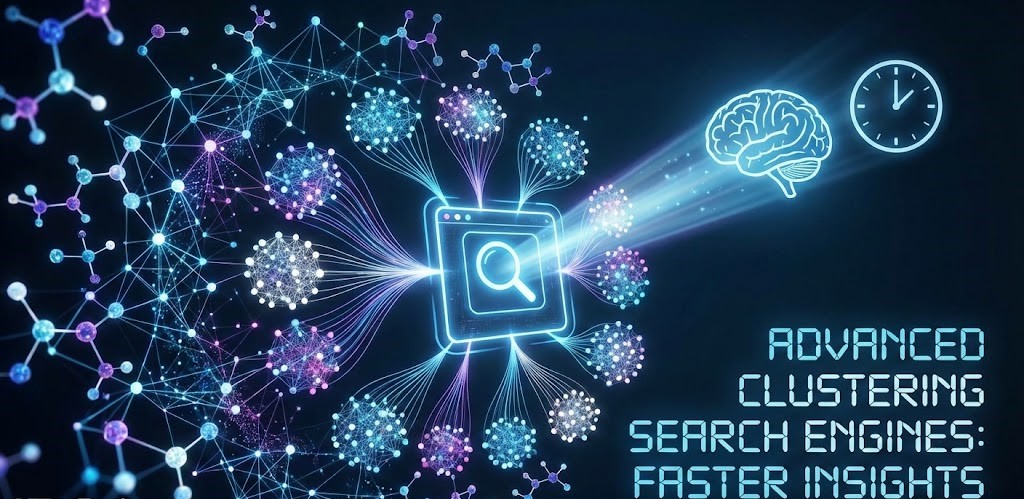
Clustering Search Engines are intelligent data tools that automatically group similar features, patterns, or molecular signatures within large datasets. Instead of manually searching through thousands of compounds, signals, or mass spectrometry peaks, researchers can instantly see how related data points behave, cluster, and interact.
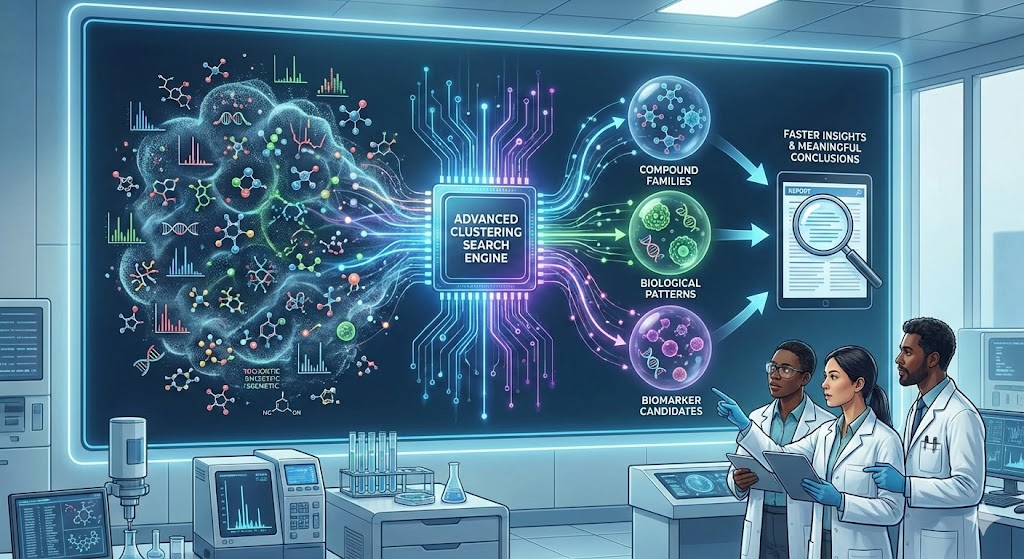
In metabolomics and MS-based workflows, clustering allows scientists to:
- Identify compound families
- Detect biological patterns and relationships
- Improve compound validation
- Reduce false positives
- Visualize high-dimensional data
The purpose is not only to analyze data but to make sense of it quickly, effectively, and with scientific confidence.
Modern datasets contain tens of thousands of measurable variables. Manual interpretation is no longer practical. Clustering Search Engines offer a structured, automated, and scalable way to convert raw data into meaningful biological interpretations.
Why Clustering Search Engines Are Essential Today
The rise of omics technologies and high-resolution instrumentation has dramatically increased the volume of data researchers collect. More data is beneficial but only if scientists can interpret it effectively.
Here’s why these powerful tools are now essential:
1. The Complexity of Biological Data
Biological systems contain thousands of interacting components. Whether you are identifying metabolites, assessing biomarker changes, or validating unknown compounds, the complexity is overwhelming without advanced computational tools.
2. Manual Analysis Is No Longer Enough
Traditional workflows depend on manual peak picking, library matching, and expert interpretation. While valuable, they cannot keep pace with today’s data size and diversity.
3. Increased Pressure for Accuracy and Reproducibility
Scientific studies rely heavily on accurate compound identification and reproducible workflows. Clustering algorithms reduce variability, improve classification, and strengthen analytical confidence.
4. Faster Time to Insight
Pharma, clinical research, food safety, environmental monitoring, and academic laboratories all face pressure to deliver results faster. Automated clustering significantly reduces analysis time.
5. Growing Adoption of AI-assisted Tools
As AI and machine learning continue to expand, clustering is now a standard expectation for modern analytical platforms.
Clustering Search Engines bridge the gap between massive datasets and actionable insights, helping scientists move from raw data to meaningful conclusions with speed and clarity.
How Clustering Search Engines Work
At a basic level, clustering is the process of grouping similar data points together based on their characteristics. These characteristics may include:
- Mass-to-charge ratios
- Retention times
- Ion intensities
- Isotopic profiles
- Fragmentation patterns
- Biological relationships
Clustering Search Engines use algorithms such as:
- Hierarchical clustering
- K-means clustering
- Density-based spatial clustering (DBSCAN)
- Machine-learning–based clustering
- Multi-omics integration models
In scientific workflows, this enables:
- Grouping compounds with similar biochemical origins
- Detecting patterns that distinguish experimental groups
- Identifying relationships hidden in complex datasets
- Improving classification and feature annotation
- Supporting better decision-making during discovery
The strength of Clustering Search Engines lies in their ability to simplify complexity without losing scientific detail.
What Makes IROA Technologies’ Approach Unique?
IROA Technologies has spent years developing innovative solutions designed specifically for metabolomics and MS-based research. The company understands scientific challenges that occur in real-world laboratory workflows—from instrument variability to matrix effects, drift, and inconsistent compound identification.
Here is what sets IROA Technologies apart:
1. A Deep Understanding of Biological Systems
IROA’s tools are built with biological context in mind, not just computational speed. This ensures that clustering results are scientifically meaningful, not just statistically grouped.
2. Standardized Workflow Enhancements
Through isotopic labeling standards and quality control tools, IROA ensures that dataset clustering reflects true biological changes rather than analytical variability.
3. Accuracy-Driven Software Tools
IROA Technologies focuses on clarity, precision, and reproducibility. Their tools support high-quality data interpretation, enabling scientists to validate results with confidence.
4. Support for High-Resolution Mass Spectrometry
With instrument platforms generating increasingly complex data, IROA tools are designed to keep pace with modern analytical performance.
5. User-Friendly and Research-Focused Design
IROA Technologies builds solutions that empower researcher whether they are beginners or advanced experts.
Together, these strengths offer a powerful combination for scientists who need fast, accurate insights from metabolomics or other high-complexity datasets.
Benefits of Using Clustering Search Engines in Your Workflow
1. Improved Data Clarity
Clustering reveals structure in data that would otherwise appear chaotic. Researchers instantly see relationships between features, making analysis more intuitive.
2. Faster Biological Interpretation
Complex datasets are reduced to clear patterns. This allows teams to interpret biological meaning more quickly and move forward with actionable decisions.
3. Reduced Noise and Variability
Clustering helps separate true biological signals from instrument noise or random variability.
4. Stronger Biomarker Discovery
By identifying groups of related features, clustering strengthens early biomarker detection and validation.
5. Enhanced Reporting and Visualization
Clear visual groupings improve communication with collaborators, stakeholders, and regulatory teams.
6. Better Integration with Downstream Analysis
Clustering results can easily feed into pathway analysis, functional annotation, or statistical modeling.
7. Automation of Repetitive Tasks
This frees scientists to focus on interpretation, innovation, and discovery instead of manual sorting.
Applications of Clustering Search Engines Across Industries
Clustering plays a powerful role across a wide range of scientific fields:
Metabolomics Research
- Identify related metabolite families
- Support compound annotation and validation
- Improve interpretation of biochemical pathways
Pharmaceutical R&D
- Drug metabolite identification
- Toxicology and safety assessment
- Pharmacokinetic analysis
Clinical Diagnostics
- Biomarker discovery
- Disease classification
- Patient stratification
Food and Nutrition Science
- Ingredient authentication
- Quality control monitoring
- Contamination detection
Environmental and Exposure Research
- Chemical fingerprinting
- Pollution analysis
- Exposure biomonitoring
Agricultural Science
- Crop quality measurement
- Soil and nutrient analysis
- Microbial metabolite profiling
Across every discipline, Clustering Search Engines support faster insights and stronger scientific outcomes.
How Clustering Enhances Metabolomics Workflows Specifically
Metabolomics is one of the most data-rich domains in modern biology. Every sample contains thousands of metabolites with different structures, functions, and biochemical relationships.
Clustering:
- Reveals biochemical pathway signatures
- Groups metabolites based on shared origins
- Improves annotation of unknown compounds
- Reduces false discoveries
- Strengthens repeatability
For laboratories using IROA Technologies’ standards and tools, clustering provides even stronger performance because isotopic labeling supports clear identification and data consistency.
The Future of Clustering Search Engines
Scientific data will continue to grow in size and complexity. The future will rely heavily on intelligent search engines powered by machine learning, AI, and automated workflows.
Upcoming advancements include:
- Real-time clustering
- Multi-omics integration
- Predictive analytics
- Automated annotation and classification
- AI-driven quality scoring
- Enhanced interoperability with MS platforms
IROA Technologies remains committed to leading innovation that shapes this future. As more researchers adopt Clustering Search Engines, scientific discovery will become faster, more confident, and more reliable.
External Resource (Working Link)
To learn more about data clustering concepts, you may explore:
https://scikit-learn.org/stable/modules/clustering.html
(This is an official and reliable resource.)
Conclusion
Clustering Search Engines have become essential tools in modern scientific workflows. They help researchers interpret large datasets quickly, detect meaningful patterns, and improve accuracy across metabolomics, pharmaceuticals, clinical diagnostics, environmental studies, and more.
For scientists seeking speed, clarity, and confidence, Clustering Search Engines offer a powerful path to actionable insights.
IROA Technologies continues to support the global research community with advanced analytical tools that enhance accuracy, encourage reproducibility, and simplify complex data interpretation.
As scientific datasets grow, clustering will shape the future of discover faster, smarter, and more precise than ever before.
FAQs
1. What are Clustering Search Engines?
Clustering Search Engines are intelligent tools that automatically group similar data points in large datasets, helping researchers identify patterns quickly and accurately.
2. Why are they important in metabolomics?
Metabolomics produces highly complex datasets. Clustering simplifies interpretation, supports accurate identification, and helps researchers uncover biochemical relationships.
3. How does IROA Technologies use clustering in its tools?
IROA Technologies integrates clustering principles to improve compound classification, reduce variability, and enhance analytical precision in MS-based workflows.
4. What industries benefit from clustering technologies?
Pharmaceuticals, academia, diagnostics, food science, environmental monitoring, and agricultural research all benefit from clustering-based data analysis.
5. Does clustering replace manual analysis?
No. Clustering enhances human expertise by reducing complexity and highlighting meaningful patterns. Researchers still interpret final results.