
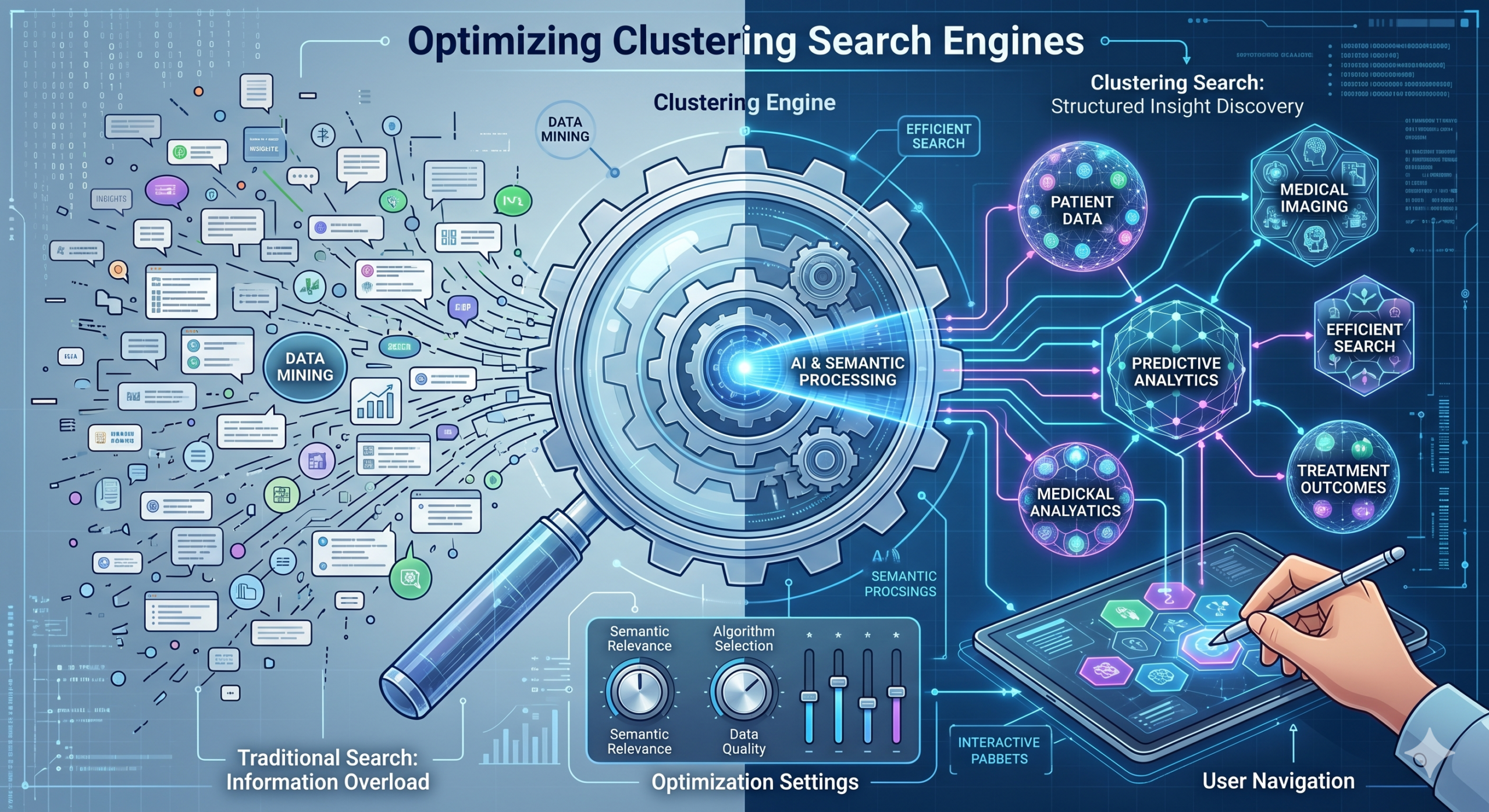
In today’s data-driven world, finding relevant information quickly has become more challenging than ever. Traditional search methods often return massive lists of unrelated results, making it difficult for researchers, businesses, and analysts to identify meaningful insights efficiently. This is where Clustering Search Engines play a transformative role. By organizing search results into thematic clusters, these advanced systems help users discover patterns, relationships, and hidden insights faster than conventional search technologies.
What Are Clustering Search Engines?
Clustering Search Engines are advanced information retrieval systems that automatically group related search results into categories or clusters based on shared themes, keywords, or semantic meaning. Instead of presenting a simple ranked list of results, these systems create organized topic groups that allow users to explore information more effectively.
For example, a search related to healthcare analytics may generate clusters for patient data, medical imaging, predictive analysis, and treatment outcomes. This structure helps users navigate extensive datasets with greater clarity and precision.
These search technologies are widely used in scientific research, e-commerce, enterprise data management, and artificial intelligence applications because they improve search relevance and reduce information overload.
Why Optimization Matters
Even the most advanced search systems require proper optimization to deliver accurate and meaningful results. Poorly configured clustering methods can lead to irrelevant groupings, duplicate information, or confusing search experiences.
Optimizing search clustering improves:
- Search accuracy
- User experience
- Data categorization
- Insight discovery
- Research efficiency
- Decision-making speed
Businesses and researchers handling complex datasets especially benefit from properly optimized clustering strategies.
Best Practices for Better Search Clustering Results
1. Use High-Quality and Structured Data
The quality of search results depends heavily on the quality of the input data. Clean, structured, and well-labeled datasets help clustering algorithms identify relationships more effectively.
Best practices include:
- Removing duplicate records
- Standardizing terminology
- Correcting spelling inconsistencies
- Using metadata and tags
- Maintaining consistent formatting
When datasets are properly organized, clustering systems can produce more meaningful and accurate topic groups.
2. Focus on Semantic Relevance
Modern search systems rely heavily on semantic analysis rather than simple keyword matching. Semantic relevance allows the engine to understand context, user intent, and conceptual relationships between terms.
To improve semantic clustering:
- Use descriptive keywords
- Include related terminology
- Optimize metadata descriptions
- Apply natural language processing techniques
For example, terms like metabolomics, mass spectrometry, and biomarker analysis may belong within related scientific clusters even if the exact keywords differ.
3. Choose the Right Clustering Algorithm
Different clustering techniques work better for different types of data. Selecting the appropriate algorithm significantly impacts the quality of grouped results.
Common clustering methods include:
- Hierarchical clustering
- K-means clustering
- Density-based clustering
- Neural network-based clustering
Each method has strengths depending on data complexity, scale, and application requirements. Research-driven industries often require more advanced clustering approaches to handle scientific and multidimensional datasets.
You can learn more about clustering methods through IBM’s guide to data clustering.
4. Optimize Search Queries
Well-designed search queries produce more accurate clusters. Broad or vague queries may generate scattered results, while specific queries improve categorization.
Helpful query optimization strategies include:
- Using precise terminology
- Adding contextual keywords
- Avoiding unnecessary filler words
- Using filters when available
For instance, searching for metabolomics biomarker discovery using LC-MS will typically generate more targeted clusters than simply searching for biomarker research.
5. Continuously Update the Search Index
Search indexes must remain updated to maintain relevance and accuracy. Outdated indexes can produce incomplete or misleading clusters.
Regular index maintenance should include:
- Adding new datasets
- Removing obsolete information
- Updating metadata
- Reprocessing semantic relationships
Industries such as healthcare, biotechnology, and artificial intelligence evolve rapidly, making continuous updates especially important.

6. Incorporate Machine Learning and AI
Artificial intelligence significantly improves clustering efficiency by learning from user behavior and data relationships over time.
AI-powered optimization can help:
- Improve search relevance
- Detect hidden patterns
- Adapt to user intent
- Refine cluster labeling
- Enhance predictive insights
Many modern Clustering Search Engines now integrate machine learning models to create smarter and more adaptive search experiences.
For additional scientific reading on biological data analysis, visit the NCBI Bookshelf.
7. Improve User Navigation and Visualization
Effective clustering is not only about backend algorithms but also about user experience. Visual organization and intuitive navigation help users interact with clustered data more efficiently.
Useful optimization techniques include:
- Interactive dashboards
- Expandable category trees
- Color-coded clusters
- Search refinement filters
- Visual analytics tools
Clear visualization helps users understand relationships between data categories more quickly.
The Growing Role of Search Clustering in Research and Analytics
As organizations generate larger volumes of structured and unstructured data, intelligent search organization becomes increasingly valuable. Industries such as biotechnology, healthcare, cybersecurity, and finance now rely on clustering technologies to improve knowledge discovery and analytical workflows.
Scientific organizations including IROA Technologies benefit from advanced data organization techniques to support complex analytical processes and research innovation. Efficient clustering enables researchers to uncover trends, interpret results, and manage large datasets more effectively.
Conclusion
Optimizing search clustering is essential for improving information retrieval in modern data-intensive environments. From semantic relevance and structured datasets to AI-driven algorithms and user-friendly visualization, every optimization strategy contributes to better search accuracy and faster insight discovery.
As data complexity continues to grow, organizations that implement intelligent clustering practices will gain a significant advantage in research, analytics, and decision-making. By following these best practices, businesses and researchers can maximize the value of modern search technologies while improving productivity and user experience.
FAQs
What are Clustering Search Engines used for?
Clustering Search Engines organize search results into related categories or themes, making it easier for users to discover relevant information quickly and efficiently.
How do clustering algorithms improve search results?
Clustering algorithms group similar data points based on relationships, keywords, or semantic meaning, improving search organization and relevance.
Why is semantic analysis important in search clustering?
Semantic analysis helps search systems understand context and user intent, allowing them to deliver more accurate and meaningful clustered results.
Which industries benefit most from search clustering?
Healthcare, biotechnology, finance, cybersecurity, e-commerce, and scientific research all benefit significantly from advanced search clustering technologies.
How does AI improve clustering search systems?
Artificial intelligence learns from user behavior and data patterns to improve clustering accuracy, refine search relevance, and deliver more adaptive search experiences over time.