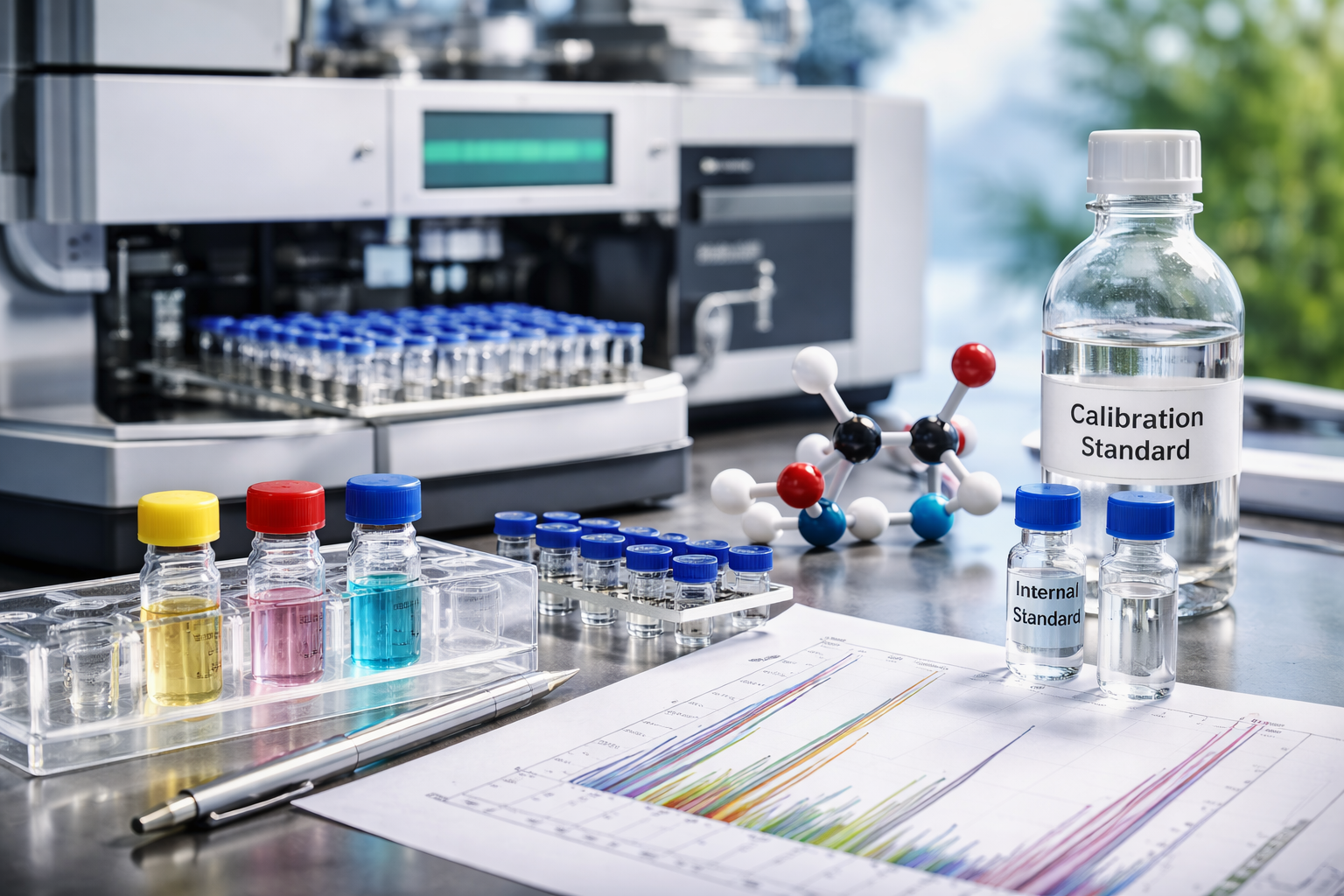
Laboratory setup showing calibration vials, internal standards, chromatogram data, and a mass spectrometer system

Understanding Mass Spectrometry Standards for Reliable Analytical Results

In modern analytical laboratories, precision is not optional—it is the foundation of credible science, regulatory compliance, and product quality. From pharmaceutical development and clinical research to food safety, environmental monitoring, and metabolomics, laboratories rely on mass spectrometry to identify, quantify, and characterize complex chemical compounds with exceptional sensitivity. However, even the most advanced instruments cannot…

Details


A pipette drips liquid into a beaker with green leaves. Nearby, amber bottles, test tubes, capsules, and laboratory equipment suggest scientific research.

The Role of Phytochemical Analytical Standards in Modern Laboratory Testing

In today’s data-driven scientific landscape, laboratories are expected to deliver results that are not only accurate but also reproducible, traceable, and defensible. Whether researchers are studying plant-based medicines, food safety, nutraceuticals, or environmental samples, the quality of analytical data directly impacts regulatory compliance, product safety, and scientific credibility. One of the most critical yet often…

Details
Cluster Search Engine Architecture for Distributed Data Systems

How a Cluster Search Engine Optimizes Distributed Data Search

In today’s digital-first world, organizations generate and store massive volumes of data across multiple systems, servers, and locations. From cloud platforms and data centers to edge devices, information is no longer centralized. While this distributed approach improves resilience and scalability, it also introduces a major challenge: how do you search through all that data quickly,…

Details
Mass spectrometry workflow showing peptide standards, molecular structures, and analytical data used for proteomics research

How a Standard Peptide Library Enables Consistent MS-Based Research

In the world of proteomics and metabolomics, mass spectrometry (MS) stands as one of the most powerful analytical technologies available today. From biomarker discovery and drug development to systems biology and clinical research, MS-based workflows enable scientists to measure thousands of molecules with exceptional sensitivity. Yet, despite its power, mass spectrometry comes with a persistent…

Details

Why Bile Acids for Research Matter in Metabolic and Clinical Science

Bile acids were once viewed as simple digestive molecules with a limited role in fat absorption. Today, scientific understanding has evolved dramatically. Researchers now recognize bile acids as powerful metabolic regulators, signaling molecules, and indicators of disease processes. This shift has made bile acids for research a critical focus in metabolic, clinical, and translational science.…

Details
amino-acid-internal-standard

Amino Acid Internal Standard Sets Improving Quantitation Across Complex Workflows

In the fast-moving world of metabolomics, researchers face constant pressure to deliver precise, reproducible, and biologically meaningful data. As analytical instruments become more sensitive and sample matrices grow more complex, the ability to control variability and improve quantitation has never been more important. Among the many tools available to scientists, Amino Acid Internal Standard Sets…

Details