
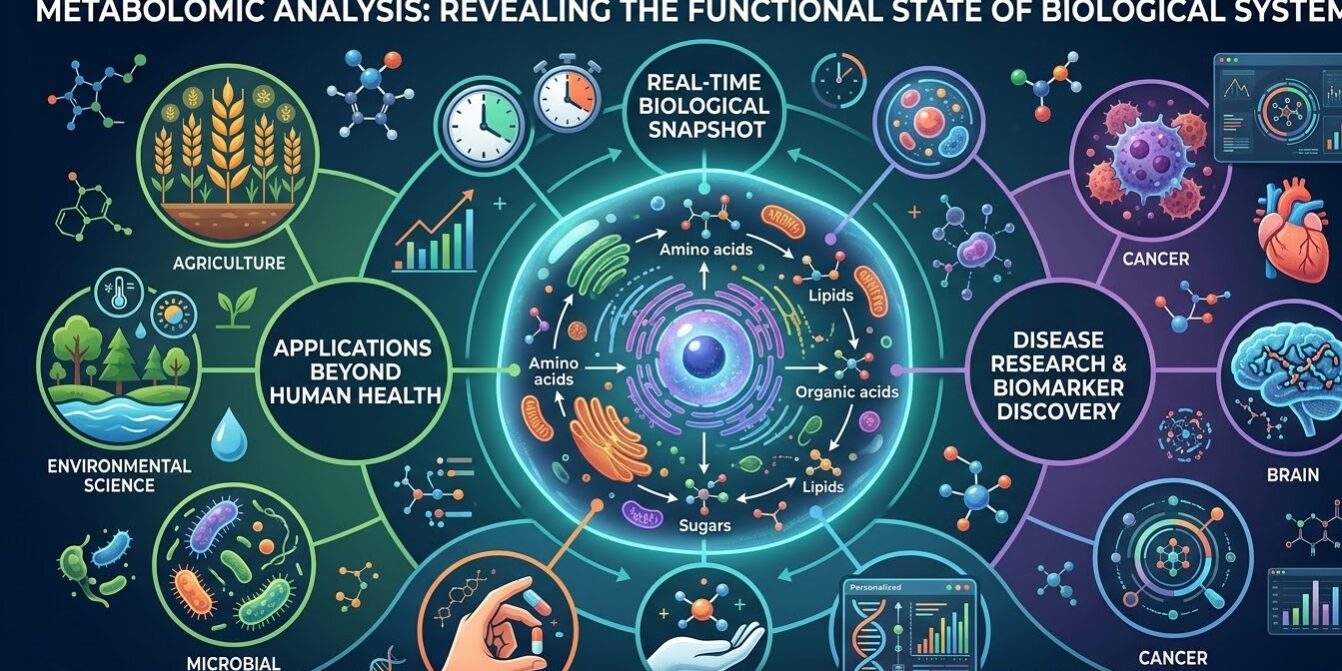
Modern biological research is evolving rapidly as scientists seek deeper insights into how living systems function at the molecular level. While genomics and proteomics have long provided valuable information about genes and proteins, understanding what actually happens inside cells requires studying the chemical processes that sustain life. This is where Metabolomic Analysis becomes a powerful scientific approach.
By examining the small molecules, or metabolites, present in biological systems, researchers can gain a real-time snapshot of cellular activity. These metabolites are the end products of cellular processes, meaning they directly reflect what is happening within cells, tissues, and organisms at any given moment. As a result, this field has become an essential tool for advancing biological research across medicine, agriculture, biotechnology, and environmental science.
Understanding Metabolomics in Biological Research
Metabolomics focuses on the comprehensive study of metabolites such as amino acids, lipids, sugars, and organic acids found within biological samples. These molecules play crucial roles in metabolic pathways that regulate growth, energy production, immune responses, and disease development.
Unlike genetic information, which represents potential biological activity, metabolites provide direct evidence of actual biological processes. Because of this, scientists rely on Metabolomic Analysis to observe how metabolic pathways change in response to environmental conditions, diseases, drug treatments, or genetic modifications.
Advanced analytical technologies such as mass spectrometry and chromatography allow researchers to identify and quantify thousands of metabolites simultaneously. These technologies have significantly expanded our ability to study biological systems in detail and uncover hidden metabolic patterns that were previously impossible to detect.
Why Metabolomic Analysis Matters in Modern Science
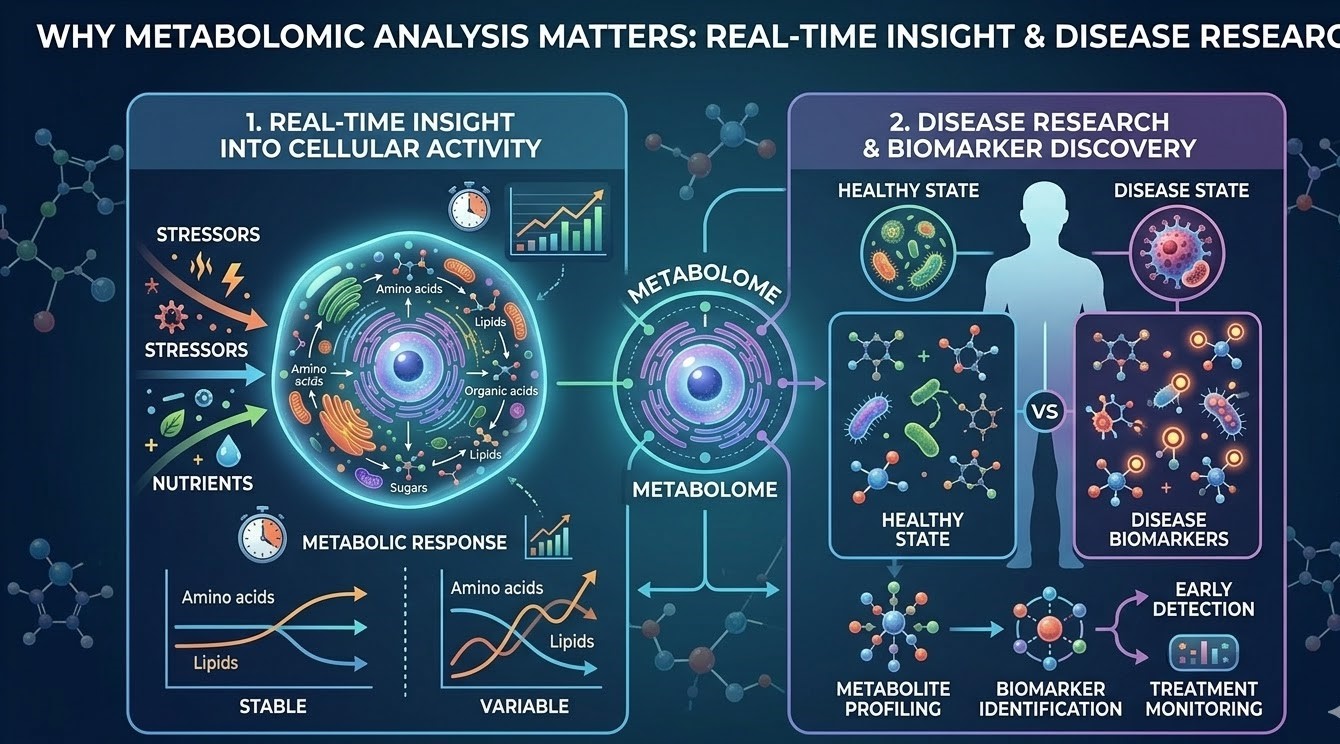
1. Provides Real-Time Insight Into Cellular Activity
One of the most significant advantages of metabolomics is its ability to capture a real-time picture of cellular function. While genes and proteins indicate biological potential, metabolites reveal the actual biochemical activities taking place inside the cell.
This allows scientists to observe how cells respond to stress, disease, nutrient availability, or therapeutic treatments. Such insights are invaluable for understanding biological systems at a functional level.
2. Accelerates Disease Research and Biomarker Discovery
Metabolite profiles often change when diseases develop. Researchers use these metabolic signatures to identify biomarkers that help detect diseases earlier or monitor treatment responses.
For example, changes in metabolite concentrations have been linked to conditions such as cancer, diabetes, cardiovascular disorders, and neurological diseases. By studying these changes, scientists can develop more accurate diagnostic tools and targeted therapies.
Organizations like Iroa Technologies contribute to this area by developing advanced tools and platforms that enable researchers to analyze complex metabolic data more efficiently.
3. Supports Drug Development and Precision Medicine
Drug discovery is a complex process that requires a deep understanding of how compounds interact with biological systems. Metabolomics plays an important role by revealing how drugs affect metabolic pathways within cells.
Researchers can use metabolic profiling to determine drug toxicity, identify potential side effects, and evaluate therapeutic effectiveness. This approach also supports the development of precision medicine, where treatments are tailored to individual metabolic profiles.
4. Enhances Systems Biology Research
Biological systems are highly interconnected, with genes, proteins, and metabolites influencing each other in complex networks. Metabolomics helps scientists understand these interactions by providing detailed insights into metabolic pathways.
When combined with other “omics” fields such as genomics and proteomics, Metabolomic Analysis helps researchers build comprehensive models of biological systems. These models improve our understanding of cellular regulation and biological responses.
5. Applications Beyond Human Health
While metabolomics plays a major role in medical research, its applications extend far beyond human health. Scientists use metabolic studies in many fields, including:
-
Agricultural science: Improving crop yield, stress resistance, and nutritional value.
-
Environmental research: Studying how organisms respond to pollutants and climate change.
-
Microbial research: Understanding microbial metabolism and its role in ecosystems.
-
Food science: Analyzing food composition, quality, and safety.
These diverse applications demonstrate how metabolomics contributes to solving real-world challenges.
The Role of Advanced Technologies in Metabolomics
The rapid growth of metabolomics has been made possible by technological advancements in analytical instrumentation and computational tools. High-resolution mass spectrometry, liquid chromatography, and specialized data analysis platforms enable scientists to process massive datasets and identify metabolic patterns with greater accuracy.
Companies like Iroa Technologies provide specialized solutions that support researchers in performing accurate metabolic studies. Their innovations help scientists manage complex datasets and extract meaningful biological insights from metabolomics experiments.
For additional information on metabolomics research and its applications, you can explore resources from the
National Institutes of Health:
https://www.nih.gov
Future Perspectives of Metabolomics
As technology continues to advance, metabolomics will play an even larger role in biological research. Artificial intelligence, machine learning, and improved analytical tools are making it easier to analyze complex metabolic data and uncover new discoveries.
In the coming years, metabolomics is expected to drive progress in areas such as personalized medicine, disease prevention, environmental sustainability, and biotechnology innovation.
By providing a deeper understanding of metabolic processes, this field is helping scientists answer some of the most important biological questions of our time.
FAQs
1. What is metabolomic analysis used for?
Metabolomic studies are used to examine small molecules within biological systems. Researchers use this approach to understand cellular processes, discover disease biomarkers, and study metabolic responses to drugs or environmental changes.
2. Why is metabolomics important in biological research?
Metabolomics provides a direct snapshot of cellular activity by analyzing metabolites. This helps scientists understand how biological systems function and respond to different conditions, making it essential for modern life science research.
3. Which technologies are commonly used in metabolomics?
Common technologies include mass spectrometry, nuclear magnetic resonance (NMR) spectroscopy, and chromatography techniques. These tools allow researchers to detect and quantify metabolites with high accuracy.
4. How does metabolomics help in disease detection?
Changes in metabolic profiles often occur when diseases develop. By analyzing these changes, scientists can identify biomarkers that may help in early disease detection and monitoring treatment responses.
5. What industries benefit from metabolomics research?
Metabolomics is widely used in healthcare, pharmaceuticals, agriculture, environmental science, and biotechnology. Its applications range from drug development to crop improvement and environmental monitoring.