
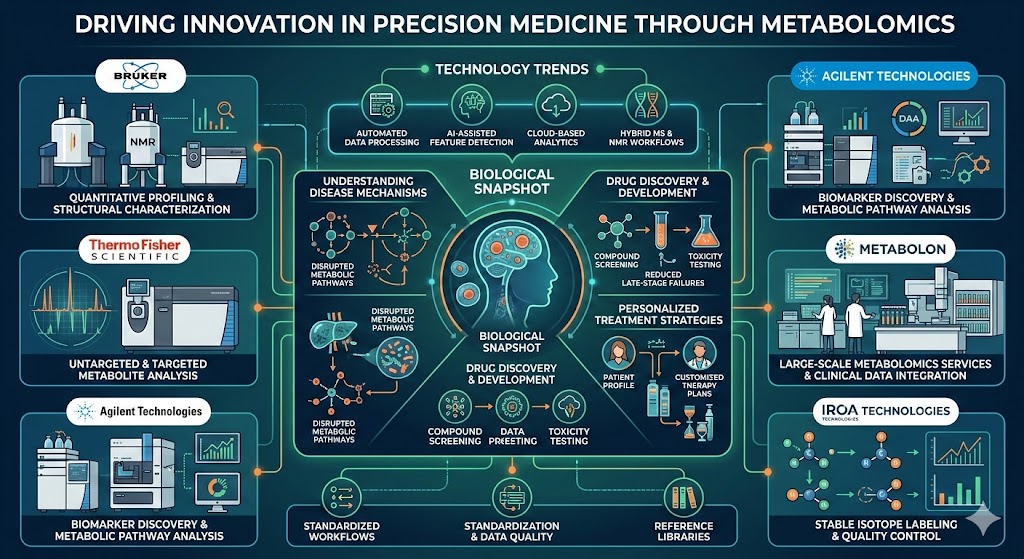
Over the past decade, metabolomics has emerged as one of the most powerful tools in modern life sciences. By studying small molecules produced during biological processes, researchers can gain a real-time snapshot of how cells, tissues, and entire organisms respond to disease, drugs, and environmental factors. Behind this rapid growth are several leading metabolomics companies that continue to shape the future of precision medicine, biotechnology, and pharmaceutical research.
In this article, we explore how industry leaders are advancing metabolomics technologies and why their innovations matter for healthcare and scientific discovery.
Why Metabolomics Matters in Modern Research
Metabolomics focuses on the comprehensive analysis of metabolites—the small molecules that reflect ongoing biochemical activity. Unlike genomics or proteomics, which reveal what could happen in a biological system, metabolomics shows what is actually happening at a given moment.
This real-time insight is crucial for:
- Understanding disease mechanisms
- Identifying new drug targets
- Supporting personalized treatment strategies
- Monitoring therapy response
As demand for deeper biological insight grows, metabolomics is becoming an essential part of translational research and clinical development pipelines.
How Metabolomics Supports Precision Medicine
Precision medicine relies on accurate biological data to tailor therapies for individual patients. Metabolomic profiles can reveal subtle metabolic changes long before traditional clinical markers appear.
For example, metabolomics is now widely used to:
- Detect early-stage disease signatures
- Track metabolic side effects of drug candidates
- Identify patient subgroups that respond differently to therapies
This growing clinical relevance is a major reason why metabolomics companies are investing heavily in software automation, standardized workflows, and advanced analytics.
Key Players Advancing the Metabolomics Industry
Several organizations stand out for their contributions to analytical technology, software platforms, and data interpretation.
IROA Technologies
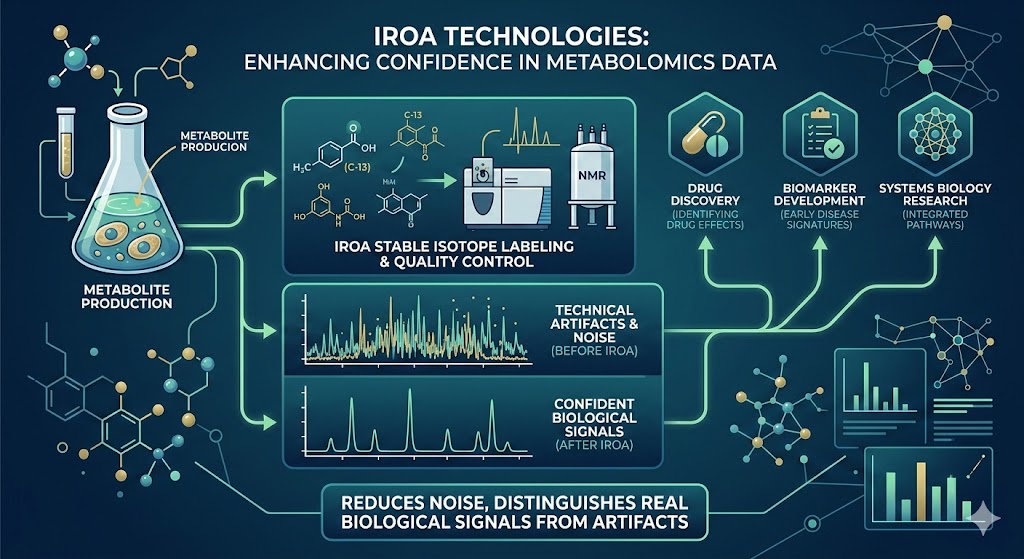
IROA Technologies is well known for its innovative approach to stable isotope labeling and quality control in metabolomics. Its workflow helps researchers improve data accuracy, reduce noise, and confidently distinguish real biological signals from technical artifacts.
By enabling high-confidence metabolite identification and more reproducible results, the company plays an important role in drug discovery, biomarker development, and systems biology research.
Metabolon
Metabolon specializes in large-scale metabolomics services and data analytics for pharmaceutical, biotechnology, and academic researchers. Its platforms focus on generating standardized, high-throughput metabolomic data that can be directly integrated into clinical and preclinical studies.
The company’s ability to link metabolite patterns with biological outcomes supports both target discovery and precision medicine programs.
Thermo Fisher Scientific
Thermo Fisher Scientific provides a broad range of high-resolution mass spectrometers and chromatography systems widely used in metabolomics laboratories. Its hardware platforms are essential for untargeted and targeted metabolite analysis across multiple biological matrices.
The company’s continuous improvements in sensitivity, speed, and data quality enable researchers to detect low-abundance metabolites with greater confidence.
Bruker
Bruker is another major contributor to the metabolomics ecosystem through its nuclear magnetic resonance (NMR) and mass spectrometry technologies. NMR-based metabolomics remains highly valuable for quantitative profiling and structural characterization of metabolites.
Bruker’s integrated solutions support both discovery-focused research and standardized clinical applications.
Agilent Technologies
Agilent Technologies offers advanced liquid chromatography and mass spectrometry systems that form the backbone of many metabolomics laboratories worldwide. Its instruments are widely used for biomarker discovery, metabolic pathway analysis, and environmental metabolomics.
The company also develops software tools that streamline data acquisition and quality control.
Technology Trends Shaping the Industry
Today’s leading platforms are not only focused on instrumentation. They are building complete end-to-end workflows that connect sample preparation, data acquisition, metabolite identification, and biological interpretation.
Some major trends include:
- Automated data processing and cloud-based analytics
- Improved spectral libraries for metabolite confirmation
- Hybrid workflows combining MS and NMR data
- AI-assisted feature detection and pathway mapping
These advancements allow researchers to process larger cohorts while maintaining data quality and biological relevance.
The Role of Standardization and Data Quality
One of the historical challenges in metabolomics has been reproducibility. Differences in sample handling, instrument performance, and data processing pipelines can introduce significant variation.
Modern workflows emphasize:
- Internal standards and quality control strategies
- Standard operating procedures for sample preparation
- Reference libraries for confident metabolite identification
As regulatory expectations increase for clinical research, standardization is becoming a critical focus for both platform providers and service laboratories.
How Metabolomics Is Transforming Drug Discovery
Pharmaceutical companies now routinely use metabolomics to complement genomics and proteomics data. By integrating metabolic information, scientists can better understand:
- Mechanisms of drug action
- Off-target effects and toxicity
- Metabolic liabilities of new compounds
This integrated approach helps reduce late-stage clinical failures and supports smarter decision-making during early development.
The growing reliance on these technologies further strengthens the strategic role of metabolomics companies in the global life sciences market.
Learning More About Metabolomics Applications
For a scientific overview of how metabolomics supports biomedical research and clinical translation, you can explore this external resource published by the U.S. National Institutes of Health:
External link: https://www.ncbi.nlm.nih.gov/pmc/articles/PMC5452221/
The Future of Metabolomics in Healthcare
Looking ahead, metabolomics is expected to move deeper into routine clinical research and, eventually, clinical diagnostics. Improvements in throughput, automation, and data interpretation will help make metabolic profiling faster, more affordable, and easier to integrate with electronic health records. Companies such as IROA Technologies are contributing to this progress by advancing standardized workflows and high-confidence metabolite identification solutions that support clinical-grade data quality.
FAQs
1. What are metabolomics companies?
Metabolomics companies develop instruments, software, and analytical services tha t enable scientists to study metabolites in biological samples and interpret metabolic changes related to health, disease, and treatment.
2. How do metabolomics technologies support precision medicine?
They reveal real-time biochemical activity in patients, helping researchers identify disease-specific metabolic signatures and tailor therapies based on individual biological responses.
3. Is metabolomics mainly used in pharmaceutical research?
No. Metabolomics is also widely used in nutrition science, environmental research, microbiome studies, agriculture, and clinical biomarker discovery.
4. What technologies are commonly used in metabolomics?
The most common technologies are mass spectrometry and nuclear magnetic resonance, often combined with advanced chromatography and data analytics platforms.
5. Will metabolomics become part of routine clinical testing?
While still primarily used in research, growing standardization and automation suggest that metabolomics will increasingly support clinical trials and diagnostic development in the coming years.