Liquid Chromatography-Mass Spectrometry (LC-MS) has become one of the most powerful analytical techniques in modern proteomics, metabolomics, and pharmaceutical research. Scientists rely on LC-MS studies to identify, quantify, and analyze complex biological molecules with high sensitivity and precision. However, generating accurate and reproducible results requires more than advanced instrumentation alone. One critical component that supports reliable LC-MS workflows is the use of a standard peptide library.
A standard peptide library serves as a collection of well-characterized peptides used as references during LC-MS analysis. These libraries help researchers validate experimental data, improve identification accuracy, and maintain consistency across studies. As research demands continue to grow in areas such as biomarker discovery, clinical diagnostics, and drug development, the importance of peptide libraries has become increasingly significant.
What Is a Standard Peptide Library?
A standard peptide library is a curated set of synthetic or experimentally validated peptides with known properties such as sequence, retention time, and mass-to-charge ratios. Researchers use these libraries as benchmarks during LC-MS experiments to compare and verify unknown peptide signals.
These libraries are carefully designed to support analytical consistency and improve confidence in data interpretation. By providing reliable reference points, peptide libraries help laboratories reduce variability and enhance reproducibility across experiments.
Why Standardization Matters in LC-MS Studies
LC-MS studies often involve highly complex biological samples containing thousands of proteins and peptides. Without standardized references, identifying compounds accurately can become challenging.
A standard peptide library helps researchers:
- Validate instrument performance
- Confirm peptide identification
- Improve retention time alignment
- Enhance quantitative accuracy
- Support data reproducibility
Standardization is particularly important in large-scale studies where data consistency across multiple instruments, laboratories, or time periods is essential.
Improving Peptide Identification Accuracy
One of the primary benefits of a peptide library is improved identification confidence. During LC-MS analysis, researchers compare experimental spectra against known peptide data stored in the library.
This process allows scientists to:
- Match peptide fragmentation patterns
- Reduce false-positive identifications
- Improve analytical precision
- Identify low-abundance peptides more effectively
Accurate peptide identification is critical in fields such as clinical proteomics, where even small analytical errors can influence research outcomes.

Supporting Quantitative Proteomics
Quantitative proteomics focuses on measuring protein abundance across biological samples. Reliable quantification depends heavily on stable reference standards and consistent analytical performance.
A standard peptide library helps normalize experimental data and improves quantitation accuracy by providing known peptide concentrations and reference signals. This allows researchers to compare protein expression levels more confidently across multiple experiments.
For laboratories handling high-throughput workflows, peptide libraries can significantly improve efficiency while maintaining analytical quality.
Enhancing Reproducibility Across Laboratories
Reproducibility remains a major challenge in scientific research. Variations in sample preparation, instrumentation, and analytical methods can lead to inconsistent results between laboratories.
Using standardized peptide references helps minimize these inconsistencies. Researchers can align retention times, validate calibration performance, and compare results more effectively across different studies.
Organizations and research facilities focused on analytical standardization often emphasize the importance of reference materials in maintaining scientific reliability. Resources from Nature Methods frequently discuss advancements in proteomics methodologies and reproducibility practices.
Applications in Biomarker Discovery
Biomarker discovery relies heavily on precise protein identification and quantification. Researchers use LC-MS studies to identify disease-related protein changes in areas such as cancer research, neurological disorders, and precision medicine.
A standard peptide library improves confidence in biomarker validation by ensuring analytical consistency throughout the discovery process. Reliable peptide references can help researchers distinguish true biological signals from experimental noise.
This is particularly important in clinical research environments where data quality directly impacts diagnostic and therapeutic development.
Importance in Pharmaceutical Research
Pharmaceutical companies use LC-MS extensively during drug development, quality control, and pharmacokinetic studies. Peptide libraries support these applications by improving analytical validation and ensuring consistent data interpretation.
In drug discovery workflows, standardized peptide references can help:
- Monitor protein interactions
- Validate therapeutic targets
- Assess drug metabolism
- Improve quality assurance processes
Reliable analytical tools are essential for meeting regulatory standards and accelerating research timelines.
Advances in High-Throughput Proteomics
Modern LC-MS platforms generate massive amounts of analytical data. High-throughput proteomics requires efficient data processing tools capable of handling complex peptide information rapidly and accurately.
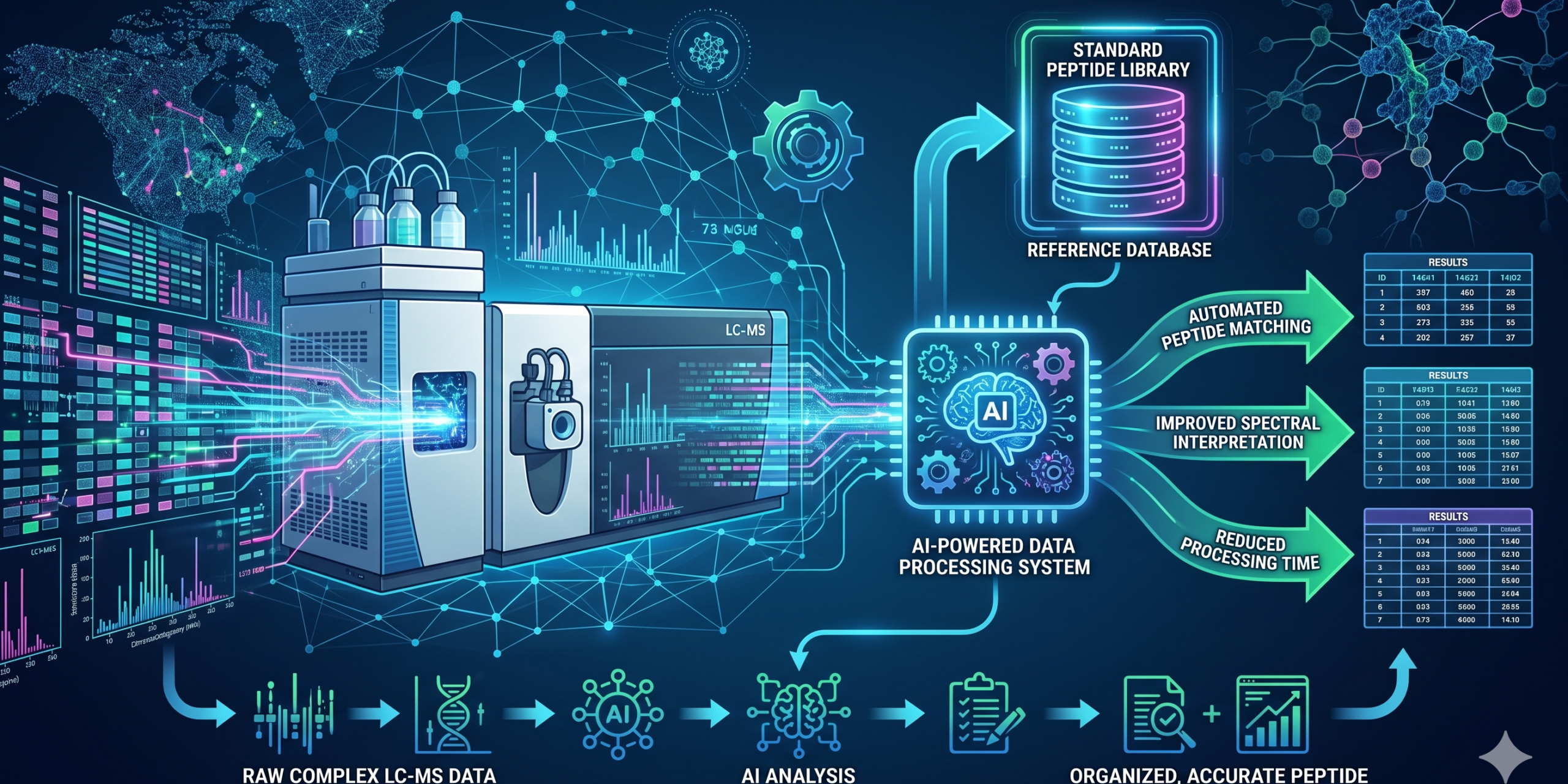
Standard peptide libraries play an important role in automating data analysis workflows. Advanced software platforms use these libraries to streamline peptide matching, improve spectral interpretation, and reduce manual processing time.
As artificial intelligence and machine learning technologies continue to evolve, peptide libraries are becoming even more valuable for enhancing computational proteomics applications.
Factors to Consider When Choosing a Peptide Library
Selecting the right peptide library depends on research goals and analytical requirements. Scientists should evaluate several factors before implementation, including:
- Peptide coverage
- Validation quality
- Instrument compatibility
- Data format support
- Application-specific design
- Quantitative standards availability
Well-designed libraries improve analytical efficiency and reduce the likelihood of inaccurate results.
The Future of Standard Peptide Libraries
The demand for high-quality analytical standards is expected to increase as proteomics and precision medicine continue advancing. Researchers are developing larger and more comprehensive peptide libraries to support emerging technologies and complex biological studies.
Future developments may include:
- AI-driven spectral prediction
- Expanded clinical peptide databases
- Improved automation integration
- Enhanced quantitative standards
- Cloud-based proteomics data sharing
These innovations will continue improving LC-MS accuracy, scalability, and reproducibility across scientific disciplines.
Conclusion
Standard peptide libraries have become essential tools in modern LC-MS studies. From improving peptide identification and quantitative accuracy to supporting reproducibility and biomarker discovery, these libraries provide the analytical foundation needed for reliable scientific research.
As proteomics and pharmaceutical applications continue evolving, the role of standardized peptide references will only grow in importance. Laboratories investing in high-quality peptide libraries can improve data confidence, streamline workflows, and support more meaningful scientific discoveries.
FAQs
What is a standard peptide library?
A standard peptide library is a collection of validated peptides used as reference standards during LC-MS analysis for accurate identification and quantification.
Why are peptide libraries important in LC-MS studies?
They improve analytical accuracy, support reproducibility, and help researchers identify peptides more confidently in complex biological samples.
How do peptide libraries support quantitative proteomics?
Peptide libraries provide known reference signals and concentrations that help normalize data and improve protein quantification accuracy.
Can peptide libraries improve biomarker discovery?
Yes, standardized peptide references help researchers validate potential biomarkers more reliably by reducing experimental variability.
Are peptide libraries used in pharmaceutical research?
Yes, pharmaceutical researchers use peptide libraries for drug development, quality control, protein analysis, and analytical validation workflows.