

Accurate metabolomics relies on precision. Whether researchers are studying disease pathways, nutritional metabolism, biomarker development, or therapeutic responses, the ability to measure amino acids with consistency is essential. Even the smallest variations introduced during sample preparation, instrument drift, or data processing can significantly impact the accuracy of quantitative results. That is why high-quality, rigorously validated internal standards have become a cornerstone of modern analytical workflows.
At IROA Technologies, we understand that every metabolomics experiment requires more than just good instrumentation—it demands reliable tools that enhance reproducibility and remove analytical bias. Our advanced amino acid internal standard sets are specifically designed to empower researchers with the highest level of accuracy, enabling them to transform raw metabolomic data into meaningful biological insights.
This comprehensive blog explores the importance of internal standards, the unique advantages of our solutions, how these standards improve metabolomic workflows, and why IROA Technologies remains a trusted partner for quantitative research.
What Are Amino Acid Internal Standard Sets?
In mass spectrometry and metabolomics, internal standards are chemically identical—or structurally similar—compounds that are added to samples, calibration curves, and quality-control materials in known quantities. Their role is to act as “anchors” during analysis, allowing researchers to compensate for variabilities that occur at multiple stages, including:
- Sample preparation inconsistencies
- Matrix effects
- Ionization efficiency fluctuations
- Instrument drift or sensitivity changes
- Differences in extraction efficiency
Amino acid internal standard sets specifically provide stable isotope-labeled versions of biological amino acids. Because they mimic the behavior of native analytes, they allow scientists to quantify each amino acid with high accuracy and confidence, even when working with complex biological samples such as plasma, urine, tissue extracts, or cell cultures.
Why Internal Standards Are Critical in Metabolomic Analysis
For many laboratories, metabolomics presents a unique challenge: small changes in sample handling or instrument performance can produce significant deviations. This leads to data uncertainty, poor reproducibility, and results that are difficult to validate or compare across studies.
Using advanced amino acid internal standard sets helps address several core challenges:
1. Improved Quantitation
Stable isotope-labeled standards provide a reference point that accounts for signal variability. This enhances both relative and absolute quantification, allowing researchers to more confidently measure subtle metabolite shifts.
2. Enhanced Reproducibility
Reproducibility remains one of the largest hurdles in metabolomics. Internal standards reduce the impact of experimental noise, making results more consistent between runs, instruments, and laboratories.
3. Correcting Matrix Effects
Biological samples often contain other molecules that can suppress or enhance ionization. Internal standards correct for these effects, ensuring quantitative results are not influenced by the sample matrix.
4. Compensating for Technical Variability
From pipetting to chromatography, every step introduces small differences. Internal standards normalize these variations, preserving data integrity.
5. Higher Confidence in Biomarker Discovery
Reliable quantitation is essential for biomarker research. Internal standards reduce false positives and false negatives, making discoveries more trustworthy.
For these reasons, laboratories conducting amino acid profiling in clinical research, sports science, nutrition, toxicology, or pharmaceutical development rely heavily on high-quality internal standards.
Why Choose IROA Technologies for Amino Acid Internal Standard Sets?
IROA Technologies is recognized for setting the gold standard in metabolomics tools and analytics. Our mission has always been to empower scientists with solutions that deliver cleaner, more accurate, and more reproducible data.
Here’s what sets our amino acid internal standard sets apart:
1. Precision-Engineered Isotopic Labeling
Our isotopic standard sets are built using highly controlled manufacturing processes that ensure exceptional purity and labeling efficiency. This level of precision enables accurate peak differentiation and eliminates ambiguity during data processing.
2. Consistent and Uniform Performance
Consistency is critical in analytical workflows. Each of our internal standard sets is rigorously validated to ensure uniform performance across different batches. This allows long-term reproducibility and reliable comparisons over time.
3. Designed for LC-MS and GC-MS Compatibility
Whether your laboratory uses liquid chromatography-mass spectrometry (LC-MS) or gas chromatography-mass spectrometry (GC-MS), our standards integrate seamlessly into your workflow. This flexibility allows researchers to adapt our standards to multiple platforms and applications.
4. Superior Quantitative Accuracy
Our standards are formulated to provide near-perfect co-elution with native amino acids. This ensures that any variations affecting the native analytes also affect the isotopic standards proportionally, resulting in more accurate quantitation.
5. Ready-to-Use Convenience
Time-consuming preparation steps can slow down research and increase the risk of error. IROA Technologies offers ready-to-use internal standard sets that simplify workflow integration and reduce preparation variability.
6. Expert Support for Metabolomics Workflows
We do more than supply reagents—our team offers guidance on experimental design, workflow optimization, and data interpretation. Whether you are new to metabolomics or scaling up your research, you receive personalized support tailored to your analytical needs.
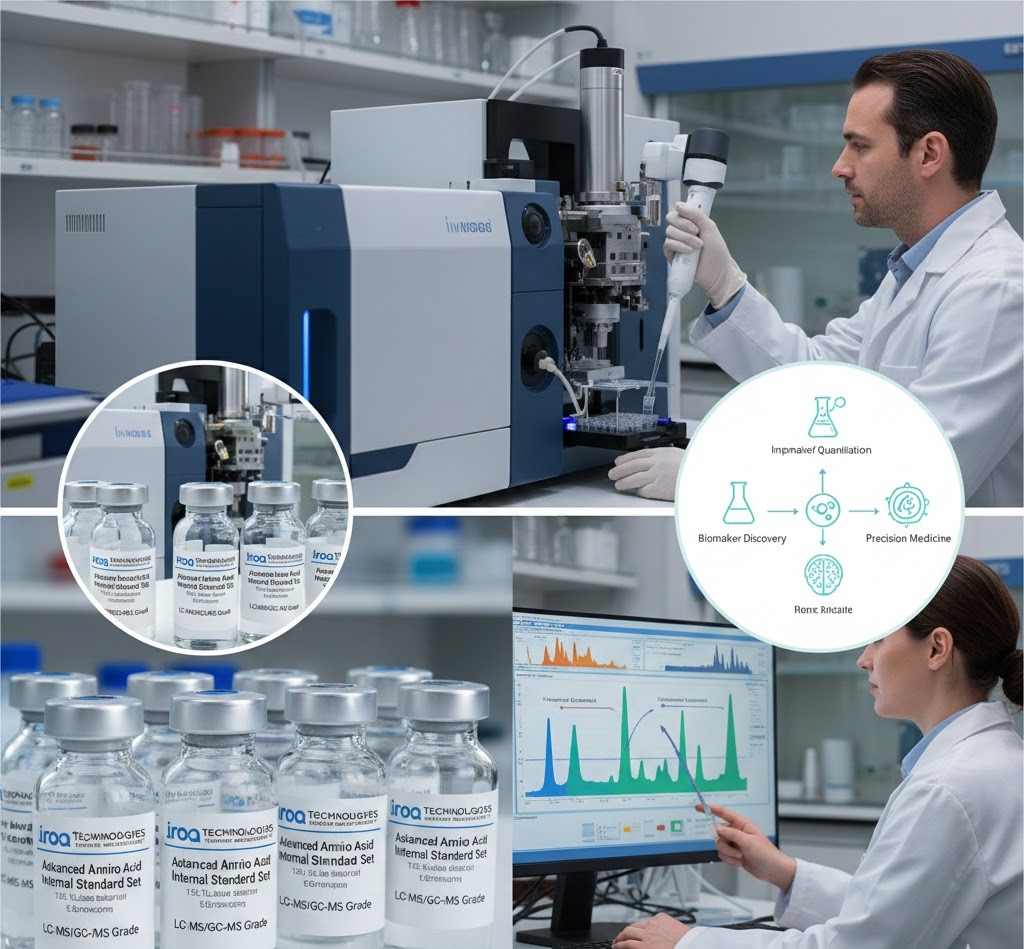
How Amino Acid Internal Standard Sets Improve Workflow Efficiency
1. Simplified Data Interpretation
By reducing noise and correcting inconsistencies, internal standards allow researchers to interpret metabolic changes with greater clarity. This is especially useful in studies involving complex diseases such as cancer, diabetes, or neurodegenerative disorders.
2. Streamlined Method Development
Scientists often spend considerable time optimizing chromatographic conditions and calibration curves. Using amino acid internal standard sets reduces this burden, enabling faster method development and shorter lead times for data acquisition.
3. Better Validation of Analytical Methods
Regulated industries—such as pharmaceuticals or clinical diagnostics—require strict method validation. Internal standards help meet these regulatory requirements by providing traceability and quantitative accuracy.
4. Enhanced Quality Control
Internal standards act as built-in quality control checkpoints. Unexpected deviations in standard behavior can alert researchers to instrument issues or sample degradation before they affect results.
5. Increased Throughput
When variations are controlled, laboratories can run more samples without sacrificing data quality. This is vital for high-throughput metabolomics facilities and projects involving large cohorts.
Applications of Amino Acid Internal Standard Sets
Amino acid profiling plays a major role in numerous fields, and high-quality internal standards enhance results across the board. Applications include:
- Clinical metabolomics
- Nutritional and dietary studies
- Pharmaceutical development
- Toxicological assessments
- Microbial and plant metabolomics
- Biomarker discovery
- Precision medicine research
- Sports science and performance monitoring
- Metabolic pathway analysis
IROA Technologies’ internal standard sets are designed to meet the needs of all these applications, ensuring accuracy regardless of sample type or analytical platform.
How IROA Technologies Supports Scientific Advancement
Our work extends far beyond manufacturing internal standards. We are committed to advancing the entire field of metabolomics.
Research Collaboration
We collaborate with research institutions, laboratories, and industry partners to support groundbreaking studies in disease biology, nutritional science, and biochemical pathway analysis.
Training and Education
IROA Technologies provides educational resources, webinars, and training to ensure scientists can utilize metabolomics tools with confidence.
Long-Term Innovation
Our team continually develops new standards, kits, and analytical solutions to meet the evolving demands of metabolomics research.
To learn more about amino acids, visit this external resource:
Conclusion
Amino acids play a vital role in nearly every biological process, making them essential targets in metabolomics research. However, accurate quantitation requires tools that overcome technical variability and deliver consistent results.
IROA Technologies amino acid internal standard sets are engineered with precision, validated for performance, and trusted by scientists around the world. Whether your goal is biomarker discovery, clinical research, or fundamental biochemical analysis, our solutions provide the accuracy and reproducibility your work demands.
By integrating these standards into your workflow, you not only improve quantitative performance but also elevate the overall quality, reliability, and confidence of your metabolomics research.
Frequently Asked Questions (FAQs)
1. What are amino acid internal standard sets used for?
They are used to improve the accuracy and reproducibility of amino acid quantitation in metabolomics and mass spectrometry. They help correct for sample variability, matrix effects, and instrument fluctuations.
2. Why should I choose IROA Technologies for internal standards?
IROA Technologies provides highly pure, isotopically labeled standards that offer exceptional accuracy, batch-to-batch consistency, and seamless integration into LC-MS or GC-MS workflows.
3. Can these standards be used in clinical research?
Yes. Our amino acid internal standard sets are suitable for clinical metabolomics, biomarker discovery, nutritional studies, pharmaceutical research, and more.
4. Are the standards compatible with different mass spectrometry platforms?
Absolutely. They are compatible with major LC-MS and GC-MS systems used in metabolomics laboratories worldwide.
5. Do you provide technical support for using the standards?
Yes. Our experts offer support in method development, workflow optimization, and data interpretation to help you get the most from your metabolomics studies.