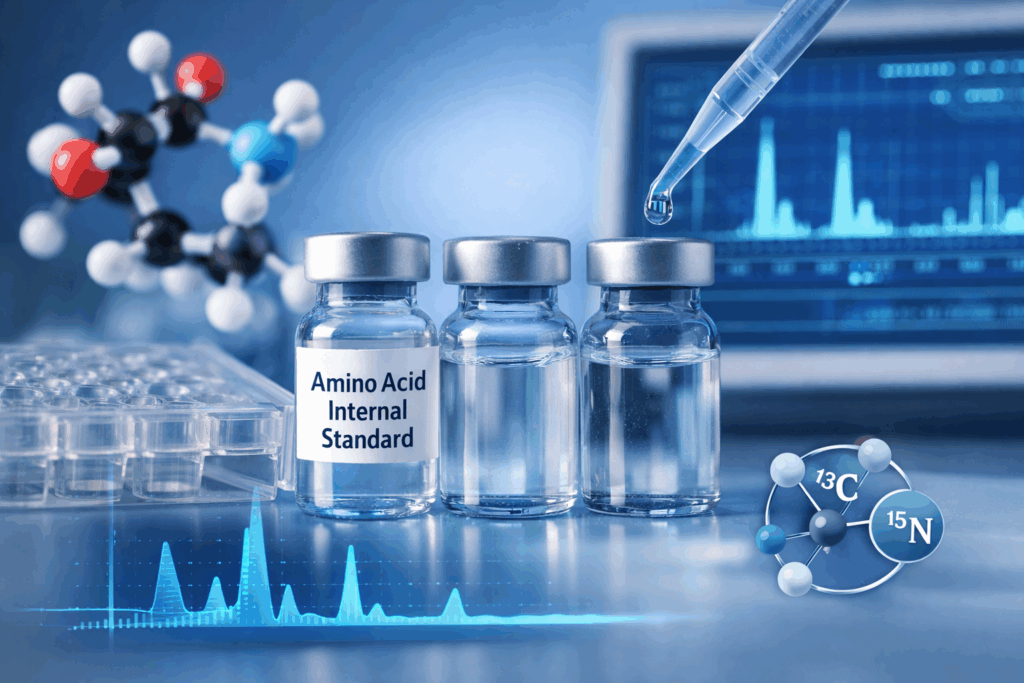

Amino Acid Internal Standard

Browse all articles filed under the "Amino Acid Internal Standard" tag.

The Growing Role of Search Clustering in Research and Analytics

Showing 1–4 of 4 articles

The Growing Role of Search Clustering in Research and Analytics

Choosing the Right Amino Acid Internal Standard Sets for Reliable Data Analysis

In modern metabolomics and analytical chemistry, accuracy and reproducibility are critical for generating meaningful research outcomes. Whether scientists are working in biomarker discovery, clinical diagnostics, pharmaceutical development, or food testing, even small variations in sample preparation or instrument performance can affect data quality. This is where Amino Acid Internal Standard Sets play a vital role. Internal standards help researchers achieve consistent quantification, improve calibration accuracy, and minimize analytical errors in LC-MS and GC-MS workflows. Selecting the right standard set is not simply about adding reference compounds to a sample—it is about ensuring reliability throughout the entire analytical process. What Are Amino Acid Internal Standard Sets? Amino acid internal standards are carefully selected reference compounds added to samples before analysis. These standards are often isotopically labeled amino acids that behave similarly to target analytes during extraction, separation, and detection. Because they closely mimic the chemical behavior of naturally occurring amino acids, they help correct for variability caused by: Sample preparation losses Instrument drift Matrix effects Variations in ionization efficiency Injection inconsistencies By compensating for these variables, internal standards improve the precision and reliability of quantitative analysis. Why Internal Standards Matter in Data Analysis Accurate metabolite quantification is essential in metabolomics research. Without reliable normalization methods, results may become inconsistent or difficult to reproduce across experiments. Internal standard sets provide several important benefits: Improved Quantitative Accuracy Internal standards enable researchers to compare analyte responses against known reference compounds. This improves the accuracy of concentration measurements, especially when analyzing complex biological samples. Better...

Modern laboratory setup showing mass spectrometry equipment and amino acid molecular structures used in quantitative analysis.

How Amino Acid Internal Standards Are Used in Quantitative Testing

In modern analytical laboratories, accuracy is everything. Whether scientists are measuring nutrients in food, monitoring metabolites in clinical samples, or validating pharmaceutical formulations, they rely on precise quantitative testing to make confident decisions. Even a small error in measurement can lead to misleading conclusions, regulatory issues, or costly rework. One of the most trusted ways to ensure reliable results in analytical chemistry is the use of internal standards—particularly amino acid–based standards. At IROA Technologies, advanced stable isotope standards and workflows help laboratories improve consistency, traceability, and data confidence across a wide range of applications. In this article, we’ll explore what internal standards are, why amino acids are so valuable in quantitative testing, how they are applied in real-world workflows, and what benefits they bring to modern laboratories. Understanding Internal Standards in Simple Terms An internal standard is a known compound added to every sample, calibration standard, and quality control material before analysis. Because it behaves similarly to the target analyte during preparation and measurement, it acts as a reference point. Think of it like a ruler placed next to every object you measure. If lighting conditions change or your camera zoom shifts slightly, the ruler remains constant and allows you to correct for distortions. In analytical testing, internal standards help compensate for: Sample preparation losses Variations in injection volume Instrument drift or sensitivity changes Matrix effects that suppress or enhance signals By comparing the response of the analyte to the response of the internal standard, analysts can calculate accurate concentrations...

amino-acid-internal-standard

Amino Acid Internal Standard Sets Improving Quantitation Across Complex Workflows

In the fast-moving world of metabolomics, researchers face constant pressure to deliver precise, reproducible, and biologically meaningful data. As analytical instruments become more sensitive and sample matrices grow more complex, the ability to control variability and improve quantitation has never been more important. Among the many tools available to scientists, Amino Acid Internal Standard Sets stand out as one of the most reliable strategies for achieving higher accuracy in LC-MS metabolomics workflows. At IROA Technologies, we've spent years developing high-quality standards and isotope-based tools designed to overcome the persistent challenges of metabolite measurement. Our focus on eliminating quantitation errors, reducing suppression effects, and enhancing reproducibility has helped researchers around the world obtain clearer and more consistent metabolic data—especially when working with amino acid pathways. This blog explores how Amino Acid Internal Standard Sets improve quantitation across complex workflows, why they matter, and how they can elevate your metabolomics results from acceptable to truly publication-ready. Why Quantitation Is Challenging in Amino Acid Metabolomics Amino acids are foundational to biological systems. They play roles in protein synthesis, cellular signaling, metabolic regulation, and disease pathways. However, their small size, diverse chemical structures, and high polarity make them challenging to measure accurately. Key Challenges Include 1. Ion Suppression and Matrix Effects Biological samples such as serum, plasma, urine, and tissue extracts contain thousands of compounds. Many co-elute during chromatography, affecting ionization efficiency. Even slight matrix variations can significantly alter amino acid signal intensity. 2. Chromatographic Variability Retention time drift and column aging can lead...

Advanced Amino Acid Internal Standard Sets from iroa Technologies

Accurate metabolomics relies on precision. Whether researchers are studying disease pathways, nutritional metabolism, biomarker development, or therapeutic responses, the ability to measure amino acids with consistency is essential. Even the smallest variations introduced during sample preparation, instrument drift, or data processing can significantly impact the accuracy of quantitative results. That is why high-quality, rigorously validated internal standards have become a cornerstone of modern analytical workflows. At IROA Technologies, we understand that every metabolomics experiment requires more than just good instrumentation—it demands reliable tools that enhance reproducibility and remove analytical bias. Our advanced amino acid internal standard sets are specifically designed to empower researchers with the highest level of accuracy, enabling them to transform raw metabolomic data into meaningful biological insights. This comprehensive blog explores the importance of internal standards, the unique advantages of our solutions, how these standards improve metabolomic workflows, and why IROA Technologies remains a trusted partner for quantitative research. What Are Amino Acid Internal Standard Sets? In mass spectrometry and metabolomics, internal standards are chemically identical—or structurally similar—compounds that are added to samples, calibration curves, and quality-control materials in known quantities. Their role is to act as "anchors" during analysis, allowing researchers to compensate for variabilities that occur at multiple stages, including: Sample preparation inconsistencies Matrix effects Ionization efficiency fluctuations Instrument drift or sensitivity changes Differences in extraction efficiency Amino acid internal standard sets specifically provide stable isotope-labeled versions of biological amino acids. Because they mimic the behavior of native analytes, they allow scientists to quantify each...