
Understanding biology at a deeper level requires more than just identifying genes or proteins. Small molecules known as metabolites provide the closest snapshot of what is actually happening inside a biological system at any given moment. This is where metabolomics data analysis plays a critical role. By turning complex chemical data into meaningful biological insights, researchers can better understand disease mechanisms, cellular responses, and metabolic pathways.
At IROA Technologies, metabolomics data analysis is approached with a strong focus on accuracy, reproducibility, and scientific confidence. This blog explores what metabolomics data analysis involves, why it matters, and how advanced tools and standardized workflows help researchers achieve reliable results.
What Is Metabolomics Data Analysis?
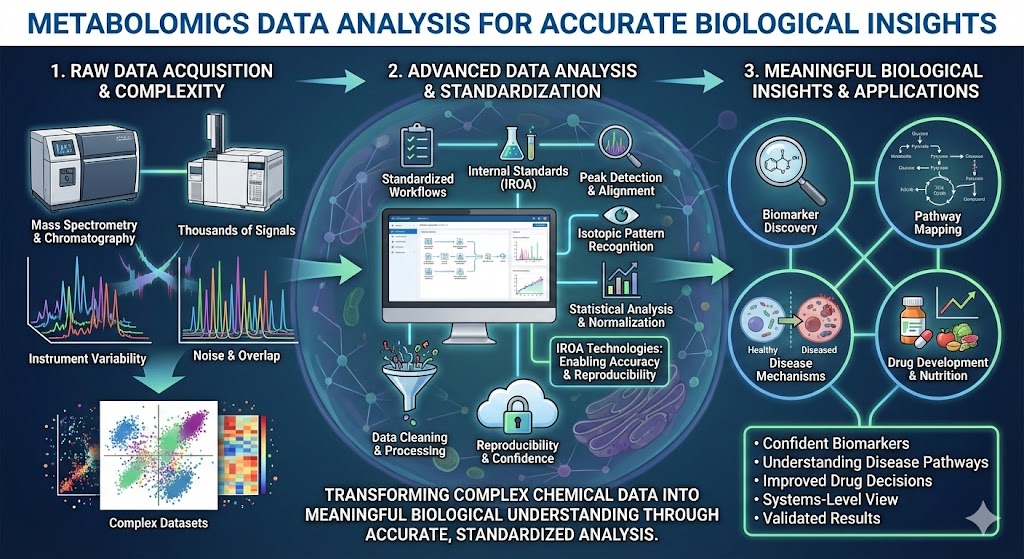
Metabolomics data analysis is the process of interpreting data generated from analytical platforms such as mass spectrometry and chromatography to identify, quantify, and compare metabolites in biological samples. These metabolites may include amino acids, lipids, sugars, bile acids, and many other small molecules involved in metabolism.
Unlike genomics or proteomics, metabolomics reflects real-time biological activity. Because metabolites change rapidly in response to disease, environment, diet, or treatment, analyzing them accurately provides direct insight into biological function and dysfunction.
However, metabolomics generates highly complex datasets. A single experiment may detect thousands of signals, many of which overlap or vary in intensity due to technical and biological factors. Effective metabolomics data analysis is essential to distinguish true biological changes from noise.
Why Accurate Metabolomics Data Analysis Matters
Accurate data analysis is the foundation of meaningful metabolomics research. Poor data handling can lead to incorrect metabolite identification, inconsistent results, or misleading conclusions.
Reliable metabolomics data analysis supports:
-
Confident biomarker discovery
-
Better understanding of disease mechanisms
-
Improved drug development decisions
-
Stronger validation of experimental results
-
Reproducibility across studies and laboratories
Without proper analytical standards and data processing strategies, even high-quality experimental data can lose its value.
Key Challenges in Metabolomics Data Analysis
Data Complexity
Biological samples contain a wide range of metabolites present at vastly different concentrations. This complexity makes it difficult to separate meaningful signals from background noise.
Instrument Variability
Instrument drift, matrix effects, and ion suppression can alter signal intensity over time. These technical variations complicate comparisons between samples and batches.
Metabolite Identification
Many metabolites have similar masses or fragmentation patterns. Accurate identification requires high-quality reference data and advanced analysis methods.
Reproducibility
Without standardized workflows, results may vary significantly between experiments, laboratories, or platforms.
Addressing these challenges is critical for producing reliable biological insights.
The Role of Standardization in Metabolomics Data Analysis
Standardization is one of the most effective ways to improve confidence in metabolomics results. By using internal standards, controlled workflows, and consistent data processing methods, researchers can reduce variability and improve data quality.
IROA Technologies has been a pioneer in developing solutions that support standardized metabolomics data analysis. These approaches help researchers distinguish real biological changes from technical variation, leading to more trustworthy conclusions.
Analytical Platforms Used in Metabolomics
Mass Spectrometry
Mass spectrometry is the most widely used technology in metabolomics. It provides high sensitivity and broad metabolite coverage. Accurate data analysis is essential to interpret mass spectra, detect isotopic patterns, and assign compound identities.
Chromatography
Chromatographic separation, such as liquid chromatography or gas chromatography, helps reduce sample complexity before detection. Proper alignment and peak integration during metabolomics data analysis ensure consistent results across samples.
How Metabolomics Data Analysis Delivers Biological Insights
Pathway Analysis
Once metabolites are identified and quantified, data can be mapped to metabolic pathways. This reveals how biological systems respond to disease, treatment, or environmental changes.
Comparative Studies
Metabolomics data analysis allows researchers to compare control and experimental groups, identifying metabolites that significantly differ between conditions.
Systems-Level Understanding
Because metabolites reflect the combined output of genes, proteins, and environmental influences, metabolomics provides a holistic view of biological function.
Improving Confidence Through Advanced Data Analysis Tools
Modern metabolomics relies heavily on software tools that support data processing, visualization, and interpretation. These tools assist with:
-
Peak detection and alignment
-
Isotopic pattern recognition
-
Compound identification
-
Statistical analysis
-
Data normalization
When combined with standardized workflows, advanced tools improve accuracy and reproducibility across studies.
Applications of Metabolomics Data Analysis
Biomedical Research
Metabolomics data analysis is widely used to study disease mechanisms, identify biomarkers, and understand metabolic dysregulation in conditions such as cancer, diabetes, and neurological disorders.
Drug Discovery
Pharmaceutical research uses metabolomics to assess drug efficacy, toxicity, and metabolic impact during development.
Nutrition and Metabolism
Researchers study how diet, supplements, and lifestyle affect metabolism by analyzing changes in metabolite profiles.
Environmental and Toxicology Studies
Metabolomics helps evaluate how environmental exposures influence biological systems and metabolic health.
Data Quality and Biological Interpretation
High-quality data alone is not enough. Metabolomics data analysis must also focus on biological interpretation. This involves connecting statistical results with biological knowledge, pathways, and experimental context.
Careful interpretation ensures that findings are biologically meaningful rather than statistically misleading.
The Importance of External Validation
To learn more about data clustering concepts, you may explore:
https://en.wikipedia.org/wiki/Metabolomics
(This is an official and reliable resource.)
Best Practices for Reliable Metabolomics Data Analysis
-
Use standardized workflows and internal controls
-
Apply consistent data processing methods
-
Validate metabolite identities with reference data
-
Perform appropriate statistical analysis
-
Interpret results in biological context
-
Ensure reproducibility through documentation and transparency
Following these practices strengthens confidence in metabolomics research outcomes.
How IROA Technologies Supports Metabolomics Data Analysis
IROA Technologies focuses on enabling accurate, reproducible metabolomics data analysis through innovative solutions and standardized approaches. By addressing variability and identification challenges, these tools help researchers achieve clearer biological insights and more confident conclusions.
Their approach supports consistent data interpretation across studies, laboratories, and analytical platforms, which is essential for advancing metabolomics research.
Conclusion
Metabolomics data analysis is a powerful tool for uncovering accurate biological insights, but its value depends on data quality, standardization, and careful interpretation. As metabolomics continues to grow in importance across biomedical research, drug development, and systems biology, reliable data analysis will remain essential.
With advanced workflows, analytical tools, and a focus on reproducibility, metabolomics data analysis enables researchers to move beyond raw data and toward meaningful scientific understanding. IROA Technologies continues to play a key role in supporting this progress by helping scientists generate confident, reproducible, and biologically relevant results.
Frequently Asked Questions (FAQs)
What is metabolomics data analysis?
Metabolomics data analysis is the process of identifying, quantifying, and interpreting metabolites from biological samples to understand metabolic activity and biological function.
Why is metabolomics important in biological research?
Metabolomics reflects real-time cellular activity, providing insights into disease mechanisms, treatment responses, and metabolic pathways that other approaches may miss.
What makes metabolomics data challenging to analyze?
Challenges include data complexity, instrument variability, metabolite identification, and the need for reproducible workflows.
How does standardization improve metabolomics results?
Standardization reduces technical variation, improves data consistency, and increases confidence in biological interpretation.
Which technologies are commonly used in metabolomics?
Mass spectrometry and chromatography are the primary technologies used to generate metabolomics data.
How does metabolomics data analysis support drug discovery?
It helps evaluate drug effects, identify metabolic changes, and assess safety and efficacy during development.