

Metabolomics Normalization

Browse all articles filed under the "Metabolomics Normalization" tag.

Showing 1–5 of 5 articles

Why Compound Identification Matters in Metabolomics Research

Metabolomics has emerged as one of the most powerful fields in modern life sciences, enabling researchers to study the small molecules, or metabolites, that drive biological processes.

By analyzing these metabolites, scientists can gain valuable insights into health, disease progression, drug responses, and environmental influences. However, the value of metabolomics data depends heavily on one critical step: Compound Identification Without accurately identifying the compounds present in a biological sample, researchers cannot confidently interpret their findings or translate data into meaningful discoveries.

Whether the goal is biomarker discovery, precision medicine, agricultural research, or pharmaceutical development, reliable identification of metabolites forms the foundation of successful metabolomics studies.

Understanding Compound Identification in Metabolomics In metabolomics, thousands of metabolites can be detected within a single sample using advanced analytical techniques such as mass spectrometry...

Understanding Reproducible Science in Metabolomics

The Connection Between Metabolomics Standards and Reproducible Science

Scientific research depends heavily on accuracy, consistency, and reliability. In the rapidly evolving field of metabolomics, researchers analyze small molecules and metabolites to better understand biological systems, diseases, and treatment responses.

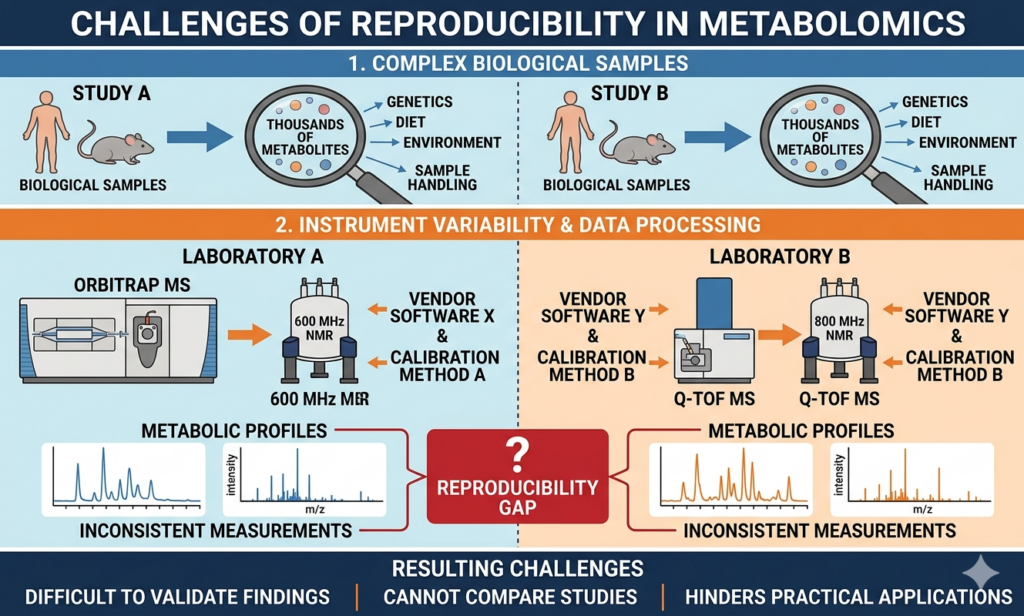
However, achieving reliable outcomes across different laboratories and studies remains a major challenge. This is where Metabolomics Standards play a critical role in supporting reproducible science.

  Understanding Reproducible Science in Metabolomics Reproducible science means that independent researchers should be able to perform the same experiment under similar conditions and obtain comparable results.

In metabolomics research, reproducibility is essential because scientists often deal with highly complex biological data generated through advanced analytical instruments such as mass spectrometry and nuclear magnetic resonance (NMR).

Without consistency in sample preparation, instrument calibration, data acquisition, and analysis methods, results can vary significantly between...

Why Metabolite Analyzers Are Essential for Scientific Research

Why Metabolite Analyzers Are Essential for Scientific Research

Scientific research has evolved significantly over the last decade, especially in areas such as metabolomics, biotechnology, pharmaceuticals, and clinical diagnostics.

Researchers today require advanced analytical tools that can provide accurate, reproducible, and high-throughput data. One of the most important technologies supporting this progress is Metabolite Analyzers.

These sophisticated analytical systems help scientists study metabolites, which are small molecules involved in biological processes. From disease detection to drug development, metabolite analysis has become a crucial part of modern research workflows.

As laboratories continue to generate complex biological data, the demand for reliable metabolite analysis tools continues to grow. Understanding Metabolites in Scientific Research Metabolites are chemical compounds produced during metabolic processes within cells, tissues, and organisms.

These compounds provide valuable insights into cellular activity, disease progression, environmental responses, and physiological conditions....

What-are-metabolomics-standards

Why Metabolomics Standards Matter for Reproducible Science

Metabolomics is transforming our understanding of biology by profiling small molecules that reflect physiological and pathological states. As the field matures, consistent and transparent practices become essential to turning complex data into reliable scientific knowledge.

Metabolomics standards are central to this effort: they ensure data quality, make experiments comparable across labs, and accelerate discovery by enabling data reuse.

In this post, we explain why these standards matter, what they cover, and how organizations like IROA Technologies contribute to building a more reproducible metabolomics ecosystem.

What Are Metabolomics Standards? Metabolomics standards are agreed-upon guidelines, formats, and best practices for designing experiments, collecting and processing data, and reporting results.

They include: Standardized sample collection and storage protocols. Instrument calibration and quality-control procedures. Data formats and metadata requirements to describe experimental context.

Statistical...

Cannabis Research Laboratory with Cannabinoids Standards

The Role of Cannabinoids Standards in Advancing Cannabis Research

The growing field of cannabis research is unlocking an entirely new world of medical, agricultural, and biochemical potential. From therapeutic applications to product formulation and quality control, cannabinoids standards play a vital role in ensuring accuracy, reproducibility, and global consistency in research data.

Without standardized reference materials, the identification and quantification of cannabinoids would vary between laboratories, leading to unreliable results and misinterpretation of findings.

This blog explores the importance of cannabinoids standards, their scientific applications, and how they are driving innovation in cannabis research and analytical testing.

Understanding Cannabinoids and Their Diversity Cannabinoids are naturally occurring compounds found in the Cannabis sativa plant. They interact with the body’s endocannabinoid system (ECS), influencing processes like mood, pain, appetite, and memory.

The most well-known cannabinoids include tetrahydrocannabinol (THC) and cannabidiol (CBD),...