
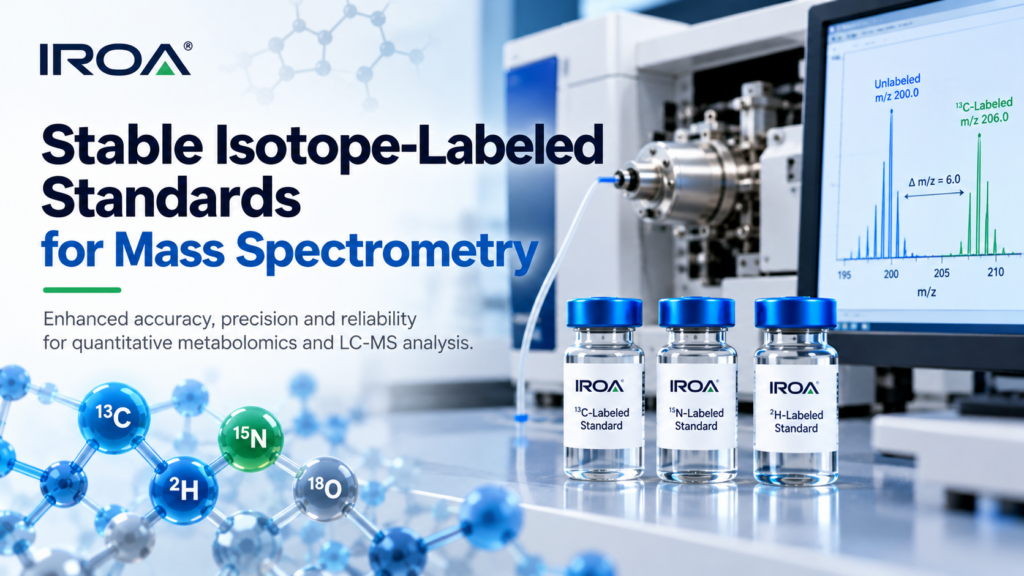
Internal Standards In Mass Spectrometry play an important role in producing LC-MS data that can be interpreted with greater confidence. This article explains the concept in practical terms and connects it with the broader requirements of metabolomics, quantitative analysis, and reproducibility.
What Is an Internal Standard?
An internal standard is a reference compound or reference mixture introduced into an analytical sample so its response can be evaluated alongside the compounds being measured. Because the standard experiences much of the same preparation and instrumental environment as the sample, it can reveal variability that an external measurement may miss.
Common Internal Standard Approaches
Internal-standard strategies range from structurally related surrogate compounds to stable isotope-labeled versions of analytes. For highly targeted assays, one labeled compound per analyte may be appropriate. For metabolomics, where hundreds of features may be measured, broader labeled mixtures can provide a scalable reference across many metabolites.
Why Stable Isotopes Are Valuable
Stable isotope labeling changes mass without requiring a major change in chemical behavior. A U-13C-labeled metabolite can therefore be separated from its natural-abundance counterpart by mass spectrometry while often showing closely related chromatographic and ionization behavior. This makes isotope-labeled standards useful for assessing matrix effects, ion suppression, and analytical response.
Uses Across the LC-MS Workflow
Internal standards can be introduced early enough to help monitor variability associated with extraction and sample handling. During LC-MS analysis they can provide reference signals for ionization behavior, retention, quantitation, and normalization. In IROA workflows, recognizable isotope patterns also support metabolite identification and the separation of meaningful features from artifacts.
Benefits for Quantitative Metabolomics
The main benefit is not simply a stronger signal; it is a more trustworthy comparison. Internal standards help researchers recognize whether changes arise from biology or from analytical conditions. This becomes particularly important in multi-batch studies, long sequences, cross-laboratory work, and experiments where small differences may influence interpretation.
IROA Internal Standards
IROA uses U-13C-labeled yeast extract as a complex internal standard for metabolomics. The approach provides broad metabolite coverage and is designed to support suppression correction, normalization, compound identification, and reproducible quantitative analysis across LC-MS workflows.
Practical Considerations
Researchers should consider when the standard is added, whether it adequately represents the chemistry of the sample, how consistently it is prepared, and whether its concentration is suitable for the instrument and study. Internal standards are most useful when their role is defined before data collection rather than added as an afterthought.
Related IROA Resources
Continue exploring: internal standards for metabolomics • IROA Internal Standard Kit • stable isotope-labeled internal standards
Suggested CTA
Need a standards strategy for your metabolomics workflow? Explore IROA standards and quantitative metabolomics solutions or speak with the IROA team about the appropriate workflow for your application.