
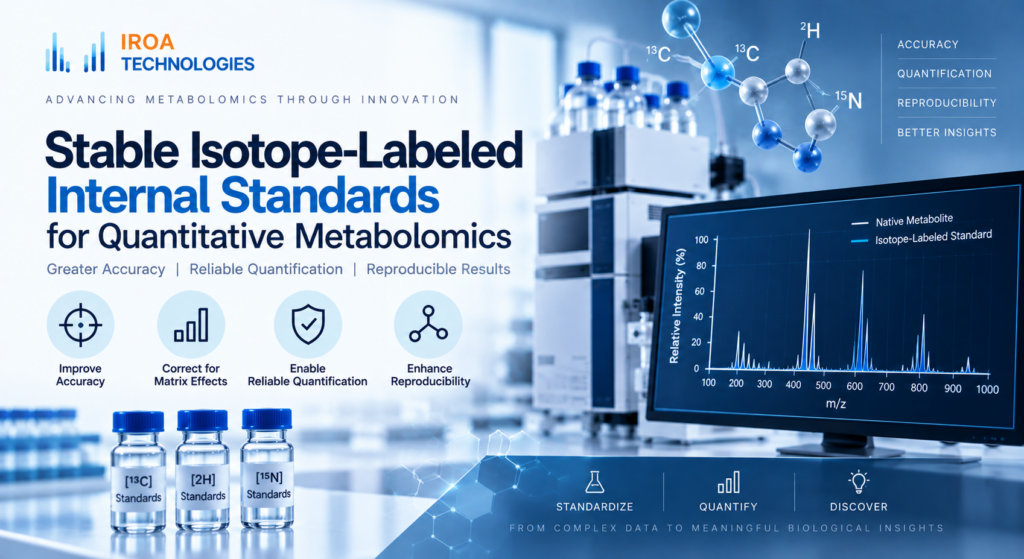
Stable isotope-labeled internal standards are among the most powerful tools for improving quantitative confidence in LC-MS metabolomics. By replacing selected atoms with stable isotopes such as 13C, a standard remains chemically similar to its natural-abundance counterpart while becoming distinguishable by mass spectrometry.
This creates a reference that can travel through the same sample preparation, chromatography, and ionization process as the analyte. IROA applies this principle using U-13C-labelled yeast extract in its internal standards for metabolomics and the TruQuant Workflow Kit.
What Makes An Isotope-Labelled Internal Standard Useful?
A useful internal standard should behave similarly to the analyte during extraction and analysis, should be clearly distinguishable in the mass spectrum, and should remain stable across the experiment. Stable isotope labeling achieves this without introducing the chemical behavior changes that may occur with structurally unrelated surrogate standards.
Because the labelled and natural-abundance forms have nearly identical chromatographic behavior, they experience similar local matrix effects and ionization conditions.
Broad Coverage Versus Single-Compound Standards
Traditional targeted assays often use one labelled standard per analyte. That approach can provide excellent specificity but becomes difficult to scale when hundreds of metabolites are measured.
IROA uses labelled yeast extract to provide a complex mixture of endogenous metabolites. The IROA Internal Standard Kit includes a U-13C-labelled yeast extract designed to provide broad coverage across metabolomics experiments.
Supporting Metabolite Identification
Stable isotope patterns provide more than a quantitative reference. In the IROA system, characteristic isotope envelopes can help distinguish real metabolic features from artifacts, fragments, and noise. The isotope pattern also contributes information about carbon composition.
ClusterFinder is designed to recognize these patterns and use them in metabolite identification and data processing.
Supporting Ion Suppression Correction
When an analyte and its labelled internal-standard counterpart co-elute, both are exposed to the same local ionization environment. If the labelled signal is reduced, that provides evidence that suppression is affecting the measurement region.
This relationship supports ion suppression correction before final quantitative interpretation. The result is more informative than relying on raw peak area alone.
Supporting Normalization And Batch Comparability
An internal standard also provides a controlled signal that can be compared across samples. If the internal-standard response changes while its true amount remains constant, the shift can be attributed to analytical variation rather than biology.
IROA uses this information in Dual MSTUS normalization to improve sample-to-sample and batch-to-batch comparability.
When Should Internal Standards Be Introduced?
To capture as much analytical variation as possible, internal standards should generally be introduced early enough to experience relevant sample-processing and analytical steps. The exact protocol depends on study design, matrix, and analytical objective.
Researchers can consult IROA’s application notes and whitepapers for workflow examples across different instrumentation and metabolomics applications.
Conclusion
Stable isotope-labelled internal standards are valuable because they connect chemistry, identification, and quantitative correction within the same analytical run. In IROA workflows, U-13C-labelled standards support feature recognition, suppression correction, normalization, and reproducibility, making them a core component of quantitative metabolomics rather than a simple calibration add-on.