
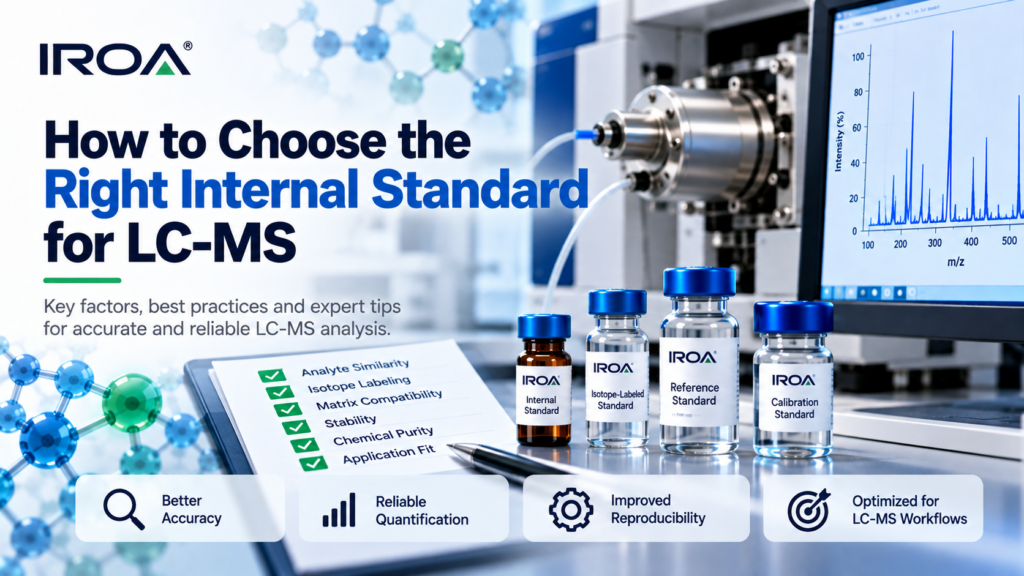
How to Choose the Right Internal Standard for LC-MS
How To Choose Internal Standard For Lc-Ms play an important role in producing LC-MS data that can be interpreted with greater confidence. This article explains the concept in practical terms and connects it with the broader requirements of metabolomics, quantitative analysis, and reproducibility.
Start With the Analytical Goal
Internal-standard selection begins with the question the experiment must answer. A targeted assay measuring a small number of analytes has different requirements from an untargeted or semi-targeted metabolomics study covering hundreds of compounds.
Prioritize Relevant Chemical Behavior
A useful internal standard should behave similarly enough to the analyte or analyte class to experience relevant extraction, chromatographic, and ionization effects. Structurally unrelated surrogates may not reproduce those effects as closely as isotope-labeled counterparts.
Consider Stable Isotope Labeling
Stable isotope-labeled standards are often preferred for quantitative LC-MS because they can remain chemically similar to natural-abundance compounds while being separated by mass. U-13C labeling is especially relevant to metabolomics because carbon-containing metabolites can be represented with predictable mass shifts.
Match Coverage to Study Scale
For a narrow targeted panel, individual labeled standards may be appropriate. For broad metabolomics, buying and managing one standard for every analyte can become impractical. Complex labeled materials such as IROA’s U-13C-labeled yeast extract offer broader metabolite coverage within one internal-standard system.
Check Matrix and Concentration
The standard must be detectable without overwhelming the analyte signal or introducing avoidable interference. Researchers should evaluate expected concentration ranges, matrix complexity, extraction conditions, and whether the standard is introduced early enough to reflect the variability they want to control.
Think Beyond a Single Run
Long studies require consistency across batches and instrument states. Internal standards can be paired with a stable long-term reference or QC material so the laboratory can distinguish sample-level variation from changes in system performance.
A Practical Selection Checklist
Define the analytes or chemical space; identify the main sources of analytical variability; determine whether compound-specific or broad coverage is needed; evaluate isotope labeling; confirm platform compatibility; establish concentration and preparation procedures; and define how the standard will be used in data processing.
Conclusion
The best internal standard is the one that matches the analytical purpose and controls the variability that matters. In metabolomics, broad isotope-labeled standards can provide a scalable route to better normalization, quantitation, and confidence.
Related IROA Resources
Continue exploring: IROA Internal Standard Kit • Internal Standards for Metabolomics • Stable Isotope-Labeled Internal Standards
Suggested CTA
Need a standards strategy for your metabolomics workflow? Explore IROA standards and quantitative metabolomics solutions or speak with the IROA team about the appropriate workflow for your application.