
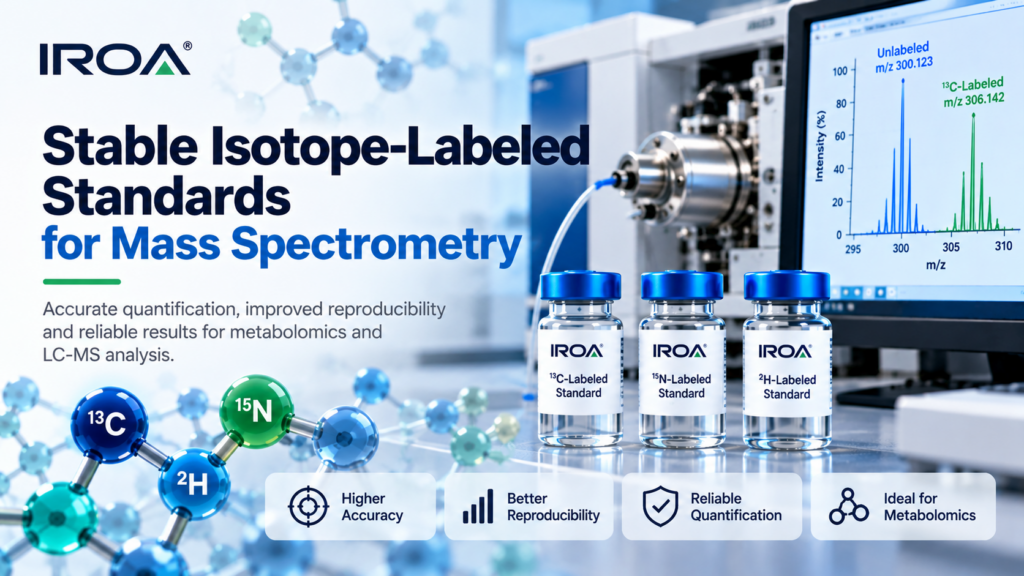
Stable Isotope-Labeled Standards for Mass Spectrometry
Stable Isotope-Labeled Standards play an important role in producing LC-MS data that can be interpreted with greater confidence. This article explains the concept in practical terms and connects it with the broader requirements of metabolomics, quantitative analysis, and reproducibility.
What Are Stable Isotope-Labeled Standards?
Stable isotope-labeled standards contain non-radioactive heavy isotopes such as 13C in place of some or all naturally abundant atoms. The resulting compound remains chemically related to its unlabeled counterpart but has a predictable mass difference that can be detected by mass spectrometry.
Why 13C Labeling Works Well
Carbon is central to metabolites, making 13C labeling particularly useful in metabolomics. Uniform labeling can create a clearly distinguishable reference while preserving closely related chemical behavior. The labeled material can therefore experience similar chromatographic conditions, matrix effects, and ionization behavior as the corresponding natural-abundance compounds.
Identification and Quantitation
A stable isotope standard can contribute to both qualitative and quantitative confidence. Mass differences and isotope envelopes provide additional evidence for feature identity, while the relationship between labeled and unlabeled signals can support quantitative comparison. This is valuable when complex biological matrices contain many co-eluting or interfering compounds.
Broad-Coverage Labeled Mixtures
One-to-one standards are powerful for targeted assays but can become impractical at metabolomics scale. IROA uses labeled yeast extract containing a broad set of metabolites, allowing many analytes to be referenced within one workflow. This creates a bridge between targeted quantitative principles and broader metabolomic discovery.
IROA Isotope Patterns
IROA technologies use distinctive isotopic labeling strategies, including 5% and 95% U-13C materials in relevant workflows. These patterns can support carbon-number information, metabolite identification, quality control, and the recognition of analytical artifacts.
Where They Add the Most Value
Stable isotope-labeled standards are particularly useful in quantitative metabolomics, biomarker research, longitudinal studies, multi-batch experiments, and workflows where matrix effects are a major concern. They also support reproducibility when results must be compared over time, between instruments, or across laboratories.
Conclusion
Stable isotope-labeled standards turn mass differences into analytical reference points. When integrated into sample preparation and LC-MS analysis, they can help researchers measure with greater confidence while reducing the risk that technical variability is mistaken for biology.
Related IROA Resources
Continue exploring: Stable Isotope-Labeled Internal Standards for Quantitative Metabolomics • IROA Internal Standard Kit • metabolomics analysis with IROA
Suggested CTA
Need a standards strategy for your metabolomics workflow? Explore IROA standards and quantitative metabolomics solutions or speak with the IROA team about the appropriate workflow for your application.