
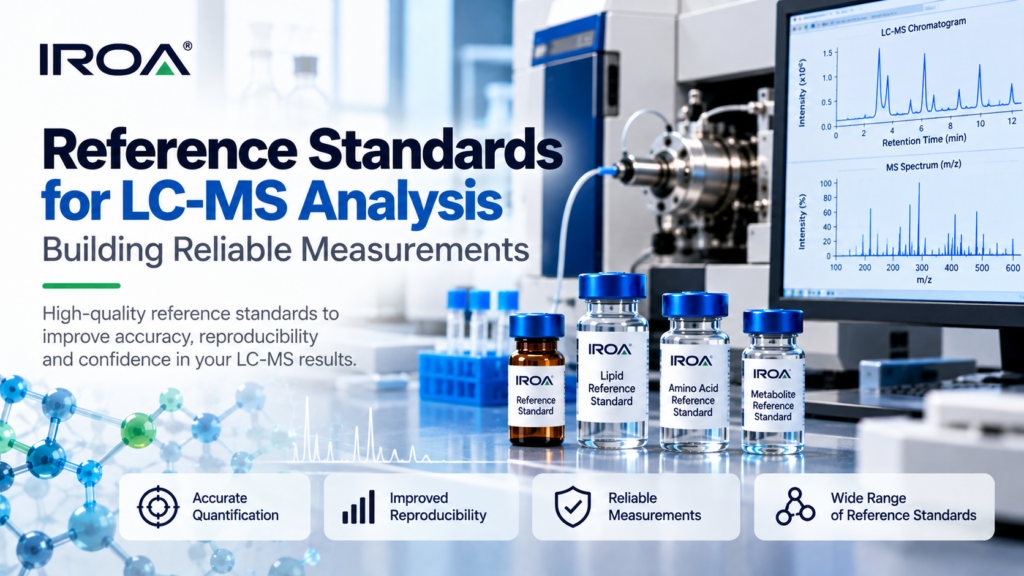
Reference Standards for LC-MS Analysis: Building Reliable Measurements
Reference Standards For Lc-Ms play an important role in producing LC-MS data that can be interpreted with greater confidence. This article explains the concept in practical terms and connects it with the broader requirements of metabolomics, quantitative analysis, and reproducibility.
What Is a Reference Standard in LC-MS?
A reference standard is a consistent material used as a point of comparison for analytical measurements. In LC-MS, reference materials can help establish expected retention behavior, mass spectral characteristics, instrument performance, and quantitative response.
Reference Standards vs Internal Standards
The terms are related but their functions can differ. An internal standard is added to experimental samples and experiences the analytical workflow with them. A long-term reference standard can instead be analyzed repeatedly as a consistent QC material. Using both approaches provides information at different levels: sample-specific correction and system-level monitoring.
Supporting Instrument Quality Control
LC-MS performance can change as columns age, sources become contaminated, calibration shifts, or mobile-phase conditions vary. Repeated analysis of a stable reference gives laboratories a way to identify drift before it compromises an entire study.
Supporting Metabolite Identification
Authentic reference compounds can provide expected retention times and spectra. IROA’s metabolite libraries are designed to provide high-quality standards for metabolite qualification and quantification, while its labeled workflows add recognizable isotopic information that can further strengthen identification.
Long-Term Reference Standards in TruQuant
The TruQuant workflow uses an IROA Long-Term Reference Standard alongside an internal standard. The LTRS is used for system QC and metabolite dictionary generation, while the internal standard is incorporated with experimental samples for quantitative correction and normalization.
Designing a Reference Strategy
A useful strategy defines how often the reference will be analyzed, which metrics will be monitored, what constitutes acceptable variation, and how deviations will be handled. The reference should be stable, consistently prepared, and relevant to the analytical chemistry being measured.
Conclusion
Reference standards give LC-MS measurements context. By combining authentic standards, long-term reference materials, and internal standards where appropriate, researchers can strengthen identification, detect analytical drift, and improve comparability across an experiment.
Related IROA Resources
Continue exploring: Reference Standards in Metabolomics • Large Scale Metabolite Library of Standards • TruQuant Workflow Kit
Suggested CTA
Need a standards strategy for your metabolomics workflow? Explore IROA standards and quantitative metabolomics solutions or speak with the IROA team about the appropriate workflow for your application.