
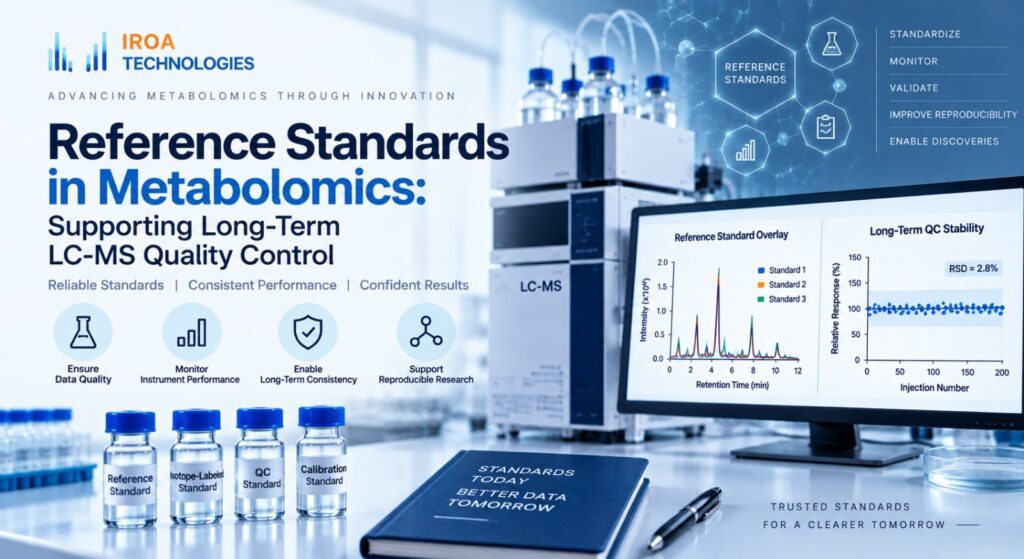
Reference Standards in Metabolomics for LC-MS Quality Control
Metabolomics reference standards provide a stable point of comparison in an analytical environment where many variables can change. LC-MS performance may shift because of column condition, source contamination, calibration, mobile-phase preparation, instrument maintenance, or day-to-day operating conditions. A long-term reference helps researchers determine whether those changes are affecting the data.
In the TruQuant Workflow Kit, IROA uses a Long-Term Reference Standard (LTRS) together with an isotope-labelled internal standard to support both system-level quality control and sample-level correction.
Why A Long-Term Reference Is Different From An Internal Standard
A long-term reference standard is analyzed as a consistent QC material across a sequence or across multiple batches. Its purpose is to reveal changes in the analytical system. An internal standard, by contrast, is added directly to experimental samples so it can track sample-specific analytical behavior.
The two roles are complementary. A reference standard tells you whether the system is behaving consistently; an internal standard helps correct what happened within a specific sample.
Building A Metabolite Dictionary
One advantage of a characterized reference material is that known compounds can be associated with expected mass-to-charge values, retention behavior, isotope patterns, fragments, and adducts. This creates a practical metabolite dictionary for subsequent sample analysis.
ClusterFinder can use IROA reference information together with isotope patterns to improve compound identification and artifact discrimination.
Monitoring Chromatographic Performance
Retention time is a basic but valuable QC variable. Shifts may indicate changes in column performance, mobile phase composition, temperature, pressure, or instrument setup. A repeated reference sample makes those shifts easier to detect because the expected compounds should appear in a consistent chromatographic pattern.
Reference standards therefore support both compound identification and routine system suitability.
Monitoring Mass-Spectrometric Performance
Mass accuracy, peak intensity, isotope-envelope quality, and background artifacts can also change over time. Repeated reference measurements provide a benchmark for recognizing gradual drift or abrupt performance changes.
When reference performance changes, researchers can investigate the analytical system before assuming that the same change in experimental samples is biological.
Reference Standards And Quantitative Correction
Reference standards are most useful when integrated with sample-level controls. The IROA approach combines the LTRS with isotope-labelled internal standards, ion suppression correction, and Dual MSTUS normalization.
This creates a layered QC strategy in which system performance is monitored, local ionization effects are corrected, and broader analytical variation is normalized.
When Long-Term References Are Especially Valuable
Long-term reference standards are particularly useful for multi-day acquisition, longitudinal studies, high-throughput projects, method transfer, cross-instrument comparison, and laboratories that need to compare results over extended periods.
Researchers can review IROA’s publications and application notes for examples of reference-standard use in metabolomics workflows.
Conclusion
A metabolomics reference standard is not only a calibration material. Used consistently, it becomes a historical record of analytical performance. In the TruQuant workflow, the LTRS supports compound identification and long-term QC while the internal standard supports sample-level correction, creating a stronger foundation for reproducible LC-MS metabolomics.