
Calibration Standards vs Internal Standards in Mass Spectrometry
Calibration Standards Vs Internal Standards play an important role in producing LC-MS data that can be interpreted with greater confidence. This article explains the concept in practical terms and connects it with the broader requirements of metabolomics, quantitative analysis, and reproducibility.
Two Standards, Different Questions
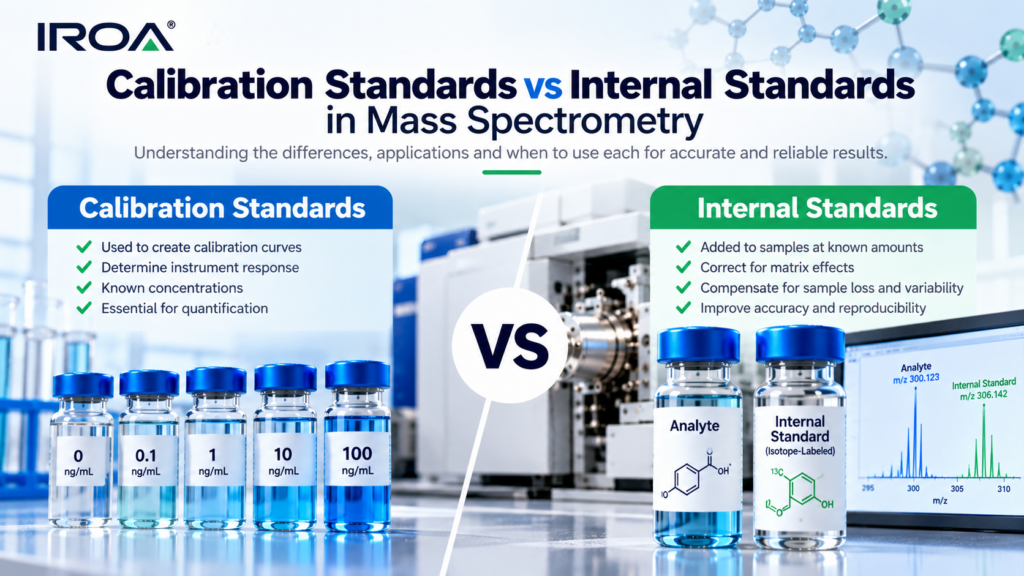
Calibration standards and internal standards both improve analytical confidence, but they do not necessarily solve the same problem. Calibration establishes the relationship between instrument response and a known reference, while an internal standard travels with a sample to help account for variation during preparation and analysis.
What Calibration Standards Do
Calibration materials are used to establish or verify expected instrument response. Depending on the method, calibration may relate signal to concentration, verify mass accuracy, or confirm that the analytical system is operating within defined conditions.
What Internal Standards Do
Internal standards are introduced into experimental samples. Their response can help reveal variability associated with extraction, matrix effects, ionization, retention, or instrument behavior. Stable isotope-labeled standards are particularly valuable because their chemistry can closely resemble the analyte while their mass remains distinguishable.
Why One Does Not Automatically Replace the Other
A perfectly calibrated instrument can still encounter sample-specific ion suppression or extraction loss. Conversely, an internal standard does not remove the need for appropriate instrument calibration and QC. Robust quantitative workflows often use multiple reference layers because analytical error can enter at different stages.
The Metabolomics Perspective
Metabolomics expands the problem from a few analytes to hundreds of features. IROA uses isotope-labeled internal standards and long-term reference materials to provide complementary controls across the workflow. Authentic metabolite libraries can add another layer of identity and reference information.
Building a Layered QC Strategy
A strong strategy can include instrument calibration, stable reference/QC materials, internal standards added to samples, authentic standards for identity, and predefined acceptance criteria. Each component answers a different analytical question.
Conclusion
Calibration standards tell researchers whether the measurement system is referenced correctly; internal standards help show what happened to the sample during analysis. Understanding the distinction makes it easier to design LC-MS workflows that are both accurate and reproducible.
Related IROA Resources
Continue exploring: Reference Standards in Metabolomics • IROA Internal Standards • Application Notes and Whitepapers
Suggested CTA
Need a standards strategy for your metabolomics workflow? Explore IROA standards and quantitative metabolomics solutions or speak with the IROA team about the appropriate workflow for your application.