
In today’s fast-paced digital world, businesses are constantly looking for smarter ways to organize and access information. Traditional search engines have served us well, but as data continues to grow exponentially, the need for more intelligent systems has become critical. This is where clustering search engines come into play.
Unlike conventional search methods that simply list results, clustering-based systems group similar information together, making it easier for users to find exactly what they need. For modern businesses, this approach is not just a technological upgrade—it’s a strategic advantage.
In this blog, we’ll explore the top benefits of clustering-based search systems and why companies like IROA Technologies are paying close attention to this innovation.
What Are Clustering Search Engines?
Before diving into the advantages, it’s important to understand the concept. Clustering search engines organize search results into meaningful groups based on similarities in content, context, or intent. Instead of scrolling through endless links, users can navigate through categorized clusters that streamline the search experience.
This method uses advanced algorithms, artificial intelligence, and machine learning to analyze patterns and relationships in data. As a result, users receive more structured and relevant information.
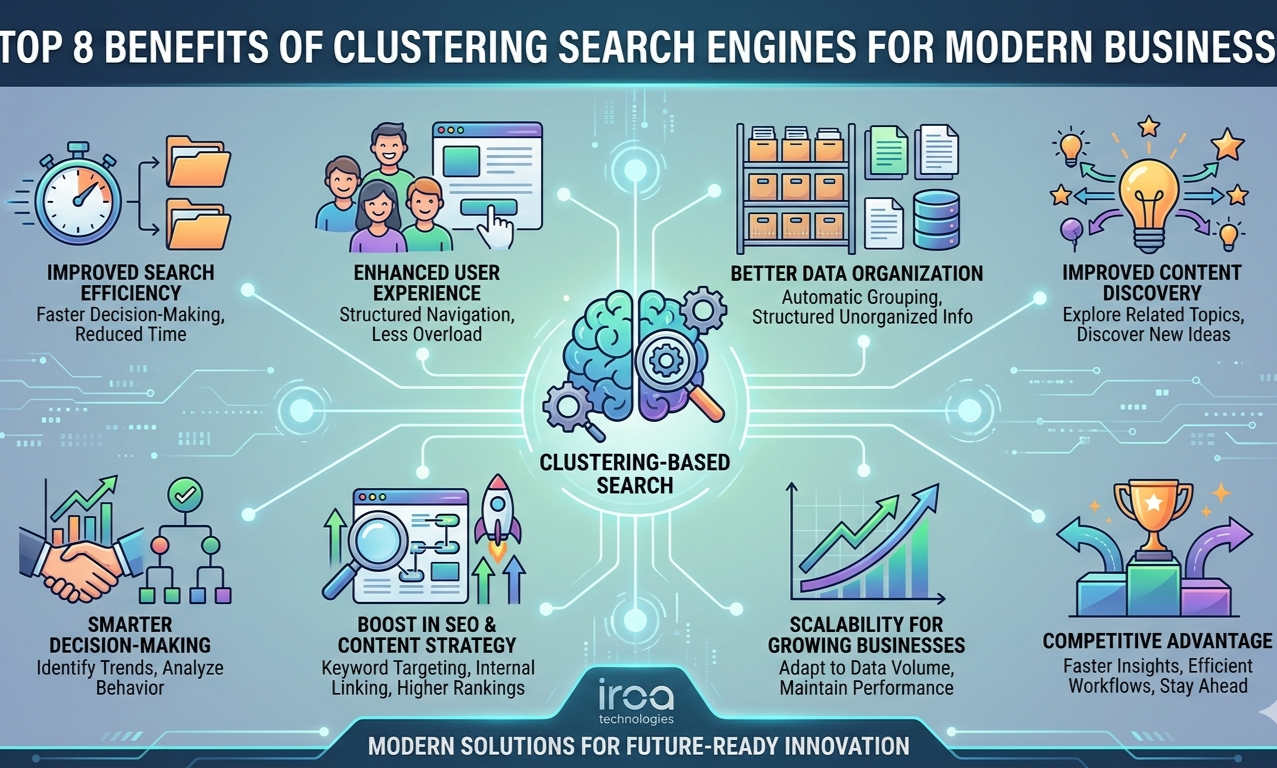
1. Improved Search Efficiency
One of the biggest advantages of clustering-based search systems is efficiency. Traditional search engines often overwhelm users with a long list of results, many of which may not be relevant.
With clustering, results are grouped into categories such as topics, themes, or intent. This allows users to quickly narrow down their search and find relevant information without wasting time.
For businesses, this means:
- Faster decision-making
- Reduced research time
- Improved employee productivity
2. Enhanced User Experience
User experience plays a critical role in customer satisfaction and retention. A well-organized search interface helps users feel more in control and confident in their decisions.
Clustering improves the overall experience by:
- Reducing information overload
- Offering structured navigation
- Making content easier to explore
When users can quickly find what they need, they are more likely to stay engaged with your platform. Companies like IROA Technologies recognize that better user experience directly translates into higher customer satisfaction.
3. Better Data Organization
Modern businesses deal with massive amounts of data daily. Managing and organizing this data efficiently is a major challenge.
Clustering helps by:
- Automatically grouping related data
- Identifying hidden patterns
- Structuring unorganized information
This is especially useful for industries like e-commerce, healthcare, and finance, where large datasets are common. Organized data allows businesses to gain deeper insights and make more informed decisions.
4. Improved Content Discovery
One of the underrated benefits of clustering search engines is improved content discovery. Users often don’t know exactly what they’re looking for, but they recognize it when they see it.
Clustering enables:
- Exploration of related topics
- Discovery of new ideas
- Better understanding of complex subjects
For example, a user searching for “digital marketing” may discover clusters like SEO, social media, and content strategy. This expands their knowledge and keeps them engaged longer.
5. Smarter Decision-Making
In business, decisions are only as good as the information behind them. Clustering provides a clearer picture by organizing data into meaningful groups.
This helps in:
- Identifying trends
- Comparing options
- Understanding customer behavior
With structured insights, businesses can make faster and more accurate decisions. According to a study by McKinsey & Company, data-driven organizations are significantly more likely to outperform their competitors.
6. Boost in SEO and Content Strategy
Clustering also plays a vital role in search engine optimization (SEO). By organizing content into topic clusters, businesses can improve their website structure and visibility.
Benefits include:
- Better keyword targeting
- Improved internal linking
- Higher search rankings
When content is grouped logically, search engines can better understand its relevance. This leads to improved indexing and higher chances of ranking on search result pages.
7. Scalability for Growing Businesses
As businesses grow, so does their data. Traditional systems often struggle to keep up with this expansion.
Clustering search engines are highly scalable because they:
- Adapt to increasing data volumes
- Continuously refine groupings
- Maintain performance efficiency
This makes them ideal for startups as well as large enterprises. Businesses like IROA Technologies can leverage this scalability to support long-term growth without compromising performance.
8. Competitive Advantage
In a competitive market, staying ahead requires innovation. Companies that adopt advanced search technologies gain a significant edge.
Clustering provides:
- Faster insights
- Better customer understanding
- More efficient workflows
By implementing modern search solutions, businesses can differentiate themselves and offer superior services compared to competitors.
Conclusion
As digital transformation continues to reshape industries, the importance of intelligent search systems cannot be ignored. Clustering search engines offer a powerful solution to the challenges of data overload, inefficiency, and poor user experience.
From improved efficiency and better data organization to enhanced decision-making and SEO benefits, the advantages are clear. Businesses that embrace this technology will be better equipped to handle the complexities of modern data environments.
For forward-thinking companies like IROA Technologies, adopting clustering-based search solutions is not just an option—it’s a step toward future-ready innovation.
FAQs
1. What are clustering search engines?
Clustering search engines group search results into categories based on similarities, making it easier for users to find relevant information quickly.
2. How do clustering-based systems improve user experience?
They reduce information overload by organizing results into structured groups, allowing users to navigate content more efficiently.
3. Are clustering search engines useful for SEO?
Yes. They help create better content structures, improve internal linking, and enhance keyword targeting, which can boost search rankings.
4. Can small businesses benefit from clustering search engines?
Absolutely. These systems are scalable and can help small businesses manage data more efficiently while improving customer experience.
5. How does clustering help in decision-making?
By organizing data into meaningful patterns and groups, clustering makes it easier to identify trends and make informed decisions.