

Clustering sarch engine

Browse all articles filed under the "Clustering sarch engine" tag.

Why Cluster Search Engines Are the Future of Data Retrieval

Showing 1–6 of 6 articles

Why Cluster Search Engines Are the Future of Data Retrieval

Why Cluster Search Engines Are the Future of Data Retrieval

In today’s data-driven world, the volume of information generated every second is staggering. From social media interactions and e-commerce transactions to enterprise databases and IoT devices, organizations are constantly dealing with massive datasets.

Traditional search systems often struggle to keep up with this scale, leading to slower performance and limited accuracy. This is where Cluster Search Engines are stepping in to reshape how data is stored, processed, and retrieved.

Understanding the Shift in Data Retrieval The way businesses handle data has evolved dramatically over the past decade. Earlier, centralized systems were enough to manage structured datasets.

However, modern data environments are more complex, distributed, and dynamic. Companies now require systems that can process large volumes of data quickly while maintaining accuracy and reliability.

Cluster-based search systems address these needs by...
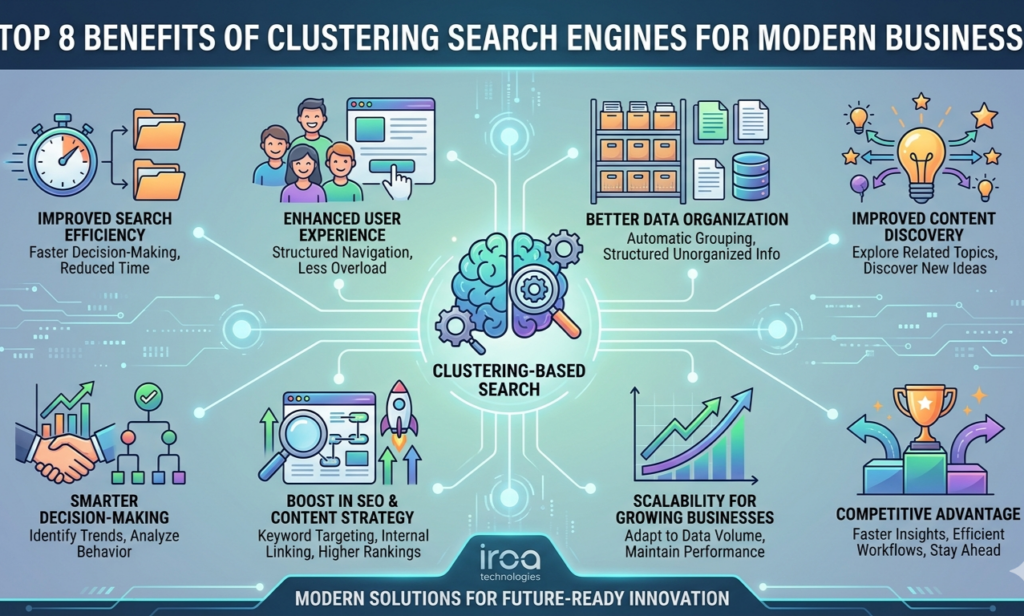
Top Advantages of Clustering Search Engines for Modern Businesses.

Top Advantages of Clustering Search Engines for Modern Businesses

In today's fast-paced digital world, businesses are constantly looking for smarter ways to organize and access information. Traditional search engines have served us well, but as data continues to grow exponentially, the need for more intelligent systems has become critical.

This is where clustering search engines come into play. Unlike conventional search methods that simply list results, clustering-based systems group similar information together, making it easier for users to find exactly what they need.

For modern businesses, this approach is not just a technological upgrade—it's a strategic advantage. In this blog, we'll explore the top benefits of clustering-based search systems and why companies like IROA Technologies are paying close attention to this innovation.

What Are Clustering Search Engines? Before diving into the advantages, it's important to understand the concept. Clustering...

How a Clustering Search Engine Improves Search Results Accuracy

In today’s digital world, search engines are the backbone of how we find information. Whether it’s a researcher looking for scientific data, a business analyst exploring market trends, or a student searching for academic resources, the accuracy of search results can make or break the experience.

But traditional search engines often struggle to deliver highly relevant and organized results. You type in a query, and you’re presented with hundreds—or even thousands—of links.

Many are repetitive. Some are loosely related. Others completely miss your intent. This is where a Clustering sarch engine changes the game.

At IROA Technologies, we understand that the future of search is not just about retrieving data—it’s about intelligently organizing it.

In this blog, we’ll explore how a clustering search engine works, why it improves search accuracy,...

Laboratory setup showing calibration vials, internal standards, chromatogram data, and a mass spectrometer system

Understanding Mass Spectrometry Standards for Reliable Analytical Results

In modern analytical laboratories, precision is not optional—it is the foundation of credible science, regulatory compliance, and product quality. From pharmaceutical development and clinical research to food safety, environmental monitoring, and metabolomics, laboratories rely on mass spectrometry to identify, quantify, and characterize complex chemical compounds with exceptional sensitivity.

However, even the most advanced instruments cannot deliver trustworthy results without proper calibration, validation, and quality control. This is where analytical standards play a decisive role.

Mass spectrometry standards provide the reference framework that ensures instruments produce accurate, reproducible, and defensible data. For laboratories striving to maintain consistency across workflows, understanding how standards function and how to implement them effectively is essential.

Companies such as IROA Technologies contribute to this ecosystem by delivering innovative solutions that help laboratories improve confidence in complex...

clustering-search-engin

Advanced Clustering Search Engines for Faster Insights

In today’s data-driven scientific world, researchers face a common challenge: biological datasets are growing larger, more complex, and more interconnected than ever before.

Whether you are working in metabolomics, systems biology, pharmaceutical development, food analysis, or environmental studies, the ability to interpret complex datasets quickly and accurately is crucial.

This is where Clustering Search Engines transform the landscape. They bring speed, structure, and intelligence to scientific data interpretation, helping teams uncover meaningful patterns in minutes instead of days.

At IROA Technologies, the mission is to provide researchers with analytical solutions that deliver clarity, precision, and confidence—starting with powerful data exploration tools designed for modern scientific demands.

This blog explores how Clustering Search Engines work, why they matter, and how IROA Technologies supports faster, smarter insights across the scientific community.

Understanding...

Laboratory glass vials and an amber bottle labeled “Internal Standard” representing internal standard sets used for accurate metabolomic analysis in a research lab.

Why Internal Standard Sets Are Essential for Reliable Metabolomic Analysis

Metabolomics is a powerful tool for understanding the complex biochemical processes that define life. It enables researchers to study small molecules and their interactions within biological systems, offering insights into disease mechanisms, drug efficacy, and metabolic health.

However, the accuracy of metabolomics data depends heavily on one critical factor Internal Standard Sets. Without proper standardization, even the most advanced mass spectrometry or chromatography instruments can produce data that’s inconsistent, incomparable, or misleading.

This is where Internal Standard Sets become indispensable, ensuring that every dataset reflects true biological changes rather than technical variability.

What Are Internal Standard Sets? Internal Standard Sets are reference compounds added to biological samples before extraction or analysis. These standards, often isotopically labeled (like ¹³C or ¹⁵N compounds), serve as benchmarks to normalize and calibrate results throughout...