

In the rapidly growing field of metabolomics, accuracy, reproducibility, and data clarity have become essential for meaningful scientific discovery. Whether the goal is disease biomarker identification, precision medicine, environmental research, or bioprocess optimization, researchers rely heavily on advanced analytical instruments to capture the complex chemical fingerprints of biological systems. At the heart of these workflows are Metabolite Analyzers, instruments designed to detect, quantify, and characterize the vast array of metabolites present in living organisms.
However, as metabolomics evolves, so do the expectations placed on these analyzers. Traditional workflows face well-known challenges: technical variability, data inconsistency, instrument drift, and the inherent complexity of biological samples. These hurdles can distort results, reduce confidence, and make long-term or cross-lab comparisons difficult.
Enter IROA Technologies, a pioneering company redefining how metabolomics data is collected, interpreted, and trusted. With innovative solutions built to enhance the performance and reliability of Metabolite Analyzers, IROA Technologies is transforming the future of metabolic research. Through advanced normalization tools, isotopic standards, and workflow optimization, IROA is helping laboratories overcome limitations that have persisted for decades.
This blog explores how IROA Technologies is elevating the world of metabolomics, why metabolite analysis matters more than ever, and how laboratories are benefiting from more accurate and biologically meaningful data.
Why Metabolite Analyzers Are Essential to Modern Science
Metabolomics has become one of the most powerful tools for understanding biological processes. Unlike genomics or proteomics, which offer indirect insights, metabolomics measures the actual biochemical activities happening within cells in real time.
Metabolite Analyzers play a foundational role in this process. They help researchers:
- Quantify metabolic changes in health and disease
- Monitor biochemical pathways with precision
- Identify biomarkers for early diagnosis and therapeutic monitoring
- Evaluate drug interactions, toxicity, and metabolism
- Study responses to environmental stressors
- Optimize microbial and bioprocess systems
Yet, despite their importance, metabolite analyzers face limitations that can compromise data accuracy.
For scientists and organizations aiming for precision, these challenges must be addressed—and this is where IROA Technologies brings transformative solutions.
The Challenges Facing Today’s Metabolite Analyzers
Even the most advanced analytical instruments are not immune to technical variation. Without correction, these factors can skew results:
1. Instrument Drift Over Time
Mass spectrometers and chromatographic systems experience natural drift, often affecting retention time, peak intensity, and sensitivity.
2. Sample Preparation Variability
Differences in extraction, drying, reconstitution, or injection volumes can introduce inconsistencies across samples.
3. Batch Effects
Long experiments or multi-day runs can create discrepancies, making cross-batch comparisons unreliable.
4. External Standards Are Not Always Reliable
Traditional spike-ins do not mimic the behavior of real metabolites, making correction incomplete or inaccurate.
5. Data Interpretation Complexity
Even clean datasets require expertise to interpret correctly, and small errors can lead to wrong conclusions.
These limitations collectively impact the performance of Metabolite Analyzers, reducing the clarity of biological signals and increasing noise.
IROA Technologies recognized this gap—and created an innovative solution designed to solve these issues at the source.
IROA Technologies: A New Era of Data Precision
Unlike traditional approaches that attempt to correct data after acquisition, IROA Technologies provides solutions that embed data correction into the metabolomics workflow itself.
This approach ensures that Metabolite Analyzers operate with greater precision, delivering data that reflects true biology rather than technical interference.
Below are the key ways IROA Technologies is transforming the metabolomics landscape.
1. True Internal Standards for Accurate Quantification
Traditional normalization relies on external standards, which do not behave like actual metabolites. IROA Technologies introduces isotopic internal standards that closely track metabolite behavior during:
- sample processing
- drying and reconstitution
- chromatographic separation
- ionization
- detection
This process dramatically increases the accuracy of data captured by Metabolite Analyzers.
With IROA’s isotopic patterns, the system corrects variation automatically, resulting in more reliable and reproducible measurements.
2. Eliminating Batch Effects at the Root
One of the greatest struggles in metabolomics research is maintaining consistency across runs, batches, and even laboratories.
IROA’s workflow-integrated internal standards provide a universal reference that allows:
- Cross-day consistency
- Cross-batch comparison
- Long-term stability
- Cross-lab repeatability
Metabolite Analyzers equipped with IROA-enhanced workflows produce data that can be reliably compared over time—a major advancement for large studies and regulated environments.
 3. Enhancing the Sensitivity and Reliability of Metabolite Analyzers
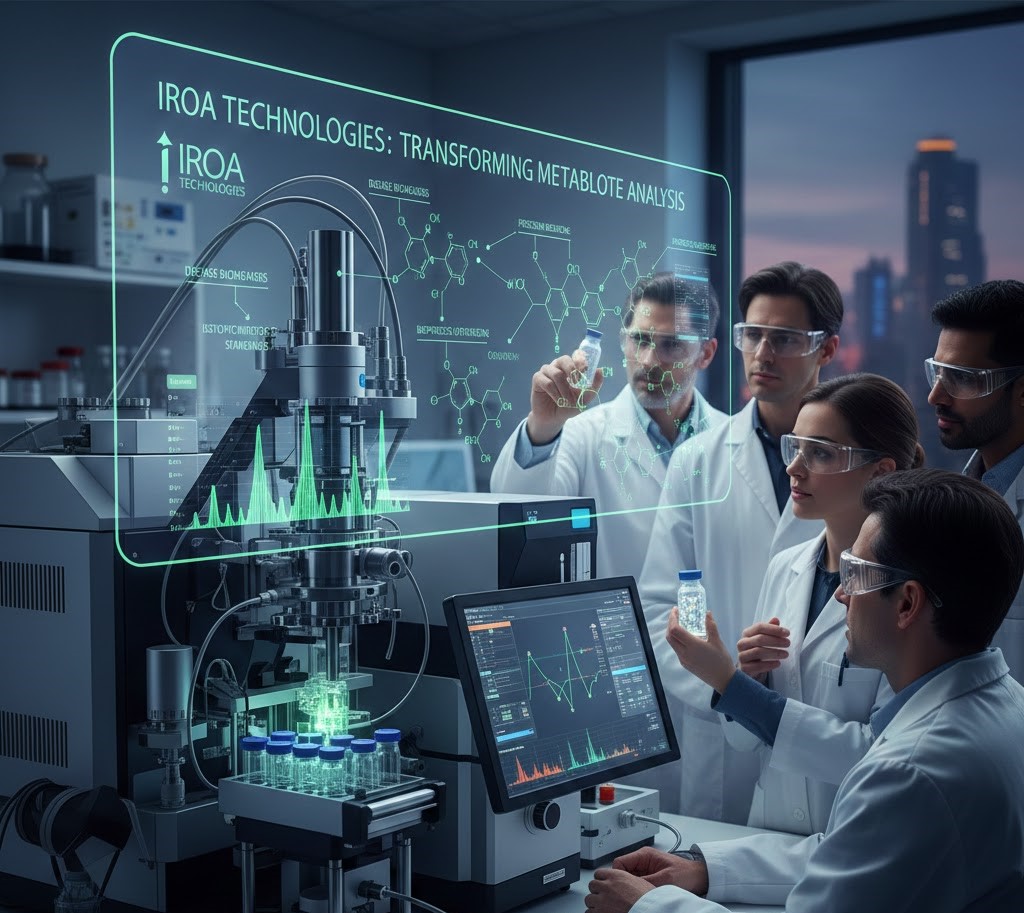 3. Enhancing the Sensitivity and Reliability of Metabolite Analyzers
By removing noise and correcting variation at each stage, IROA improves the effective performance of Metabolite Analyzers without requiring hardware upgrades.
Scientists benefit from:
- better detection of subtle metabolic changes
- more accurate quantification
- improved signal-to-noise ratios
- greater confidence in rare or low-abundance metabolites
This is particularly valuable in fields like clinical metabolomics, aging research, and precision medicine, where small metabolic shifts may hold major significance.
4. Simplifying Data Interpretation for Clearer Biological Insight
Metabolomics datasets are notoriously complex. Even experienced researchers spend significant time correcting, normalizing, and cleaning the data before meaningful analysis can begin.
IROA simplifies this process by providing:
- automatic correction through internal standards
- clearer peak identification
- simplified data visualizations
- enhanced compatibility with statistical tools
This reduces analysis time and allows scientists to focus on biological interpretation rather than technical troubleshooting.
5. Empowering Innovation Across Scientific Fields
Because metabolic changes reflect underlying biology, enhancing the accuracy of Metabolite Analyzers has wide-reaching impacts across research sectors.
IROA Technologies is helping improve outcomes in:
Biomedical Research
Better biomarkers, improved disease profiling, more accurate therapeutic monitoring.
Pharmaceutical Development
Cleaner metabolic pathways, reliable toxicity screening, stronger drug efficacy studies.
Agricultural and Environmental Science
Improved plant metabolite profiling, stress-response analysis, soil and microbial research.
Bioprocessing and Fermentation
Enhanced metabolic flux analysis, optimization of microbial strains, better QC workflows.
In every case, IROA improves the clarity and reliability of metabolic data.
Why IROA Technologies Leads the Future of Metabolite Analysis
IROA Technologies is redefining what metabolomics can achieve. The company’s unique approach to normalization gives Metabolite Analyzers the accuracy, reproducibility, and reliability required for a new era of scientific discovery.
Here’s what sets IROA apart:
Normalization built into the workflow, not added after
Internal isotopic standards that mimic real metabolites
Improved confidence in quantification and identification
Compatibility with existing LC–MS platforms
Enhanced reproducibility across labs and studies
By tackling technical variability at its source, IROA is enabling researchers to uncover hidden biological insights, validate findings with confidence, and accelerate the pace of innovation.
External Resource for Further Reading
For readers interested in metabolomics fundamentals, this resource provides valuable background information:
https://en.wikipedia.org/wiki/Metabolite
FAQs
1. What are Metabolite Analyzers?
Metabolite Analyzers are instruments—commonly LC-MS or GC-MS systems—used to detect and quantify metabolites in biological samples. They are essential tools in metabolomics research.
2. How does IROA Technologies improve metabolite analysis?
IROA Technologies uses isotopic internal standards and workflow optimization to reduce technical variation, enhance accuracy, and improve reproducibility in metabolomics data.
3. Do IROA solutions require new instruments?
No. IROA’s technologies are designed to work with existing LC-MS workflows, making them cost-effective and easy to integrate.
4. Why is normalization important in metabolomics?
Normalization corrects for technical variation, ensuring that metabolic changes reflect true biology rather than processing or instrument noise.
5. Who benefits most from IROA-enhanced metabolomics workflows?
Researchers in biomedical science, pharmaceuticals, environmental biology, and bioprocessing all benefit from more accurate and reproducible metabolite data.