
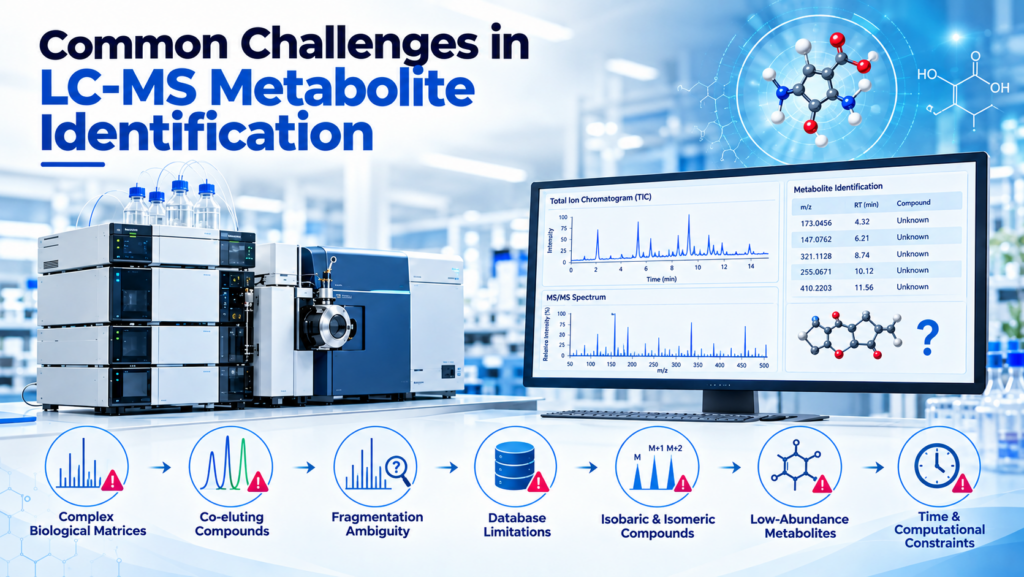
Biological matrices contain compounds with widely different abundances, chemical properties, and stability. Extraction conditions, storage, and sample handling can alter the metabolite profile before analysis. A reliable identification program therefore starts with consistent preparation and suitable blanks and controls.
Isomers and overlapping peaks
Isomeric metabolites can share an elemental formula and precursor mass. Some also yield highly similar MS/MS spectra. Insufficient chromatographic resolution or co-elution may prevent confident distinction. Alternative columns, gradients, or authentic standards can help resolve difficult pairs.
Adducts, isotopes, and in-source fragments
A single metabolite can produce multiple LC-MS features. Without adduct grouping and isotope-pattern review, software may count them as separate compounds. In-source fragmentation can also mimic lower-mass metabolites. Analysts should review feature relationships before drawing biological conclusions.
Matrix effects and signal suppression
Co-eluting sample components can suppress or enhance ionization, altering measured responses. These effects complicate comparison across sample types and batches. Appropriate internal standards, dilution checks, pooled controls, and validated methods help assess and reduce the impact, particularly during quantitation.
Incomplete spectral libraries
Experimental MS/MS libraries do not cover the full metabolome, and reference spectra may differ across instruments and collision energies. Computational predictions are helpful for prioritization but add uncertainty. Unmatched features should remain unresolved until stronger evidence becomes available.
Retention-time drift and batch variability
Changes in chromatography and instrument condition can shift peaks and alter spectral quality. Regular QC injections, calibration, system suitability checks, and documented processing rules help keep assignments consistent. Long-running studies should explicitly monitor drift.
A realistic path to higher confidence
Use a staged process: quality filtering, feature grouping, accurate-mass and isotope assessment, MS/MS interpretation, library matching, and authentic-standard confirmation for priority metabolites. Report confidence honestly. Better identification is achieved by accumulating independent evidence, not by increasing the number of tentative names.
Explore relevant IROA resources
For further information, see Mass Spectrometry Metabolite Library of Standards, Internal Standards for Metabolomics, and Application Notes and White Papers.