
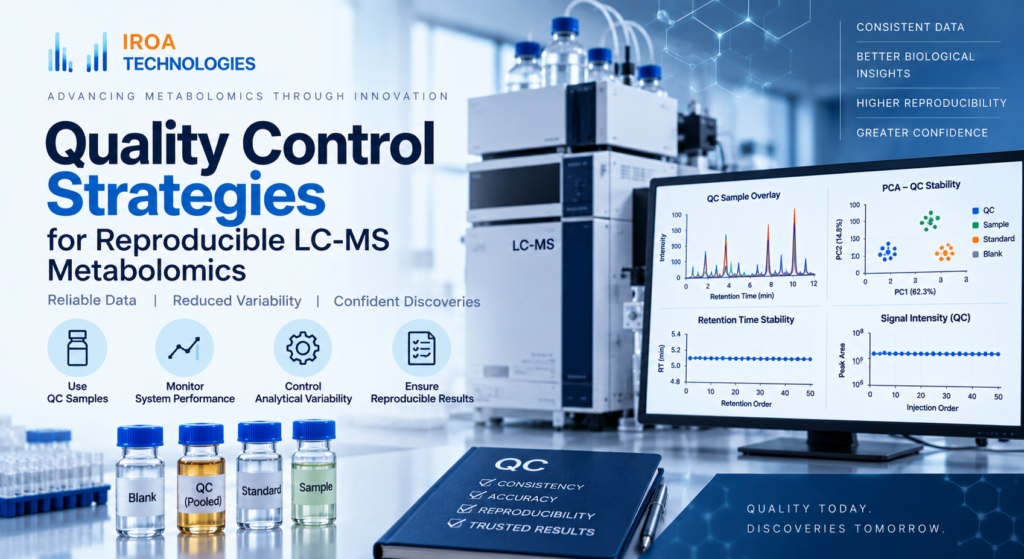
Metabolomics quality control is the process of proving that observed changes in a dataset are more likely to reflect biology than analytical instability. Because LC-MS workflows can vary across preparation steps, chromatographic runs, ionization conditions, and instrument response, QA/QC should be built into the experiment rather than added only after data acquisition.
The TruQuant Workflow Kit uses a long-term reference standard, an isotope-labelled internal standard, and software-based processing to create multiple checkpoints for identification and quantitative consistency.
Qc Should Monitor The Full Analytical System
A robust QC plan should monitor more than instrument sensitivity. Retention time, mass accuracy, peak shape, signal intensity, ion suppression, background artifacts, and normalization behavior can all affect data quality.
Reference materials are useful because they provide a consistent sample that can be analyzed repeatedly to determine whether the system is performing as expected.
The Role Of A Long-Term Reference Standard
The IROA workflow uses an IROA Long-Term Reference Standard (LTRS) as a consistent QC material. Because the reference contains characteristic isotope-labelled patterns, it can be used to build a compound dictionary and to monitor chromatographic and mass-spectrometric behavior over time.
A stable reference is especially important in long batches, multi-day studies, and projects where results must be compared across instruments or laboratories.
Internal Standards Monitor Each Analytical Sample
Where the LTRS provides a recurring system-level reference, the internal standard travels with the experimental sample. This enables sample-specific evaluation of analytical behavior.
IROA’s internal standards and IROA Internal Standard Kit provide labelled metabolite signals that support identification, suppression correction, and normalization.
Qc, Suppression Correction, And Normalization Work Together
QC can reveal that something changed, but additional correction is needed to improve the measurement.
Ion suppression correction addresses compound-specific ionization losses, while Dual MSTUS normalization addresses broader sample-to-sample analytical variation.
Together, these steps create a more complete QA/QC framework than a single pooled QC injection or post hoc statistical correction.
Software-Assisted Review Of Qc Performance
ClusterFinder analyzes characteristic IROA isotope patterns, identifies compounds, and provides raw, suppression-corrected, and normalized values. This allows researchers to compare different stages of processing and evaluate whether the corrections improve analytical consistency.
Practical Qc Checkpoints For Lc-Ms Metabolomics
A practical QC plan may include system suitability before a batch, recurring reference-standard injections, monitoring retention-time stability, reviewing mass accuracy, evaluating internal-standard response, checking suppression behavior, reviewing normalized intensity distributions, and documenting any batch interruptions or instrument maintenance.
These checkpoints are valuable because reproducibility is easier to defend when quality metrics are measured and recorded throughout the run.
Conclusion
Metabolomics QC is not a single sample type or one software flag. It is a workflow that combines stable references, internal standards, instrument monitoring, suppression correction, normalization, and documented review. The TruQuant approach integrates these elements so that quantitative conclusions are supported by visible analytical controls.