
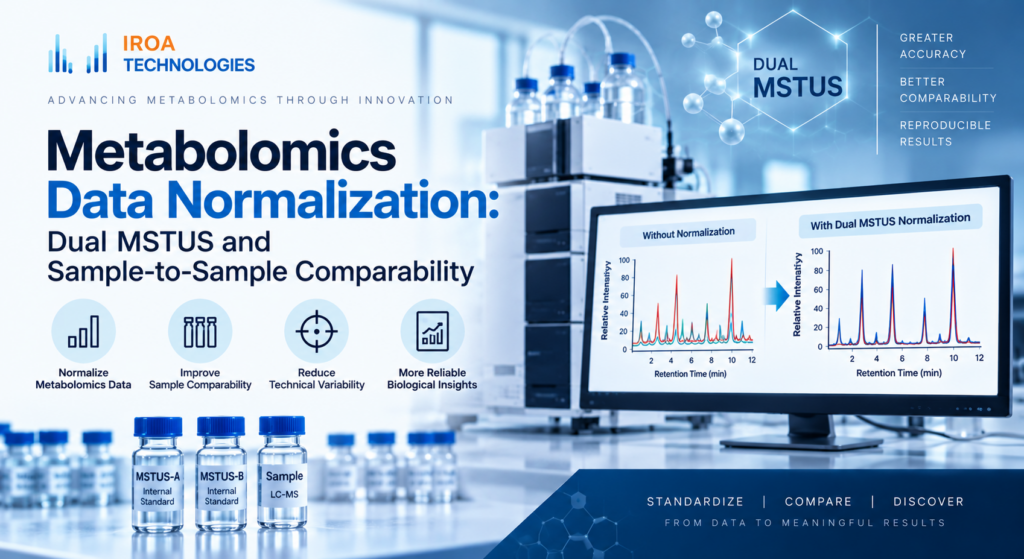
Normalization is one of the most important steps in quantitative metabolomics because raw LC-MS intensity can vary for reasons unrelated to biology. Differences in extraction yield, sample loading, ionization efficiency, instrument response, and batch conditions can change the overall scale of a dataset. Without appropriate normalization, downstream statistics may reflect technical variation rather than true metabolic differences.
IROA incorporates Dual MSTUS normalization into the TruQuant workflow to improve sample-to-sample comparability using information from both natural-abundance and isotope-labelled signals.
Why Metabolomics Data Need Normalization
LC-MS datasets contain thousands of measurements collected under conditions that are never perfectly constant. Even well-controlled studies can experience day-to-day variation, gradual instrument drift, or differences in total recovered material between samples. Normalization places samples on a more comparable analytical scale before statistical interpretation.
The challenge is to reduce unwanted variation without erasing real biological differences. This is why normalization should be connected to measured internal references rather than applied as an arbitrary mathematical rescaling.
What Mstus Is Designed To Address
MSTUS, commonly described as a mass-spectrometry total useful signal approach, estimates a scaling factor from a broad set of reliable metabolite signals rather than depending on a single compound. This can reduce the influence of one unstable feature and provide a more representative view of overall analytical response.
However, when isotope-labelled internal standards are available, additional information can be used to distinguish analytical change from biological change.
The Logic Of Dual Mstus
Dual MSTUS extends normalization by incorporating both experimental and internal-standard information. In the IROA workflow, natural-abundance metabolites represent the biological sample, while the U-13C-labelled internal-standard signals provide a controlled analytical reference.
Because the internal standard is introduced consistently, shifts in its response can indicate analytical variation. Combining information from both signal populations provides a stronger normalization framework than relying on the experimental features alone.
Why Internal Standards Matter To Normalization
Internal standards create a reference that should not change with the biological condition being studied. If their measured response changes across samples, that change is more likely to reflect extraction, injection, ionization, or instrument effects.
IROA’s internal standards for metabolomics are designed to support this type of correction. The IROA Internal Standard Kit provides U-13C-labelled yeast metabolites that can be added to experimental samples and tracked throughout LC-MS analysis.
Normalization Should Follow Suppression Correction
A metabolite can experience compound-specific ion suppression while the sample also experiences global analytical variation. These are separate sources of error. Suppression correction should therefore address local ionization losses before normalization is used to improve overall sample comparability.
The TruQuant Workflow Kit integrates these steps in sequence: identify metabolites, evaluate labelled and unlabeled signals, correct suppression, and then apply normalization.
Using Normalized Values In Downstream Analysis
Normalized values are intended to provide a more stable basis for fold-change calculations, multivariate statistics, biomarker discovery, clustering, and cross-batch comparisons. Researchers should still inspect QC performance, distributional behavior, and biological plausibility rather than assuming normalization automatically solves every source of variation.
ClusterFinder provides raw, suppression-corrected, and normalized outputs so analysts can evaluate how each correction changes the data.
Conclusion
Metabolomics normalization is most useful when it is grounded in experimental controls. Dual MSTUS uses both biological and isotope-labelled reference information to improve comparability without treating every sample as identical. Combined with suppression correction and QC, this provides a more defensible path to reproducible quantitative LC-MS results.