
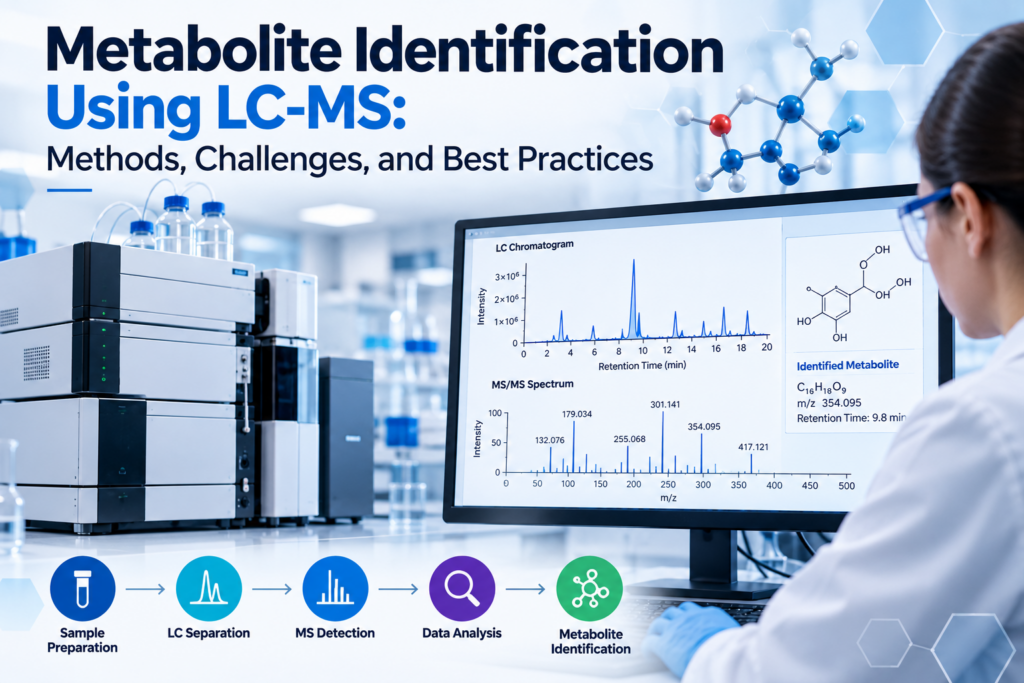
Liquid chromatography–mass spectrometry (LC-MS) can detect thousands of signals in biological samples, but a detected feature is not automatically an identified metabolite. Multiple compounds may share a similar mass, and adducts, isotopes, or fragments can create additional signals. A defensible identification workflow connects measured evidence to a specific chemical structure and reports the remaining uncertainty.
Start with reliable LC-MS data
Begin with a documented sample-preparation procedure, blanks, pooled quality-control samples, and a suitable chromatographic method. Inspect peak shape, signal-to-noise ratio, carryover, retention-time stability, and mass accuracy. Remove obvious contaminants and artifacts before assigning chemical names. Good feature detection and alignment reduce the chance of interpreting instrument noise as biology.
Combine orthogonal evidence
Accurate precursor mass narrows possible molecular formulas but rarely proves identity. Isotope patterns, expected adduct behavior, tandem mass spectrometry (MS/MS) fragmentation, and chromatographic retention time add complementary evidence. Search curated spectral libraries, then examine whether the experimental collision energy, ionization mode, and instrument conditions are comparable to the reference.
Use authentic standards for stronger confidence
When an authentic reference standard is available, analyze it using the same method as the sample. Agreement in retention time and MS/MS behavior provides stronger evidence than an exact-mass match alone. A standards library can also support method development, retention-time checks, and consistent interpretation across batches. Co-eluting isomers may still require additional separation or experiments.
Report identification confidence transparently
Separate confirmed identifications from probable annotations and tentative candidates. Record the evidence supporting each assignment, including mass error, major product ions, retention time, and standard comparison where available. Do not present every database match as a confirmed compound. This distinction is especially important when comparing cohorts or publishing biomarker results.
Best-practice workflow
A practical sequence is feature detection, quality filtering, formula/adduct assessment, MS/MS interpretation, reference-library search, authentic-standard verification, and confidence-level reporting. For targeted follow-up, add calibration and appropriate internal standards to quantify the metabolites of interest. A reproducible process is more valuable than a long list of uncertain names.
Explore relevant IROA resources
For further information, see Mass Spectrometry Metabolite Library of Standards, Internal Standards for Metabolomics, and Application Notes and White Papers.