
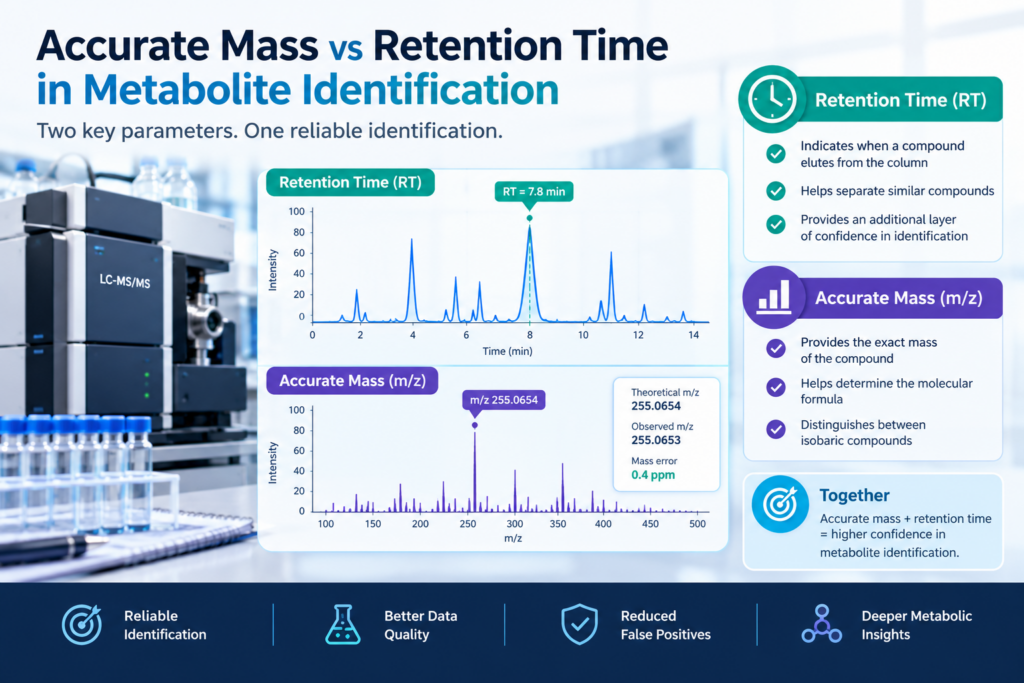
Accurate mass describes the measured mass-to-charge ratio of an ion, while retention time describes when a compound elutes from a chromatographic system. Both are useful, but neither is usually unique to a chemical structure. Treating them as complementary evidence produces more reliable annotations.
What accurate mass can tell you
High-resolution MS can constrain possible elemental compositions when mass accuracy and isotope information are adequate. Yet different structures can share the same formula, and isobaric compounds can have extremely close masses. Adduct formation, charge state, and calibration quality must be considered before converting m/z into a candidate formula.
What retention time adds
Retention time reflects interactions among the analyte, stationary phase, mobile phase, and gradient. It can help distinguish compounds with similar masses, especially when compared with authentic standards under identical conditions. But retention time is method-dependent and may shift with column age, temperature, solvent composition, and instrument setup.
Why MS/MS remains essential
Fragmentation data adds structural clues that mass and retention time alone may not provide. For example, two candidates may have matching precursor masses but different diagnostic product ions. Other isomers may remain difficult to separate even after MS/MS; additional chromatography or analytical techniques may be needed.
Use a combined evidence framework
A strong workflow compares precursor mass, isotope pattern, retention time, and MS/MS fragments, then uses a reference standard when available. Record the experimental tolerances rather than describing a match as simply exact. A retention-time agreement measured under a different LC method should not be treated as confirmation.
Implications for laboratories
Reference-standard collections can make retention-time comparison practical for commonly studied metabolites, while MS/MS libraries help scale annotation. Together they support consistent decisions and fewer false-positive assignments, particularly in multi-batch quantitative metabolomics projects.
Explore relevant IROA resources
For further information, see Mass Spectrometry Metabolite Library of Standards, Internal Standards for Metabolomics, and Application Notes and White Papers.