
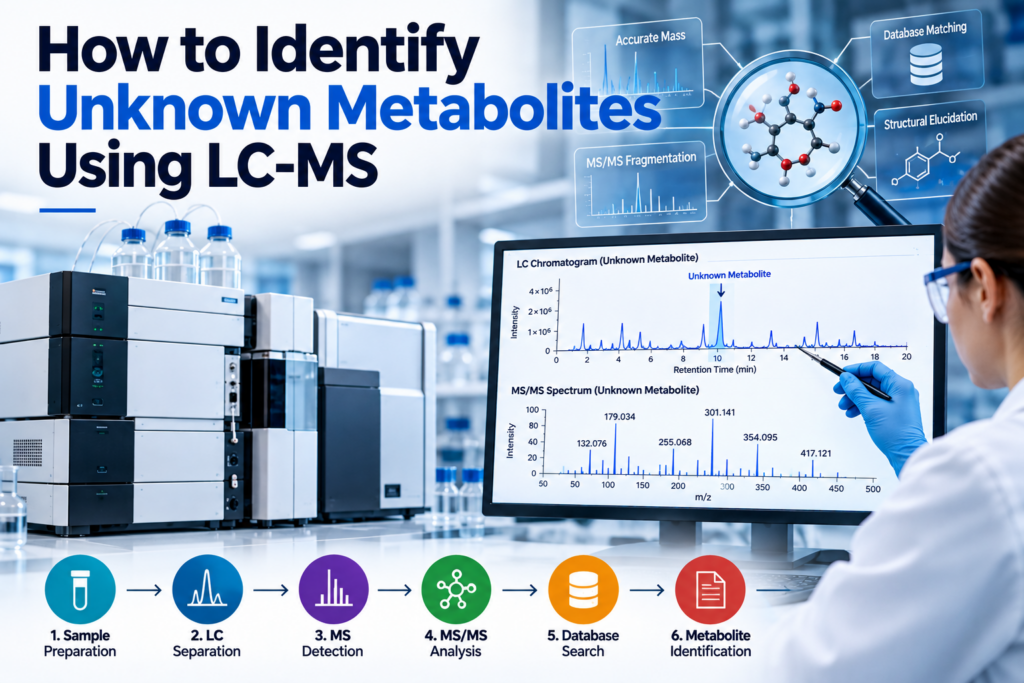
 Untargeted LC-MS experiments frequently produce features with no immediate chemical assignment. Some are genuine endogenous metabolites, while others arise from sample handling, contaminants, in-source fragments, or unexpected adducts. The objective is to build a ranked, evidence-based candidate list rather than attach the first database name that matches an observed mass.
Prioritize credible features
Review procedural blanks, pooled controls, replicate consistency, and peak shape. A feature that appears strongly in blanks or varies unpredictably may not justify extensive structural work. Prioritize reproducible signals associated with a meaningful biological comparison, while recognizing that abundance alone does not establish biological importance.
Determine formula and ion type
Measure accurate m/z and inspect isotope spacing and abundance. Determine whether the feature is likely [M+H]+, [M−H]−, a sodium adduct, or another ion species. An incorrect adduct assignment produces incorrect neutral-mass calculations and misleading candidate lists. Apply sensible elemental constraints rather than assuming any database hit is plausible.
Interpret tandem mass spectra
Acquire MS/MS at suitable collision energies. Product ions and neutral losses can indicate substructures, functional groups, or compound classes. Compare observed spectra with curated experimental libraries and computational predictions, while documenting the limits of each match. Closely related isomers can yield nearly indistinguishable fragments.
Confirm candidates experimentally
Where possible, run authentic standards under matching LC-MS conditions. Compare retention time, precursor mass, and fragment patterns. If standards are unavailable, consider alternative chromatography, additional fragmentation experiments, or complementary methods. Label unresolved results as putative annotations rather than confirmed identities.
Create an auditable identification record
Maintain a feature identifier, sample context, ion mode, retention time, measured mass, proposed adduct, candidate formulas, spectral matches, and confidence designation. This evidence trail enables other analysts to review assignments and makes future standard-based confirmation much easier.
Explore relevant IROA resources
For further information, see Mass Spectrometry Metabolite Library of Standards, Internal Standards for Metabolomics, and Application Notes and White Papers.