
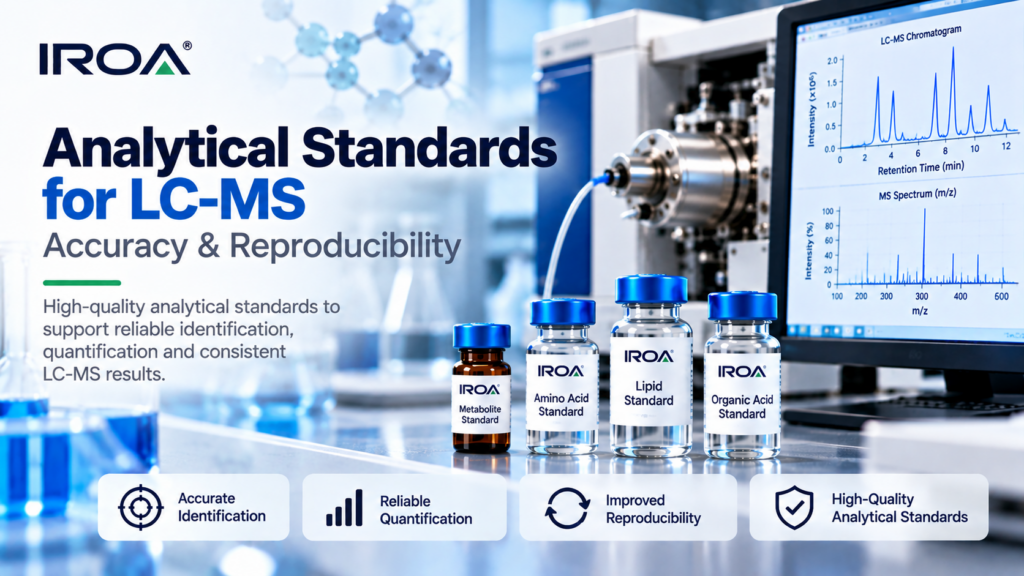
Analytical Standards For Lc-Ms play an important role in producing LC-MS data that can be interpreted with greater confidence. This article explains the concept in practical terms and connects it with the broader requirements of metabolomics, quantitative analysis, and reproducibility.
Why Analytical Standards Matter
LC-MS combines separation and mass detection, but both stages can introduce variability. Analytical standards provide known reference points that help laboratories evaluate whether changes in data are caused by samples, preparation, chromatography, ionization, or the instrument.
Accuracy, Precision and Reproducibility
Accuracy concerns how closely a measurement reflects the intended reference, while precision concerns repeated consistency. Reproducibility extends the question across runs, batches, operators, instruments, or laboratories. Standards can support all three by giving researchers stable signals and identities against which measurements can be compared.
Authentic Standards for Identification
Authentic metabolite standards can provide retention and spectral information. IROA’s Large Scale Metabolite Library of Standards contains hundreds of high-quality biochemical standards intended for applications including metabolite qualification and quantification by MS and NMR.
Isotope-Labeled Standards for Correction
Stable isotope-labeled internal standards add another dimension. Because they are distinguishable by mass but chemically related to natural compounds, they can help monitor analytical effects within the sample itself. This supports quantitative correction and normalization in complex matrices.
Reference Materials for Long Studies
A long-term reference standard can reveal whether the analytical system changes during a study. Repeated reference measurements help researchers identify drift and batch-level differences that might otherwise be mistaken for biological effects.
Combining Standards With Software
Standards create the most value when their information is incorporated into data processing. IROA workflows use characteristic isotope patterns and software tools to support feature characterization, identification, quantitation, suppression correction, and normalization.
Conclusion
Analytical standards provide structure to LC-MS data. Authentic compounds, isotope-labeled internal standards, and stable reference materials can work together to improve confidence from feature identification through quantitative interpretation.
Related IROA Resources
Continue exploring: Large Scale Metabolite Library of Standards • Metabolomics Analysis and IROA Quantitation • Application Notes
Suggested CTA
Need a standards strategy for your metabolomics workflow? Explore IROA standards and quantitative metabolomics solutions or speak with the IROA team about the appropriate workflow for your application.