

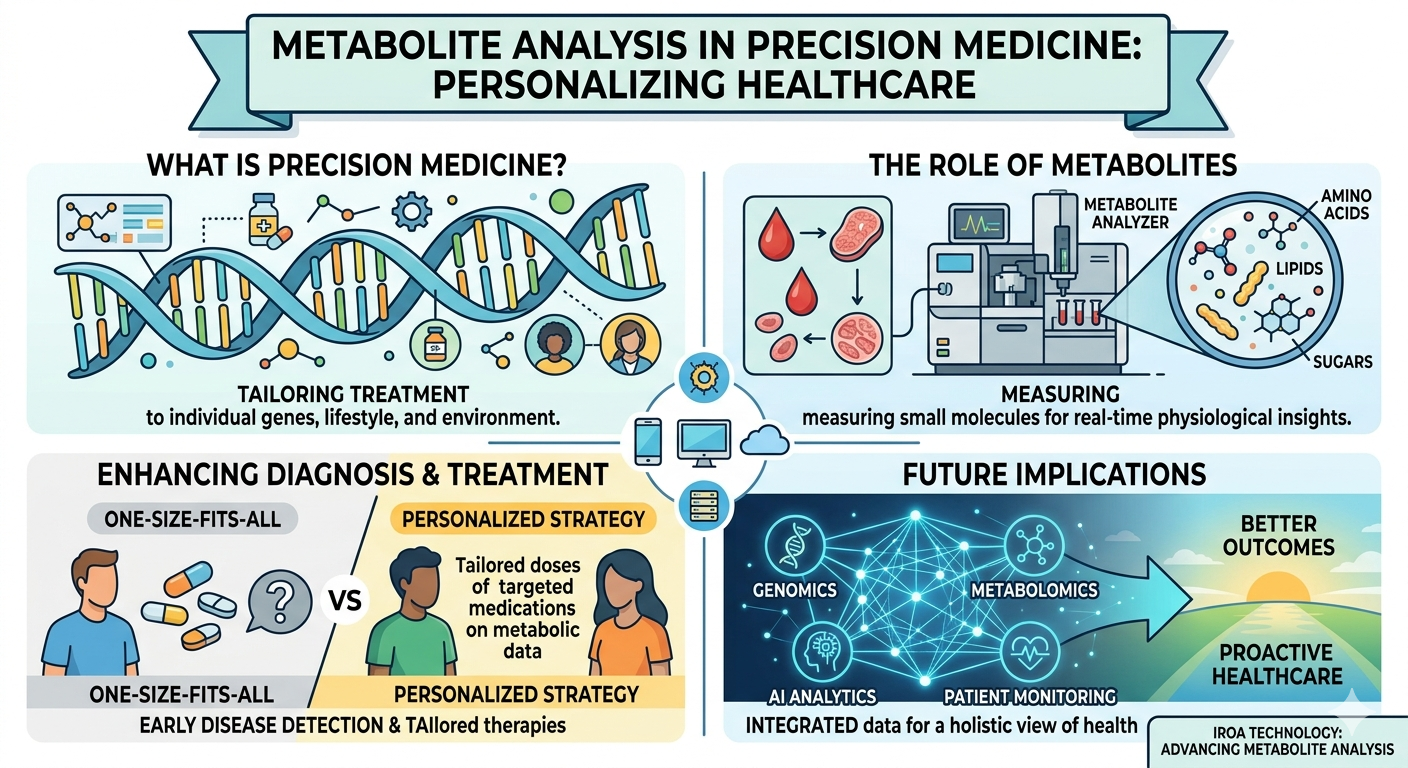
Precision medicine is transforming the healthcare landscape by shifting from a one-size-fits-all approach to more personalized treatment strategies. Instead of relying solely on generalized data, clinicians and researchers now focus on individual variability in genes, environment, and lifestyle. One of the key technologies enabling this shift is metabolite analysis. By studying small molecules within cells, tissues, and biofluids, scientists can gain deep insights into a patient’s health status. This is where metabolite analyzers play a crucial role.
Understanding Precision Medicine
Precision medicine aims to tailor medical treatment to the individual characteristics of each patient. It involves integrating data from genomics, proteomics, and metabolomics to create a comprehensive picture of health and disease. While genetic information provides a blueprint, metabolites reflect real-time physiological changes, making them highly valuable for diagnosis and monitoring.
Metabolites are the end products of cellular processes, and their levels can change rapidly in response to disease, medication, or environmental factors. By analyzing these changes, healthcare providers can detect diseases earlier, monitor progression, and evaluate treatment effectiveness more accurately.
The Science Behind Metabolite Analysis
Metabolomics, the study of metabolites, is a rapidly growing field in biomedical research. It focuses on identifying and quantifying small molecules such as amino acids, lipids, and sugars in biological samples. These molecules act as biomarkers, offering clues about metabolic pathways and disease mechanisms.
Advanced metabolite analyzers are designed to measure these compounds with high precision and reproducibility. They use cutting-edge technologies such as mass spectrometry and chromatography to deliver accurate and reliable results. This level of detail is essential for understanding complex diseases like cancer, diabetes, and cardiovascular disorders.
Enhancing Disease Diagnosis and Early Detection
One of the most significant contributions of metabolite analysis to precision medicine is early disease detection. Changes in metabolite levels often occur before clinical symptoms appear, allowing for earlier intervention. For example, specific metabolic signatures can indicate the onset of metabolic disorders or even certain types of cancer.
By incorporating metabolite profiling into routine diagnostics, healthcare providers can identify at-risk individuals and implement preventive measures. This proactive approach not only improves patient outcomes but also reduces healthcare costs in the long run.
Personalizing Treatment Strategies
Every patient responds differently to treatment, and understanding these differences is a cornerstone of precision medicine. Metabolite analysis provides insights into how a patient’s body processes drugs, enabling clinicians to tailor therapies accordingly.
For instance, metabolite data can reveal whether a patient is likely to respond to a particular medication or experience adverse effects. This information allows doctors to adjust dosages, choose alternative treatments, or combine therapies for better results.
Companies like IROA Technologies are at the forefront of developing advanced solutions that support such personalized approaches. Their innovative platforms help researchers and clinicians gain deeper insights into metabolic processes, ultimately improving patient care.
Supporting Drug Development and Research
Metabolite analysis is not only valuable in clinical settings but also plays a critical role in pharmaceutical research. During drug development, scientists use metabolite data to understand how new compounds interact with biological systems. This helps in identifying potential side effects, optimizing drug efficacy, and ensuring safety.
Moreover, metabolomics enables researchers to uncover new therapeutic targets by mapping metabolic pathways associated with diseases. These discoveries can lead to the development of more effective and targeted treatments.
For more information on how metabolomics contributes to modern healthcare, visit:
Improving Patient Monitoring and Outcomes
Continuous monitoring is essential for managing chronic diseases and evaluating treatment effectiveness. Metabolite analysis provides real-time data on a patient’s metabolic state, allowing healthcare providers to track progress and make informed decisions.
For example, in diabetes management, monitoring metabolite levels can help assess how well a patient is responding to treatment and whether adjustments are needed. Similarly, in oncology, metabolite profiling can indicate how a tumor is responding to therapy.
By enabling more precise monitoring, metabolite analysis contributes to better patient outcomes and improved quality of life.
The Future of Precision Medicine
As technology continues to evolve, the role of metabolite analysis in precision medicine is expected to grow even further. Advances in data analytics, artificial intelligence, and machine learning are enhancing the ability to interpret complex metabolic data.
In the future, integrated platforms combining genomics, proteomics, and metabolomics will provide a holistic view of patient health. This will enable even more accurate diagnoses, personalized treatments, and preventive strategies.
Organizations like IROA Technologies are driving innovation in this space, developing tools that make metabolite analysis more accessible and reliable. Their contributions are helping to bridge the gap between research and clinical application.
Conclusion
The integration of metabolite analysis into precision medicine is revolutionizing healthcare. By providing real-time insights into physiological processes, it enables early disease detection, personalized treatment, and improved patient monitoring. As technology advances, the impact of this approach will continue to expand, paving the way for more effective and efficient healthcare solutions.
Metabolite analysis is not just a scientific advancement—it is a vital component of the future of medicine, offering hope for better outcomes and a more personalized approach to care.
Frequently Asked Questions
What are metabolite analyzers used for?
They are used to identify and measure small molecules in biological samples, helping in disease diagnosis, research, and treatment monitoring.
How do metabolite analyzers support precision medicine?
They provide real-time data on metabolic changes, enabling personalized treatment plans and early detection of diseases.
Why is metabolomics important in healthcare?
Metabolomics helps in understanding disease mechanisms, discovering biomarkers, and improving diagnostic accuracy.
Can metabolite analysis help in drug development?
Yes, it plays a crucial role in identifying drug effects, optimizing efficacy, and ensuring safety during development.
What makes IROA Technologies significant in this field?
IROA Technologies offers advanced solutions that enhance the accuracy and reliability of metabolite analysis, supporting both research and clinical applications.