Library Generation
Generate curated metabolite libraries directly from authentic standard LC–MS data for confident compound identification.
Create intelligent metabolite libraries using retention time, fragmentation spectra, adduct detection and scientific curation.
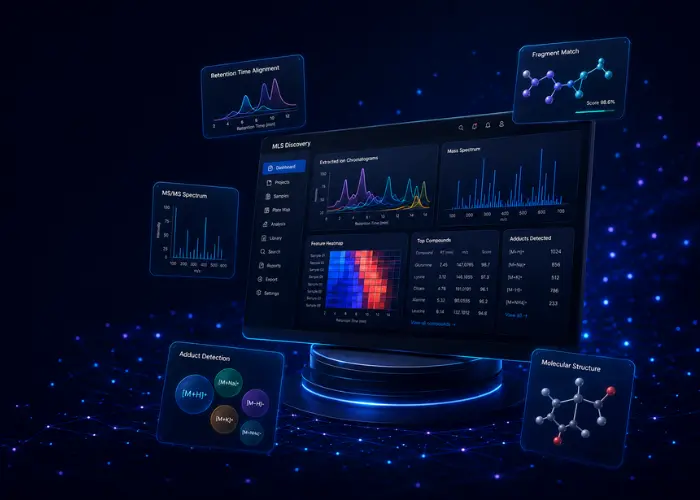
MLS Discovery™ is library generation software, not isotope-assisted analysis software. It builds unlabeled metabolite libraries from authentic standards by analyzing raw LC–MS data, extracting chromatographic and spectral information, identifying compounds, and exporting curated libraries for downstream metabolomics workflows.
Generate curated metabolite libraries directly from authentic standard LC–MS data for confident compound identification.
Search LC–MS datasets against curated libraries using chromatographic, spectral, fragment, and adduct information.
Capture and curate retention time information together with mass spectra for reliable metabolite identification.
Automatically matches adducts and fragments to improve compound identification and library quality.
View and evaluate available MS/MS spectra alongside MS1 data for additional structural confirmation.
Export curated metabolite libraries in CEF, TSV, and MSP formats for downstream software and research workflows.
MLS Discovery processes LC–MS data from authentic standards to extract chromatographic and spectral information, identify compounds, and generate curated metabolite libraries ready for downstream metabolomics research.
Complex, noisy, and unorganized data containing thousands of signals.

Advanced algorithms extract meaningful information and reveal the true chemical composition.

Curated, validated, and ready-to-use libraries for confident compound identification.

MLS Discovery is designed to generate curated metabolite libraries from authentic standards. These libraries can be imported into ClusterFinder software for isotope-assisted metabolomics analysis.
Every metabolite library begins with authentic reference standards, providing a reliable foundation for confident compound identification.
Curated retention times, mass spectra, and fragmentation information are validated to maximize confidence, consistency, and reproducibility.
Export reusable metabolite libraries for future studies, software platforms, instruments, and downstream metabolomics workflows.
Follow our streamlined workflow to transform raw LC-MS data into high-quality, publication-ready metabolite libraries.
Define project details, name, description and location.
Add LC-MS methods (polarity, MS level, deconvolution).
Define your experimental samples.
Select the authentic standards library version.
Import centroided mzXML files and activate datasets.
Import centroided mzXML files and activate datasets.
Run compound search with selected parameters.
Review, curate and export your library (CEF / TSV / MSP).
MLS Discovery seamlessly integrates with IROA's authentic standards and ClusterFinder software to create a complete workflow for building high-quality metabolite libraries, identifying compounds with confidence, and generating reproducible biological insights.
Curated metabolite standards
Build & curate metabolite libraries
Quantitative analysis of biological samples
Confident, reproducible discoveries

Authentic chemical standards provide experimentally verified retention times, chromatographic behavior, accurate masses, isotope distributions, and fragmentation patterns. Because every compound is measured under controlled laboratory conditions, the resulting library reflects real analytical data rather than predicted values. MLS Discovery is designed around experimentally acquired standards, allowing researchers to construct metabolite libraries that are reproducible, scientifically validated, and suitable for long-term reuse across different projects and analytical workflows.

Accurate mass alone is often insufficient for confidently distinguishing compounds with similar molecular weights. Retention time introduces an additional layer of analytical evidence that helps separate isomers and confirm chromatographic identity during library construction. By combining retention information with mass spectral evidence, MLS Discovery enables researchers to generate metabolite libraries with greater confidence and fewer ambiguous compound assignments.

Many metabolites share similar precursor masses while producing distinct fragmentation patterns during tandem mass spectrometry. Fragment interpretation provides valuable structural information that helps differentiate compounds which cannot be resolved through accurate mass alone. MLS Discovery integrates fragmentation evidence directly into the library creation workflow, allowing researchers to verify structural identity before compounds become permanent entries within curated metabolite libraries.

High-quality metabolite libraries require more than automated processing. Scientific review ensures that compound annotations, chromatographic behavior, retention characteristics, and fragmentation evidence are consistent before inclusion within a reference library. MLS Discovery provides researchers with an environment for reviewing, validating, and organizing compound information so that exported libraries remain reliable across future studies.

Reference libraries become increasingly valuable as they expand. Rather than recreating compound annotations for every new experiment, validated libraries can be reused, updated, and continuously improved as additional authentic standards are analyzed. This approach reduces repetitive work while providing researchers with a consistent scientific foundation for future metabolomics projects.

MLS Discovery integrates naturally into modern metabolomics workflows by supporting laboratory data generated from authentic standards and exporting curated libraries for downstream analytical applications. Researchers can move efficiently from data acquisition through validation and final library creation without unnecessary manual reconstruction. The result is a streamlined workflow that improves consistency, accelerates metabolite library development, and supports collaborative scientific research.
Find answers to common questions about authentic metabolite standards, library coverage, LC-MS compatibility, and selecting the right library for your metabolomics research.
MLS Discovery is a mass spectrometry software solution designed to simplify the creation, management, and analysis of authentic compound libraries. It helps researchers build high-quality metabolite libraries from IROA Metabolite Libraries of Standards (MLS), automate compound identification, curate results, and prepare libraries for future experiments.
MLS Discovery supports both library generation and sample analysis workflows. Users can create custom compound libraries from authentic standards, perform compound searches on experimental samples, curate results, and export validated libraries for future LC-MS and LC-MS/MS studies.
The software supports centroided mzXML files for LC-MS and LC-MS/MS data. Using centroided data ensures accurate compound identification while reducing processing time and memory usage.
Yes. Users can define and manage multiple acquisition methods, including different polarities and MS/MS acquisition modes, within the same project. Methods can be edited, reused, or loaded from the software database whenever needed.
MLS Discovery allows compounds to be assigned through an intuitive Multiplex Designer using either a graphical plate map or a searchable compound table. This makes it easy to define sample composition and accurately map authentic standards to each experimental sample.
Yes. The software provides extensive control over search parameters, including peak intensity thresholds, retention time limits, isotope tolerance, fragment matching, smoothing filters, signal-to-noise settings, and chromatographic peak width, allowing users to optimize searches for different instruments and experimental conditions.
Yes. Users can create, edit, import, export, and manage custom adducts and mass modifications using the built-in Adduct List Editor, providing flexibility for specialized mass spectrometry workflows.
Yes. MLS Discovery includes integrated visualization tools for Total Ion Chromatograms (TIC), Base Peak Chromatograms (BPC), Extracted Ion Chromatograms (XIC), average mass spectra, and raw spectral data, allowing users to thoroughly inspect data before and after compound identification.
Search results include detected compounds, extracted ion chromatograms, average mass spectra, MS/MS spectra (when available), detected adducts, retention times, and other analytical information needed for accurate compound verification and curation.
Yes. MLS Discovery includes powerful curation tools that allow users to review automated identifications, evaluate chromatographic peaks, correct assignments, edit compound information, and remove incorrect results before finalizing a library.
The software supports exporting libraries in multiple industry-standard formats, including TSV (Tab-Separated Values), Chemical Exchange Format (CEF), and MSP (NIST format), making the data compatible with a wide range of downstream applications and research workflows.
Yes. MLS Discovery includes a comprehensive Library Database Editor that allows users to import, organize, edit, merge, filter, link, and export compound libraries while maintaining a centralized database for future projects.
Yes. The software includes an integrated MS Calculator featuring isotopic pattern prediction, molecular formula generation, and mass error calculations to assist researchers during compound identification and manual data curation.
Absolutely. Once a compound library has been created, it can be used for sample analysis projects and loaded into the software of choice including ClusterFinder where experimental data is processed, compounds are identified, and quantitative results are exported for downstream analysis.
Yes. Every MLS Discovery project stores raw data, generated libraries, preferences, and project settings, allowing users to save their work at any stage and reopen the project whenever needed.