
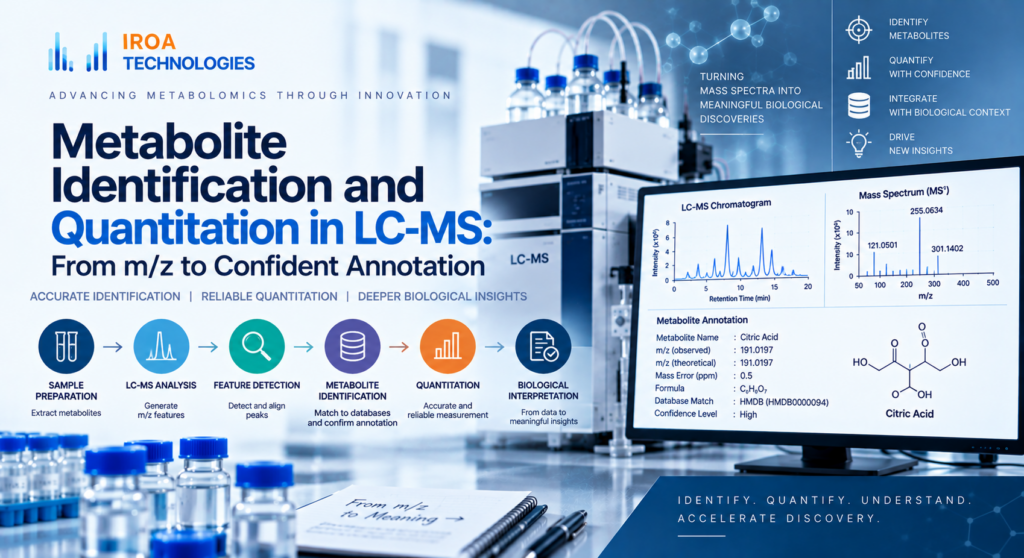
Metabolite identification is one of the main bottlenecks in LC-MS metabolomics. A detected feature is not automatically a unique metabolite. Isotopes, adducts, fragments, in-source products, contaminants, and electronic noise can all generate peaks that resemble biologically meaningful signals.
Confident quantitation therefore depends on confident identity. IROA combines isotope-labelled standards, reference data, and ClusterFinder software to link compound recognition with quantitative correction.
Why Accurate Mass Alone Is Not Enough
High-resolution MS can narrow the list of candidate formulas, but different compounds can share similar exact masses. A single m/z value may also correspond to an adduct or fragment rather than the intact metabolite.
Identification confidence improves when multiple orthogonal properties agree: accurate mass, retention time, isotope behavior, fragments, adduct relationships, and reference-standard information.
Retention Time As An Identity Constraint
Chromatographic retention provides an additional dimension of evidence. If a compound appears at the expected m/z and retention time under a defined method, the assignment is stronger than mass alone.
Reference materials and metabolite libraries help connect measured features with expected analytical behavior.
Isotope Patterns Add Structural Information
IROA uses characteristic isotope-labelled patterns to identify true biological compounds and distinguish them from artifactual peaks. U-13C labelling creates predictable mass relationships that can be recognized computationally.
This is particularly useful because artifacts generally do not reproduce the same structured isotope envelopes as real labelled metabolites.
The Role Of A Metabolite Dictionary
A long-term reference standard can be used to build a dictionary of compounds observed under a laboratory’s analytical conditions. That dictionary can include m/z, retention information, isotope characteristics, fragments, and adducts.
ClusterFinder uses this information during automated analysis to co-locate related signals and support compound-level interpretation.
Identification And Quantitation Should Be Connected
Once a metabolite is identified, quantitative interpretation still requires correction for analytical variability. The TruQuant Workflow Kit uses isotope-labelled internal standards to support ion suppression correction and Dual MSTUS normalization.
This means the same workflow that strengthens identity also contributes to quantitative reliability.
Reducing False Discoveries
Feature-based untargeted workflows can produce large tables in which multiple rows represent the same compound or analytical artifact. Grouping isotopes, fragments, and adducts around a confirmed metabolite reduces redundancy and improves the biological interpretability of the dataset.
Researchers interested in additional identification workflows can review IROA’s compound identification and mass spectrometry resources and MSMLS library information.
Conclusion
Confident metabolite identification requires multiple lines of evidence. Accurate mass is an important starting point, but retention behavior, isotope patterns, reference standards, and feature relationships provide the context needed for stronger annotation. Integrating those identity signals with suppression correction and normalization allows LC-MS metabolomics to move from feature detection toward more trustworthy quantitative biology.