
ABSTRACT: Ion suppression is a major problem in mass spectrometry (MS)-based metabolomics; it can dramatically decrease measurement accuracy, precision, and sensitivity. Here we report a method, the IROA TruQuant Workflow, that uses a stable isotope-labeled internal standard (IROA-IS) library plus companion algorithms to: 1) measure and correct for ion suppression, and 2) perform Dual MSTUS normalization of MS metabolomic data. We evaluate the method across ion chromatography (IC), hydrophilic interaction liquid chromatography (HILIC), and reversed-phase liquid chromatography (RPLC)-MS systems in both positive and negative ionization modes, with clean and unclean ion sources, and across different biological matrices. Across the broad range of conditions tested, all detected metabolites exhibit ion suppression ranging from 1% to >90% and coefficients of variation ranging from 1% to 20%, but the Workflow and companion algorithms are highly effective at nulling out that suppression and error. To demonstrate a routine application of the Workflow, we employ the Workflow to study ovarian cancer cell response to the enzyme-drug L-asparaginase (ASNase). The IROA-normalized data reveal significant alterations in peptide metabolism, which have not been reported previously. Overall, the Workflow corrects ion suppression across diverse analytical conditions and produces robust normalization of non-targeted metabolomic data.
We have some exciting news to share!
A new open access article published in Analytical Chemistry illustrates how IROA and the Shulaev lab at The University of North Texas used the IROA TruQuant Workflow to achieve effective batch-to-batch correction.
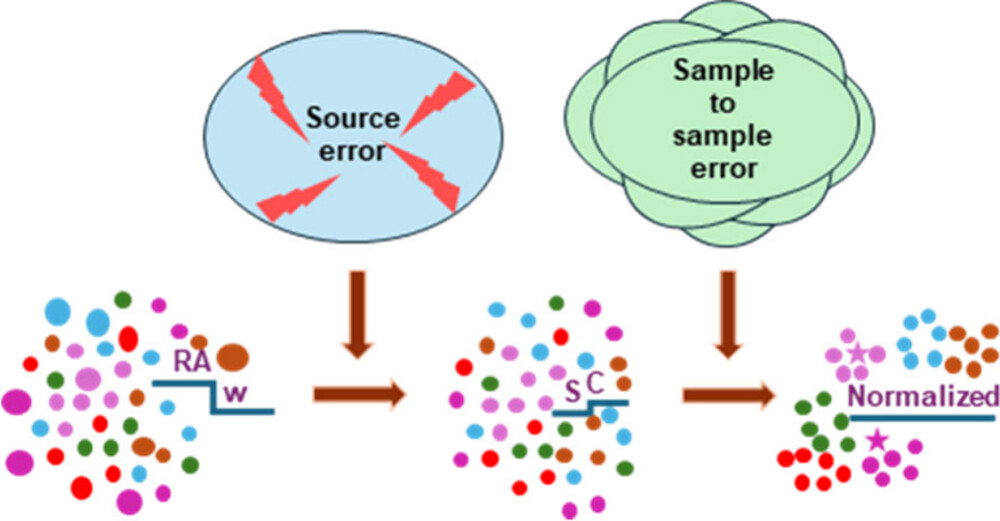
This publication demonstrates that when technical variances are corrected, and a Dual MSTUS normalization is applied to a highly variable multi-batch dataset, not only is statistical power improved, but the quality, reproducibility, and fidelity of the results is significantly enhanced. Enhanced results support better clinical biomarker discovery (click image below for the article).
We conducted careful statistical evaluation and biological validation to ensure that the correction had effectively removed batch effects without losing biological signal, despite the introduction of gross variability introduced by source manipulations across the six batch analyses. These results were compared to those of other widely used normalization methods. This method not only outperformed the other methods but could successfully distinguish between technical and biological variances. The corrected dataset presented an RSD error of 1% compared to 43% RSD in the raw dataset. The experimental design afforded us with a means to test the ability of each normalization method to correctly group similar samples across batches in a “data fidelity test”. These results demonstrated that this method can be used to reliably enhance data quality.
Can your LC-MS workflow deliver consistent batch-batch results? Discover how this TruQuant workflow can deliver reproducible quantitative data across days, weeks, or years of analyses.
Let us know how we can help!
The IROA Team