
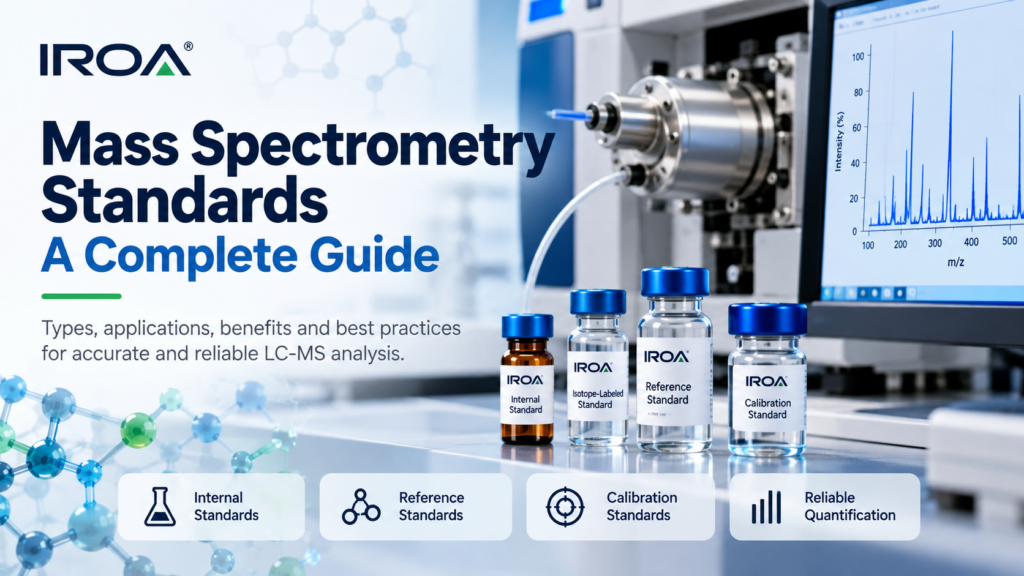
Mass Spectrometry Standards play an important role in producing LC-MS data that can be interpreted with greater confidence. This article explains the concept in practical terms and connects it with the broader requirements of metabolomics, quantitative analysis, and reproducibility.
What Are Mass Spectrometry Standards?
Mass spectrometry standards are known reference materials used to make analytical measurements more interpretable, comparable, and reproducible. Depending on the workflow, a standard may support instrument quality control, metabolite identification, calibration, normalization, or quantitative correction. In LC-MS metabolomics, standards are especially important because sample preparation, chromatography, ionization, matrix effects, and instrument behavior can all influence the measured signal.
Why Standards Matter in LC-MS
A mass spectrometer can generate highly detailed data, but signal intensity alone does not automatically equal biological concentration. Ion suppression, source conditions, retention-time changes, batch effects, and instrument drift can change response. A well-designed standard provides a stable point of comparison so researchers can distinguish analytical variation from meaningful biological differences.
Main Types of Standards
External standards are generally analyzed separately from the experimental sample and can support calibration or identification. Internal standards are added to samples and travel through the analytical workflow with the analytes. Stable isotope-labeled internal standards are particularly useful because the labeled and unlabeled forms can behave similarly during chromatography and ionization while remaining distinguishable by mass. Long-term reference materials can also be analyzed repeatedly to monitor system performance across runs and batches.
Mass Spectrometry Standards in Metabolomics
Metabolomics presents a scale challenge because hundreds of chemically diverse metabolites may be present in one experiment. IROA addresses this with isotope-labeled standards and metabolite libraries designed for broad metabolomic workflows. Its internal-standard approach can support correction of analytical variability, normalization, metabolite identification, and quantitative comparison.
How IROA Approaches Standardization
IROA uses stable-isotope strategies, including U-13C-labeled materials, to create recognizable isotopic patterns. In the TruQuant workflow, a long-term reference standard and an internal standard serve complementary roles: the reference material supports system QC and dictionary generation, while the internal standard accompanies experimental samples for quantitation and normalization.
Choosing a Standard Strategy
The right standard depends on the analytical question. A targeted assay may require a compound-specific labeled standard, while broader metabolomics can benefit from complex labeled mixtures and authentic metabolite libraries. Researchers should consider chemical coverage, matrix compatibility, required quantitative confidence, instrument platform, identification needs, and whether comparisons must remain stable across long studies.
Key Takeaway
Mass spectrometry standards are not simply calibration materials. In modern LC-MS metabolomics they can form the measurement backbone that connects instrument performance, compound identification, normalization, and quantitative confidence. Building standards into the workflow from the beginning makes it easier to identify analytical problems before they become biological conclusions.
Related IROA Resources
Continue exploring: IROA Internal Standards • Large Scale Metabolite Library of Standards • TruQuant Workflow Kit
Suggested CTA
Need a standards strategy for your metabolomics workflow? Explore IROA standards and quantitative metabolomics solutions or speak with the IROA team about the appropriate workflow for your application.