
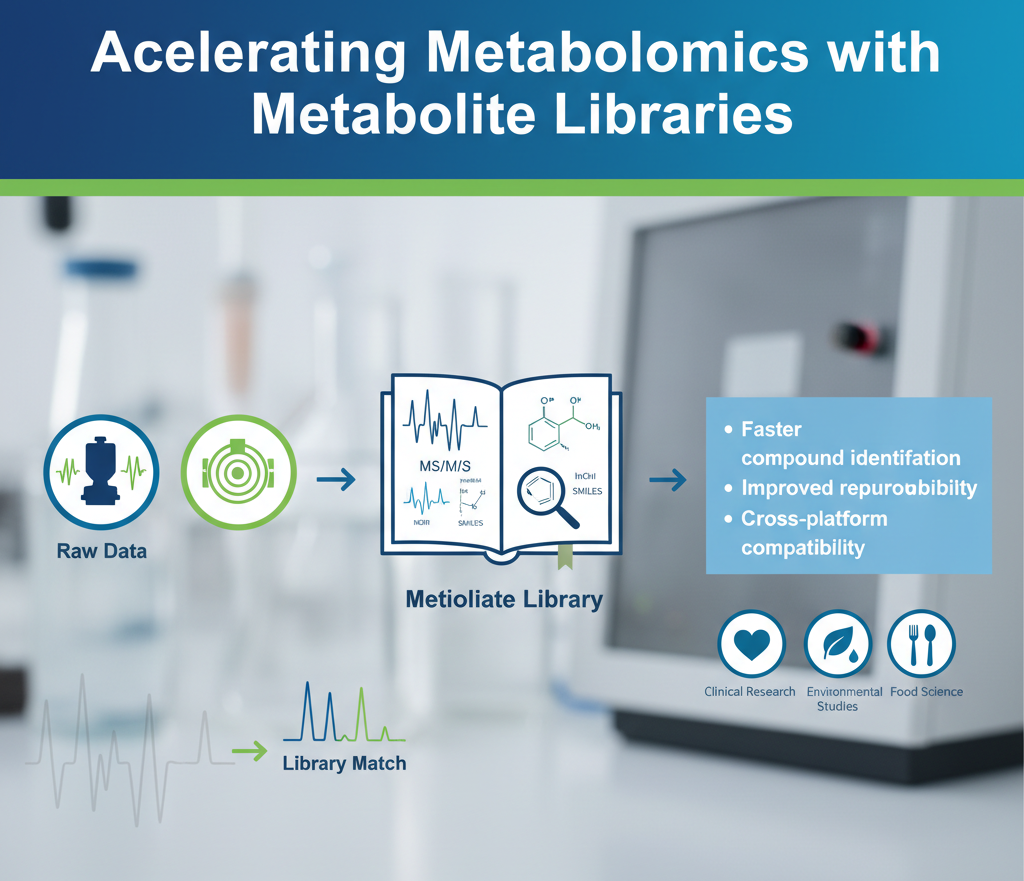
Metabolomics—the comprehensive study of small molecules (metabolites) in biological systems—has become a cornerstone of modern life sciences. From disease biomarker discovery to precision nutrition and environmental monitoring, metabolomics offers insights that bridge genotype and phenotype. However, the field’s potential depends heavily on reliable identification and interpretation of complex spectral data. This is where a well-constructed Metabolite Library becomes indispensable.
In this article, we’ll examine how a metabolite library accelerates metabolomics research, the key steps involved in building one, and how IROA Technologies helps laboratories transform raw analytical data into actionable biological insights.
Why Identification Is the Bottleneck in Metabolomics
Mass spectrometry (MS) and nuclear magnetic resonance (NMR) generate enormous volumes of analytical data, but raw spectra provide little value without accurate metabolite identification. Researchers commonly face several challenges:
- Ambiguous metabolite identification due to overlapping spectra or isomeric compounds.
- Lengthy manual curation and validation processes.
- Inconsistencies between analytical platforms and laboratories.
These limitations slow scientific discovery and reduce reproducibility. A curated metabolite library addresses these issues by providing validated reference spectra, standardized metadata, and efficient search capabilities that enable rapid, confident metabolite identification.
What Is a Metabolite Library?
A metabolite library is a structured, searchable collection of validated reference information for metabolites. Each library entry typically contains:
- Reference spectra (MS/MS, GC-MS, or NMR)
- Retention time or retention index information
- Chemical identifiers (InChI, SMILES, CAS)
- Structural annotations and compound synonyms
- Experimental conditions, including instrument settings and ionization mode
- Quality metrics and curation notes
By combining spectral information with comprehensive metadata, metabolite libraries enable researchers to compare unknown compounds against validated references quickly and consistently.
How a Metabolite Library Speeds Up Research Workflows
1. Faster Compound Identification
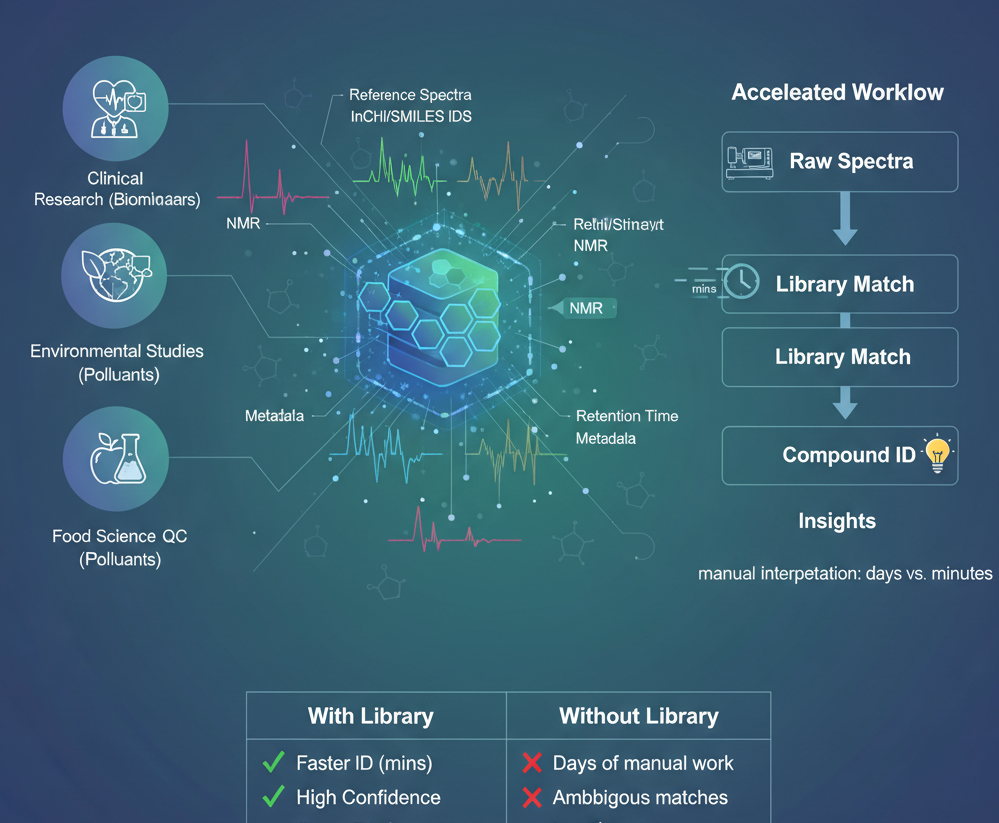
Researchers can automatically compare experimental spectra with validated library entries, reducing interpretation time from days to minutes. This capability is particularly valuable for high-throughput screening and large cohort studies.
2. Improved Confidence and Reproducibility
Libraries containing validated spectra and traceable provenance information reduce false-positive identifications while supporting reproducible scientific research, publications, and regulatory submissions.
3. Cross-Platform Compatibility
Comprehensive libraries include retention indices and instrument-specific metadata, allowing researchers to adapt reference data across different mass spectrometry platforms and chromatographic methods.
4. Scalable Curation and Automation
Modern metabolite libraries integrate with analytical software and automated processing pipelines, enabling continuous expansion while maintaining high-quality curation standards.
5. Supporting Multi-Omics Research
Accurate metabolite identification forms the foundation for integrating metabolomics with genomics, transcriptomics, and proteomics, leading to more comprehensive biological insights.
Best Practices for Building a High-Quality Metabolite Library
Start with Authentic Reference Standards
Whenever possible, generate spectra from highly purified reference standards and carefully document all experimental conditions to maximize reliability and reproducibility.
Capture Comprehensive Metadata
Include retention times, instrument parameters, sample matrices, acquisition methods, and curation notes. Rich metadata significantly improves identification accuracy.
Use Standardized Chemical Identifiers
Employ internationally recognized identifiers such as InChI, SMILES, and CAS numbers while storing data in standard formats like mzML or mzXML to maximize interoperability.
Implement Quality Control and Version Management
Track data provenance, curator modifications, quality scores, and library versions to ensure complete analytical traceability.
Encourage Community Contributions with Expert Validation
Community-driven metabolite libraries can expand rapidly, but expert review and rigorous validation remain essential for maintaining data quality.
How Technology Partners Support Modern Metabolomics
IROA Technologies develops integrated metabolomics solutions that help laboratories create, manage, and utilize comprehensive metabolite libraries. By combining automated spectral matching, metadata management, and standardized analytical workflows, IROA Technologies enables researchers to improve identification accuracy while reducing analysis time.
These scalable and interoperable solutions support laboratories ranging from small research groups to large multi-site scientific collaborations while maintaining regulatory-grade traceability.
Real-World Applications
Clinical Research
Rapid metabolite identification accelerates biomarker discovery, disease diagnosis, and therapeutic monitoring.
Environmental Science
Comprehensive metabolite libraries enable fast screening of pollutants and environmental contaminants across complex biological and ecological samples.
Food and Agricultural Research
Researchers use metabolite libraries to support quality control, authenticity verification, and food origin analysis through rapid comparison against validated metabolic profiles.
These examples demonstrate how metabolite libraries reduce manual bottlenecks while enabling larger, more sophisticated scientific studies.
External Resource
For additional information about metabolomics standards and spectral data formats, visit the Metabolomics Standards Initiative (MSI).
Frequently Asked Questions (FAQs)
How many spectra should a metabolite library contain?
There is no fixed number. Quality is more important than quantity. A valuable metabolite library should include validated reference spectra for compounds relevant to your research along with sufficient metadata for reliable identification.
Should I use public metabolite libraries or build my own?
Public libraries provide an excellent starting point, but creating a laboratory-specific library using authentic reference standards and instrument-specific retention data significantly improves identification accuracy and reproducibility.
How often should a metabolite library be updated?
Libraries should be updated regularly—typically at least once a year or whenever new analytical methods, instruments, or validated standards become available. Version control is essential for maintaining traceability.
What role does software play in metabolite library management?
Software automates spectral matching, scoring, metadata management, and integration with metabolomics data analysis workflows. Choosing software that supports standardized file formats improves long-term interoperability.
Can metabolite libraries be used with techniques other than mass spectrometry?
Yes. Metabolite libraries can also include NMR and other spectroscopic reference data. The most important factors are high-quality reference spectra, standardized metadata, and validated compound annotations.